
Cordless Leaf Blower Review
Teslong 20V Brushless Leaf Blower 600 CFM Cordless Review: Specs and Pros
As an Amazon Associate, I earn from qualifying purchases at no extra cost to you.
⚡ Overview: 600 CFM From a Compact 20V Blower With a Pivoting Head
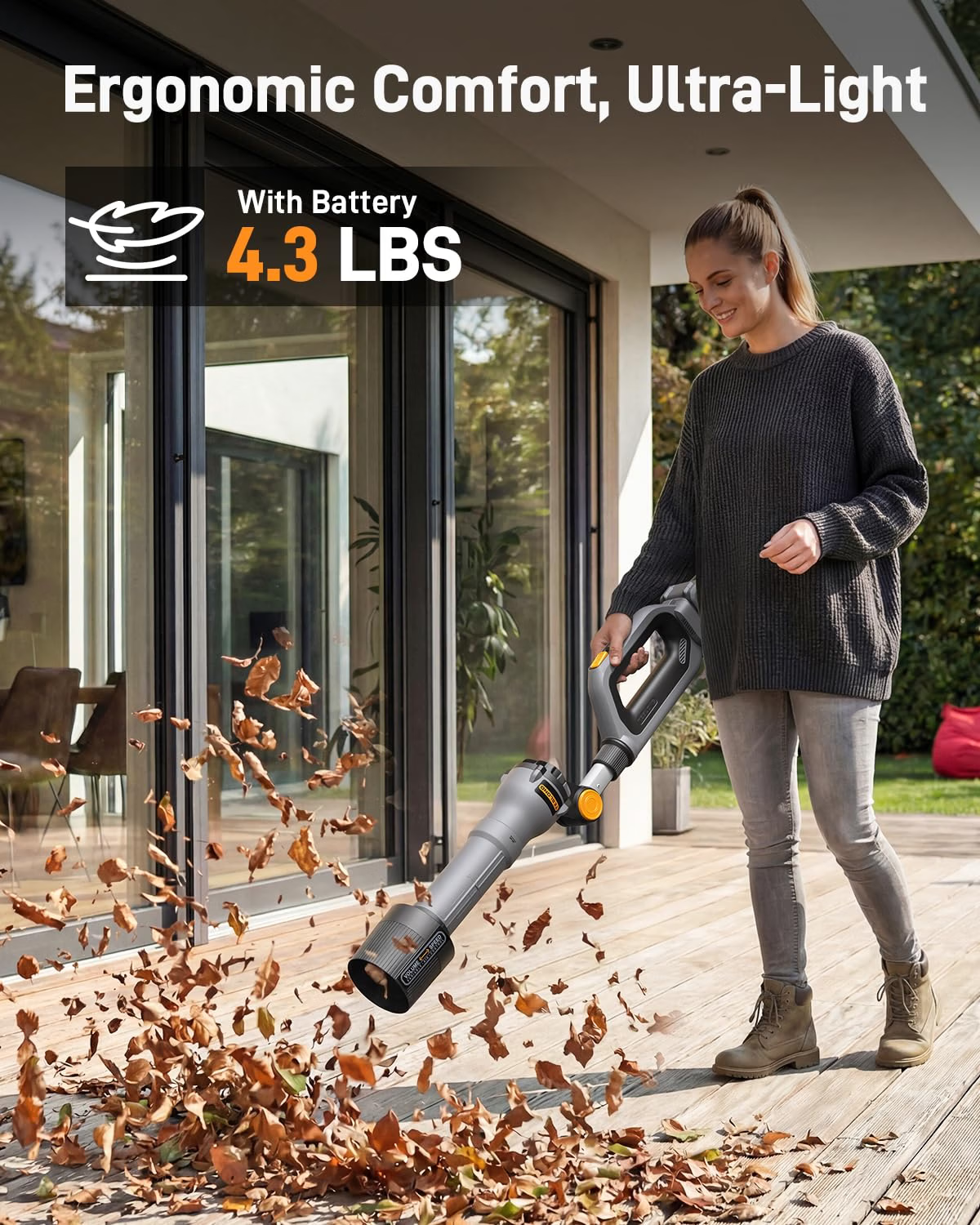
The Teslong 20V brushless leaf blower (model LB-L01) is a compact handheld that the brand rates at up to 600 CFM and 115 MPH. It weighs 4.3 lb with its 4.0Ah battery and sells for $129.99 on Teslong’s own store.
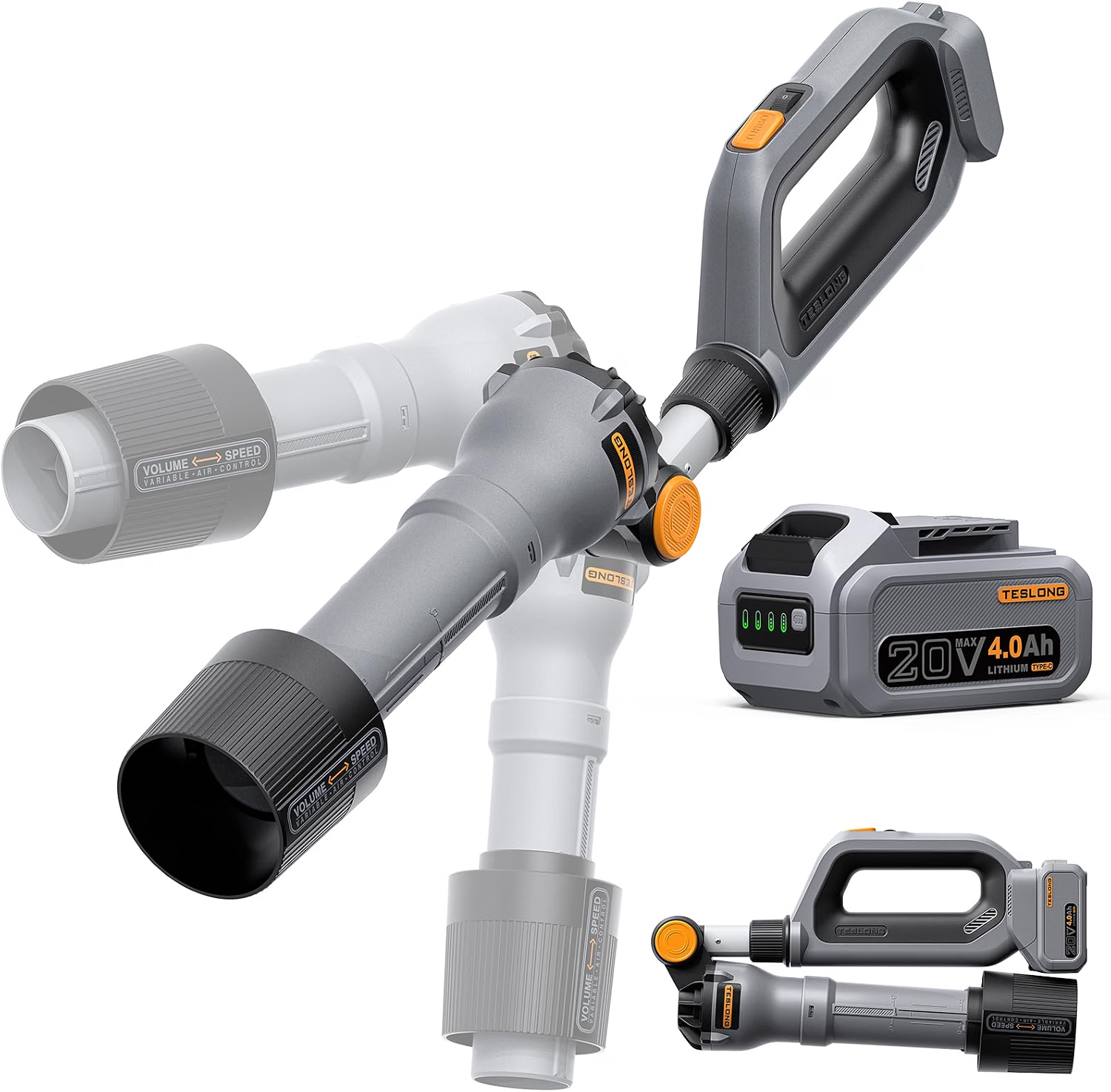
Unlike many budget blowers, Teslong publishes runtimes by mode, a 12-month warranty and a 30-day money-back guarantee. The head pivots through five positions, and the USB-C battery doubles as a power bank.
What doesn’t stand out is the evidence for the airflow. I found no independent test, and the brand’s own runtimes show Turbo lasts only about 12 minutes on one battery.
This review checks the claims with arithmetic and flags where Teslong’s pages disagree with each other. I couldn’t open Amazon, and I haven’t used the blower myself.
It looks like a solid pick for small to medium yards, patios and driveways, as long as you treat 600 CFM as a Turbo peak. You get a light body, a pivoting head, clear runtimes and real warranty terms.
The catch is one 4.0Ah battery, a wall charger you may need to buy, and no independent test. Choose a battery-platform blower like the DEWALT DCBL722B or the Milwaukee M18 FUEL if you want tested power and a bigger tool ecosystem.
Verdict Summary
Best for small to medium yards where weight and control matter
- Best for: homeowners with a patio, driveway or small to medium yard who want a light cordless blower they can aim into corners and under furniture
- Standout strength: a 4.3 lb body, a five-position pivoting head, published runtimes by mode, and a 12-month warranty with a 30-day money-back guarantee
- Biggest weakness: Turbo lasts about 12 minutes on one battery, there’s no wall charger in the box, and the 600 CFM rating has no independent test
- Skip it if: you have a large yard, mostly wet or heavy leaves, or want a big battery platform with many tools
Score basis: raised by the low weight, the published runtimes, the warranty terms and the adjustable head; lowered by the short Turbo time, the missing wall charger and the lack of independent test data. It’s an editorial judgment, not a lab score, and it isn’t based on hands-on testing.
📊 Full Specifications
Core specs (as stated by Teslong)
| Spec | Value | Source |
|---|---|---|
| Brand and model | Teslong LB-L01 20V Brushless Leaf Blower | Teslong product page |
| Air volume | Up to 600 CFM (Turbo) | Teslong (unverified) |
| Air speed | Up to 115 MPH | Teslong (unverified) |
| Blowing force | Not published. I found no independent measurement | None found |
| Motor | Brushless, up to 28,000 RPM in Turbo | Teslong feature page |
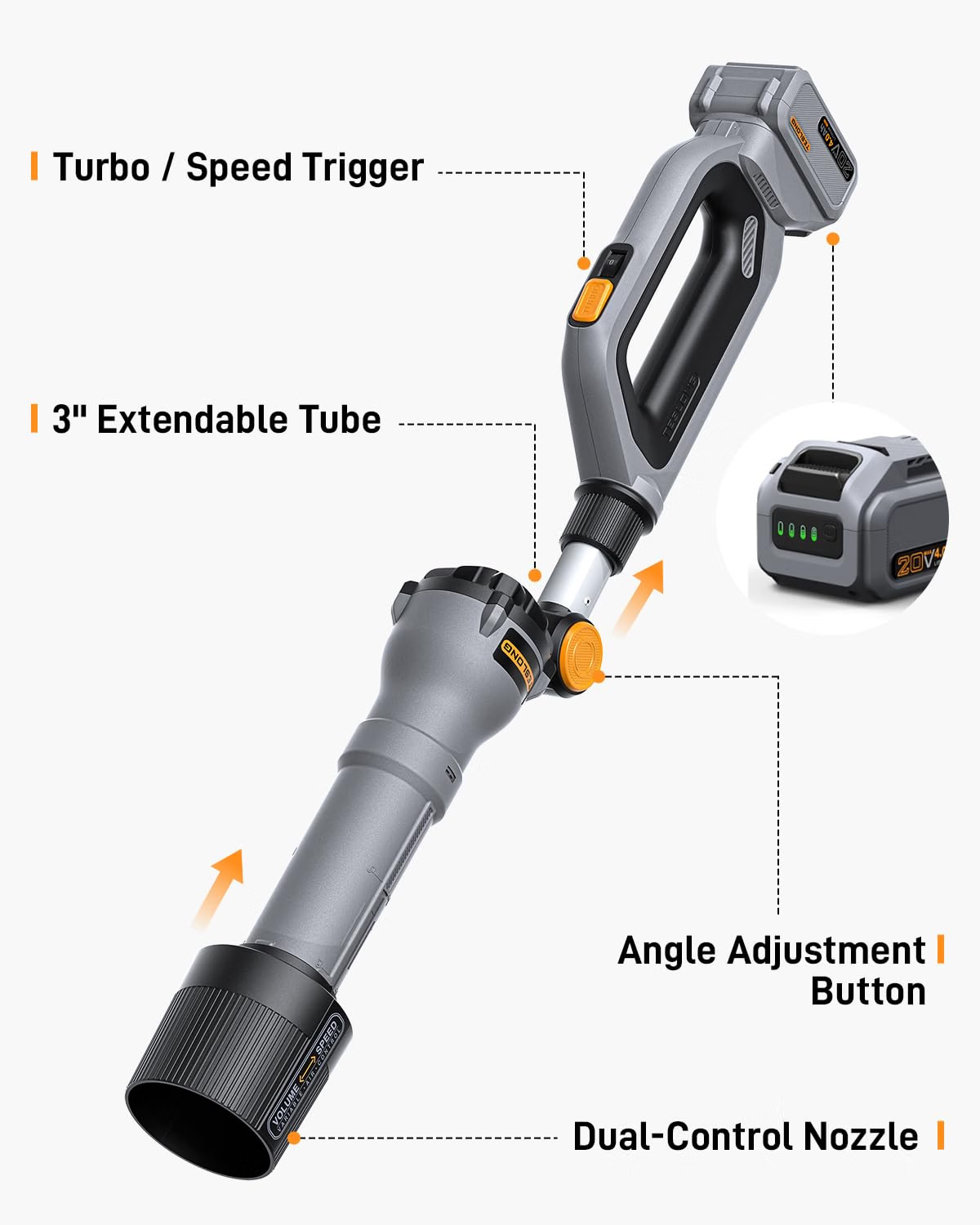
| Power levels | Low, High and Turbo | Teslong product page |
| Airflow modes | Air Volume mode (wide) and Air Speed mode (focused) | Teslong product page |
| Battery | Removable 20V 4.0Ah. Watt-hours not stated; about 72 to 80 Wh by my arithmetic | Teslong; my arithmetic |
| Runtime, Low | Up to 35 minutes (32 on another Teslong page) | Teslong feature page |
| Runtime, High | Up to 20 minutes (18 on another Teslong page) | Teslong feature page |
| Runtime, Turbo | Up to 12 minutes | Teslong feature page |
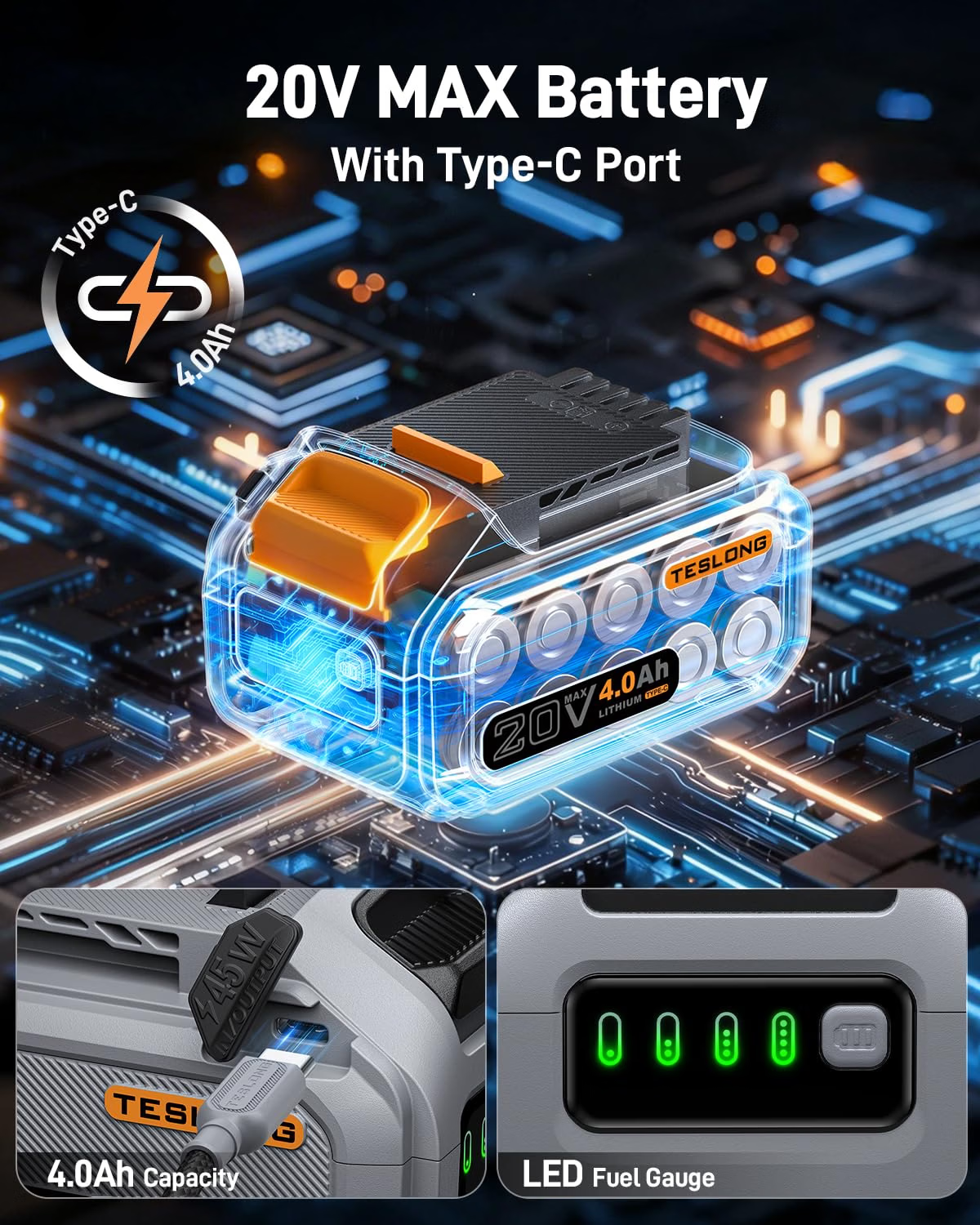
| Charging | USB-C, up to 45W input. Charge time not published | Teslong product page |
| Power bank | USB-C output up to 45W, so the battery can charge phones and laptops | Teslong product page |
| Weight | 2.86 lb bare; 4.3 lb with the 4.0Ah battery | Teslong product and feature pages |
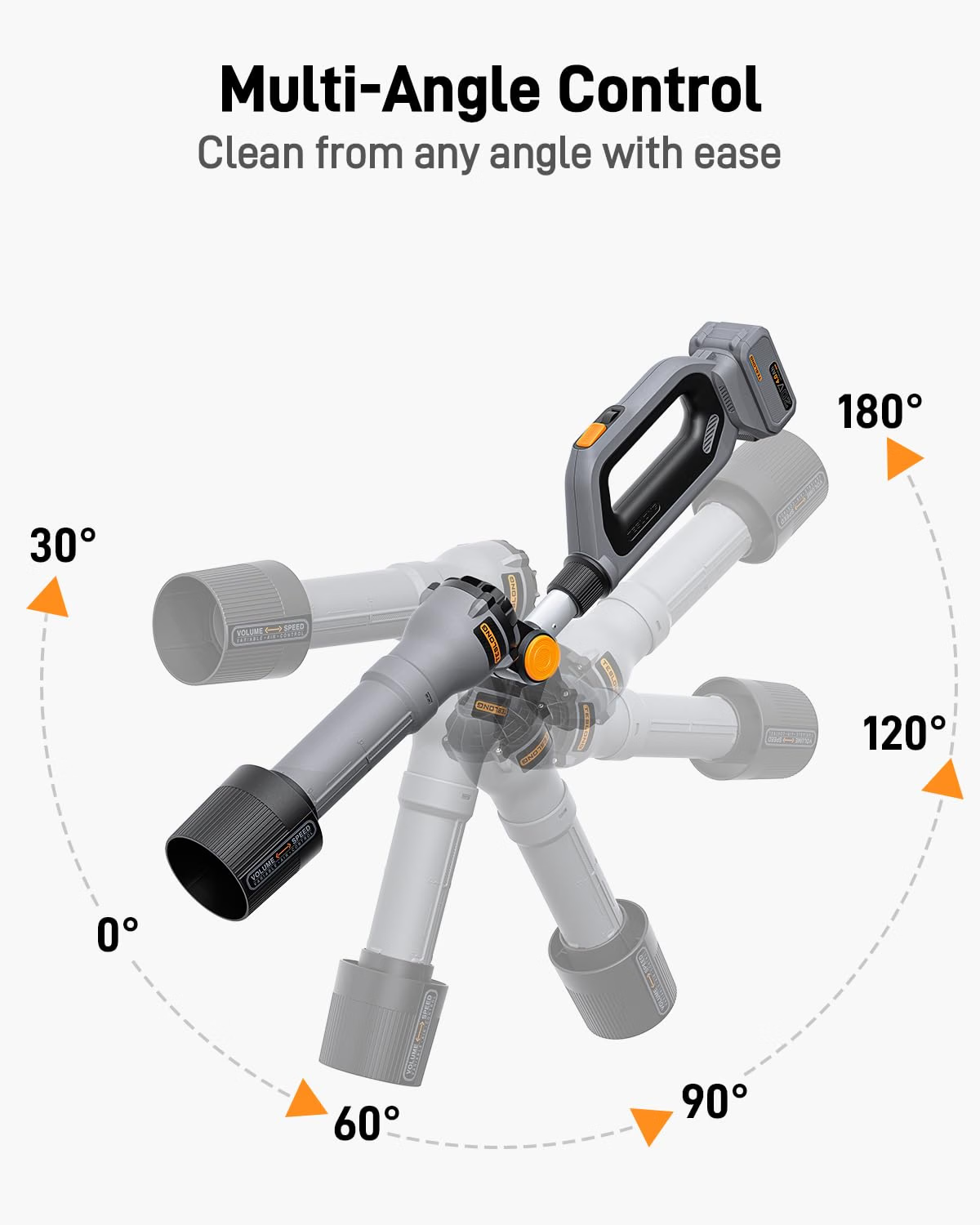
| Head and tube | Five-position pivoting head, 3 in tube extension, folds for storage | Teslong product page |
| Battery indicator | Four-stage LED | Teslong product page |
| In the box | Blower, one 4.0Ah battery, USB-C cable, manual. No wall charger listed | Teslong product page |
| Noise | No figure published that I found | None found |
| Dimensions | Not published | None found |
| Warranty | 12-month limited warranty and 30-day money-back guarantee | Teslong product page |
| Price | $129.99 on Teslong’s store; $119.99 was the launch-month price | Teslong; launch notice |
Where Teslong’s own pages disagree
These are the figures that differ between pages I read. I show each one instead of picking a winner.
| Spec | What the pages say | Why it matters |
|---|---|---|
| Low-mode runtime | 35 minutes on the feature page, about 32 minutes on the launch notice and another page | Small gap, but the true number depends on the setting |
| High-mode runtime | 20 minutes on the feature page, about 18 minutes elsewhere | Same pattern |
| Mode names | Low, High and Turbo on most pages; Eco, Standard and Turbo on another | Check which labels your unit uses |
| Tube angle | A 0° to 180° range on one page, a 30° to 180° list on another, 0° to 90° on a third | The exact range isn’t settled |
| Airflow | 600 CFM in the title; one page I read also had a 610 CFM bullet | Marketing copy isn’t fully reconciled |
| Price | $129.99 standard, $119.99 at launch | Check the current price on your listing |
💨 Power and Airflow: What 600 CFM and 115 MPH Mean
CFM is the volume of air a blower can move. MPH is how fast it leaves the nozzle. Volume carries a pile, and speed breaks wet leaves loose.
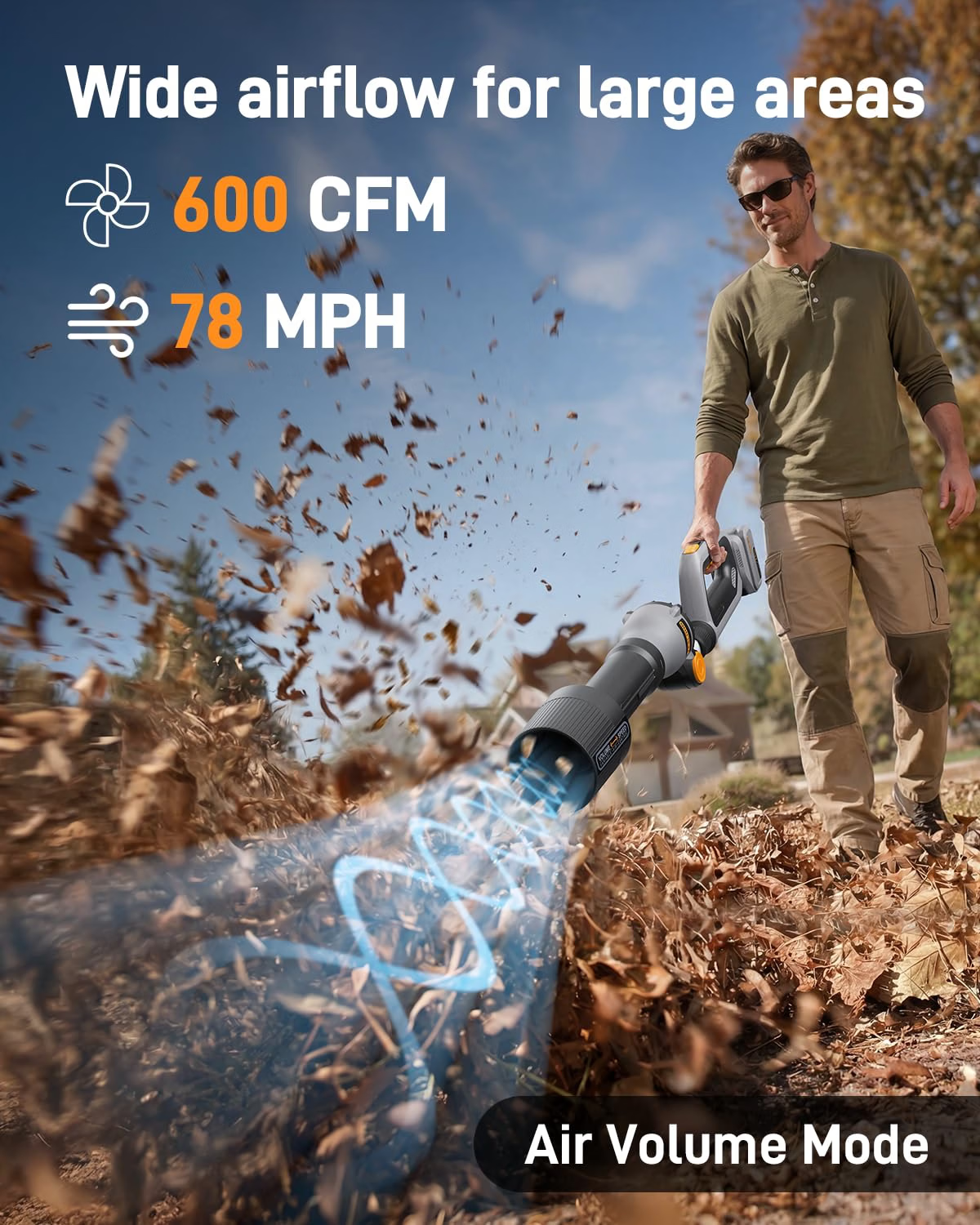
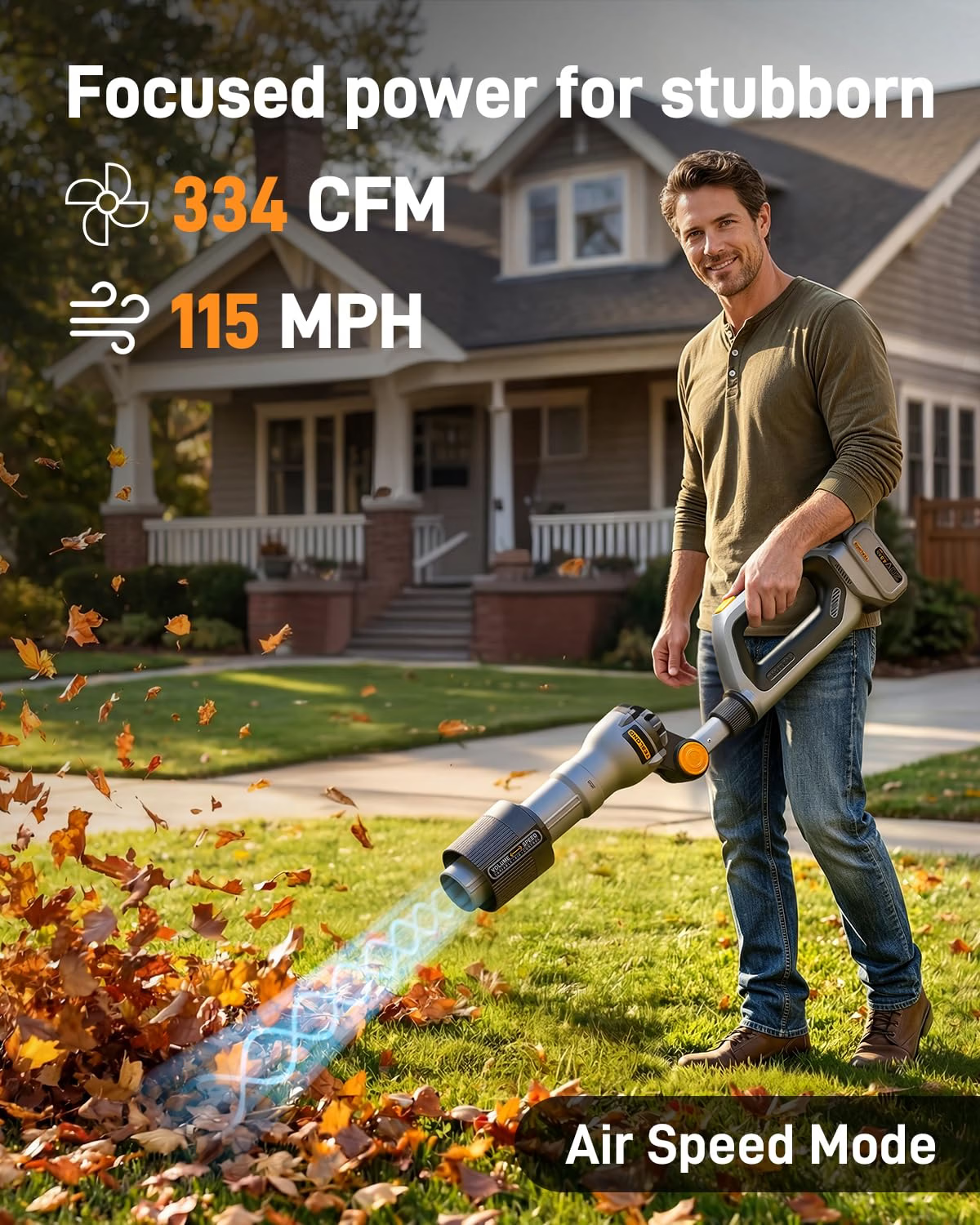
Teslong splits the two into separate modes. Air Volume mode spreads airflow over lawns and driveways, and Air Speed mode concentrates it on corners and stuck debris.
A sanity check on the numbers
Airflow equals air speed times the size of the nozzle opening. If a nozzle moved 600 CFM at 115 MPH, the opening would need to be about 3.3 inches across.
| Claimed speed | Opening needed for 600 CFM | What it tells you |
|---|---|---|
| 100 MPH | About 9.8 sq in, a round opening about 3.5 in wide | A wide nozzle |
| 115 MPH (Teslong) | About 8.5 sq in, about 3.3 in wide | A plausible wide nozzle |
| 130 MPH | About 7.5 sq in, about 3.1 in wide | A slightly narrower nozzle |
My arithmetic: area equals CFM divided by speed in feet per minute, then converted to inches. It’s an illustration, not a measurement of this blower.
How 600 CFM compares with named blowers
| Blower | Rated airflow | Rated speed | Battery | Notes |
|---|---|---|---|---|
| Teslong LB-L01 (this blower) | 600 CFM | 115 MPH | 20V 4.0Ah | Turbo peak, unverified |
| WORX WG543 | 410 CFM | 125 MPH | 20V 4.0Ah | Retailer listing figures |
| Craftsman V20 brushless | 350 CFM | Not listed | V20 4.0Ah kit | Retailer listing figures |
| DEWALT DCBL722B | 450 CFM | Not listed here | 20V MAX XR | Reviewed on this site |
| Milwaukee M18 FUEL | 450 CFM | Not listed here | M18 | Reviewed on this site |
| EGO LB5302 | 530 CFM | Not listed here | 56V | Reviewed on this site |
Ratings are manufacturer figures. They are not test results.
A 600 CFM rating on a 20V, 4.0Ah blower is high for its class. The 12-minute Turbo runtime points to a short peak, not a sustained push.
Teslong’s own buying guide says to treat a maximum airflow rating as a ceiling, not a guarantee. Check the current listing for the exact specs and buyer photos.
What the brushless motor means
A brushless motor wastes less energy as heat and wears more slowly. That helps runtime and lifespan at a given power level.
It doesn’t guarantee more airflow by itself. Fan design, nozzle shape and the battery’s ability to deliver current set what you feel.
What I’d expect in the yard
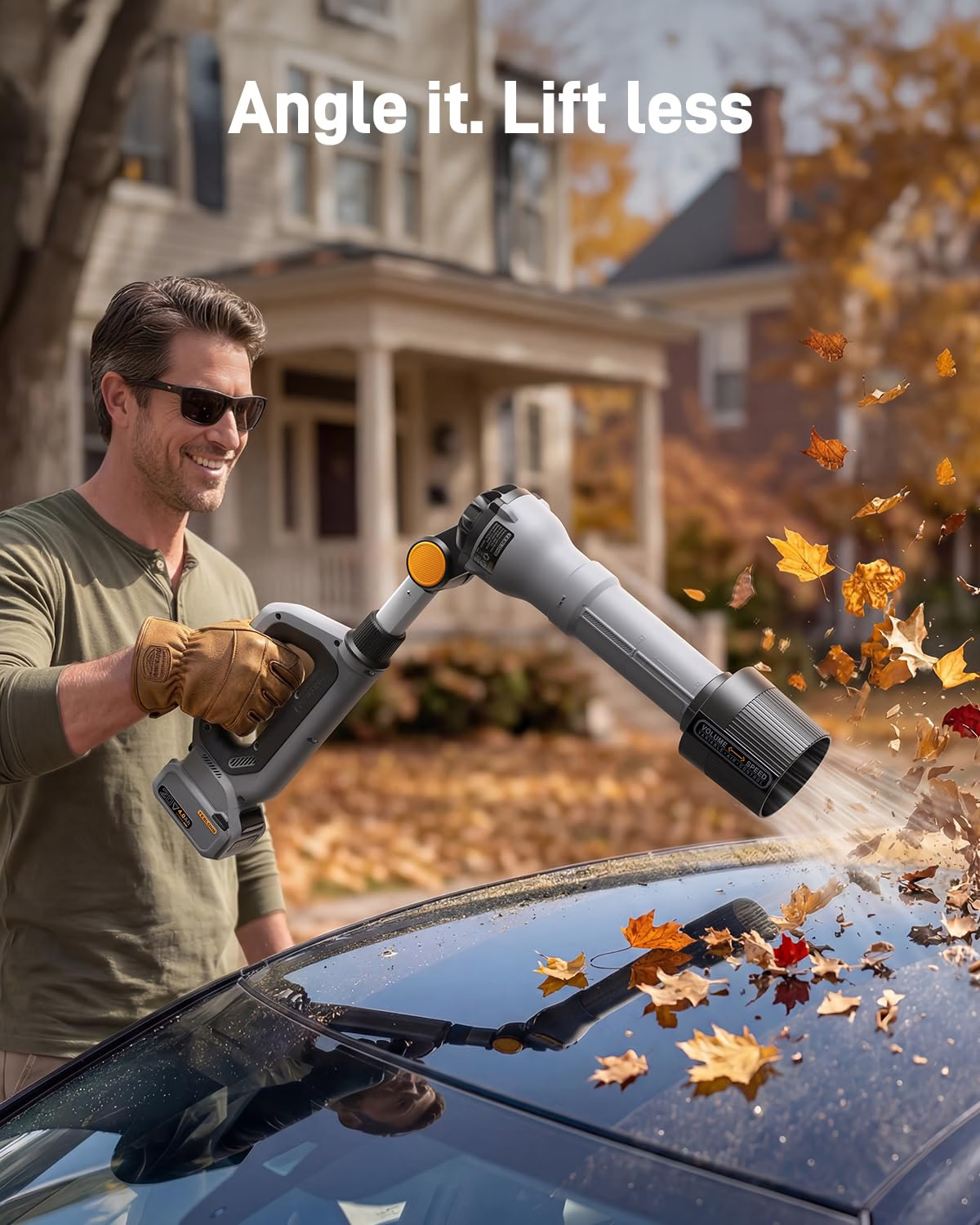
From the weight and ratings, I’d expect it to clear dry leaves, grass clippings, dust and light debris from a patio, deck, walkway or driveway. That’s my expectation, not a test result.
Wet, matted leaves are where small blowers struggle. Teslong points its Air Speed mode at wet spots, but no independent test shows how well it does.
🔋 Battery, Runtime and USB-C Charging
The battery decides how you will use this blower. It’s a single 20V 4.0Ah pack, and Teslong publishes runtimes for each mode, which most budget brands don’t.
The energy math
Battery energy in watt-hours is voltage times amp-hours. Teslong doesn’t state the figure. A 4.0Ah pack is 80 Wh at 20V, or 72 Wh if it is 18V nominal like many 20V packs.
Dividing that energy by Teslong’s runtimes gives the average power each mode draws. This is my arithmetic, not a Teslong figure.
| Mode | Teslong runtime | Implied average draw | What it means |
|---|---|---|---|
| Low (Eco) | 32 to 35 minutes | About 120 to 150 W | Light debris, dust and clippings |
| High (Standard) | 18 to 20 minutes | About 215 to 265 W | Dry leaves and driveways |
| Turbo | About 12 minutes | About 360 to 400 W | Short bursts for stubborn spots |
Watt-hours divided by runtime in hours. Real runtime varies with temperature, battery age and how you hold the trigger.
Planning a job around one pack
| Job | Suggested mode | What to expect |
|---|---|---|
| Patio, deck, porch | Low | A single pack should cover several rounds |
| Driveway and walkway | Low to High | A pack should finish a typical driveway |
| Quarter-acre of dry leaves | High, Turbo on stubborn spots | Plan for a second battery |
| Stuck wet leaves | Air Speed mode, short Turbo bursts | Expect to swap or recharge |
A spare Teslong 20V battery costs $59.00 on the brand’s store, in 2.0Ah or 4.0Ah sizes. A second 4.0Ah pack doubles every runtime above.
USB-C charging and power bank mode
The battery charges over USB-C at up to 45W and can output up to 45W to charge a phone or laptop. The wall charger isn’t in the box, only a USB-C cable.
So you need your own USB-C Power Delivery charger. At a full 45W, a 72 to 80 Wh pack takes about 1.6 to 1.8 hours before charging losses. A 20W phone charger would take closer to 4 hours.
| Topic | What to know |
|---|---|
| Charger | Use a USB-C Power Delivery charger of 45W or more for the fastest charge. Teslong doesn’t publish a charge time |
| Heat and cold | Let a hot pack cool before charging, and avoid charging or storing packs in freezing or very hot places (general battery advice) |
| Storage | Store the pack partly charged in a dry place, out of children’s reach (general battery advice) |
| Certification | Ask the seller whether the battery and any charger carry UL, ETL or a similar mark. I couldn’t confirm that |
| Tool sharing | Teslong’s page lists the blower in a “20V Sharing System” with its tire inflators, pressure washer and other tools. It doesn’t say outright that every pack fits every tool, so confirm before you buy |
| Replacements | Spare Teslong packs are sold, but they’re proprietary. Other brands’ 20V packs are unlikely to fit |
🔑 Setup and Use
I couldn’t read the Teslong manual, so this follows the brand’s product pages. Follow the manual in your box where it differs.
Plug the cable into a USB-C Power Delivery charger. The four-stage LED shows the charge level. Teslong publishes no charge time.
Slide the pack in until it locks. A loose pack can cut power mid-job.
The pivoting head has five positions. Use a low angle for ground sweeps and a higher one for vertical surfaces and tight spaces.
Use Air Volume mode to move debris across a wide area. Use Air Speed mode to focus on corners, fence lines and stuck debris.
Start on Low. Move to High for stubborn patches, and save Turbo for short bursts.
Keep the nozzle a few inches off the surface and push the pile in front of you.
The head folds flat for storage. Remove the battery and wipe the housing first.
🍂 Real-World Performance and Yard Size
No independent test exists for this blower, so this section is built from Teslong’s claims, the battery size and what similar 20V blowers usually do. Treat it as a guide, not a measurement.
What it should handle
| Job | Likely fit |
|---|---|
| Dry leaves on a lawn | Good for light to moderate drop, in short sessions |
| Patio, deck, porch | Strong fit. The pivoting head helps in corners |
| Driveway and walkway | Good for grit, dust and clippings |
| Under furniture and garden edges | A good match for the adjustable head Teslong designed it around |
| Garage floor, car, workshop | Strong fit for dust and sawdust |
| Damp or matted leaves | Slow. Use Air Speed mode and short Turbo bursts, and don’t count on it |
Yard-size guidance
These ranges are my judgment from the battery size, not a Teslong rating.
| Property | Fit | Why |
|---|---|---|
| Patio, balcony, townhouse | Excellent | Short jobs, and weight is the main benefit |
| Under 1/4 acre | Good | One pack on Low and High should cover most of it |
| 1/4 to 1/2 acre | Marginal | A second battery is close to essential |
| Over 1/2 acre | Poor | A larger battery platform or a gas blower fits better |
Technique that stretches one battery
⚖️ Teslong vs Battery-Platform and Budget Blowers
Teslong sits between a no-name budget blower and a full battery-platform kit. This table shows where the trade-offs fall.
| Teslong LB-L01 | Battery-platform blowers | No-name budget blowers | |
|---|---|---|---|
| Price (seen) | $129.99 on the brand store | Often higher, with bare-tool options | Often lower, sometimes with two batteries |
| Rated airflow | 600 CFM (claimed) | 350 to 450 CFM on the models I checked | Often 400 to 700 CFM, with little proof |
| Published runtimes | Yes, by mode | Usually by battery size | Often missing |
| Warranty terms | 12 months and 30-day money-back | Brand-wide dealer support | Often unclear |
| Tool ecosystem | A smaller 20V line of tire inflators, a pressure washer and more | A full tool line | Rarely any |
| Independent test data | None found | Often available | Rarely available |
When a different blower makes more sense
🛠️ Care, Storage and Troubleshooting
I couldn’t find a Teslong manual online, so the tables below are general care guidance for a cordless blower. Follow your own manual where it differs.
| Item | What to do | When |
|---|---|---|
| Battery pack | Remove it before cleaning, adjusting the head or clearing a blockage | Every time |
| Air inlet | Keep it clear of leaves, dust and hair. A blocked inlet cuts airflow and heats the motor | Before and after each use |
| Pivoting head | Check that it locks at each angle and is free of debris | Before each use |
| Housing | Wipe with a dry or slightly damp cloth, and keep water out of the vents and battery bay | As needed |
| USB-C port | Keep it clean and dry, and don’t force the cable | Monthly in season |
| Storage | Keep the blower and a partly charged battery indoors, dry and out of reach of children | Off-season |
Troubleshooting
| Problem | Likely cause | Fix |
|---|---|---|
| Won’t start | Battery not seated or empty | Reseat the battery and charge it |
| Cuts out quickly | Turbo mode, a hot pack or a cold pack | Use a lower mode, let it cool, or warm the pack indoors |
| Weak airflow | Blocked inlet or the head at an awkward angle | Clear the inlet and reset the head position |
| Pack charges slowly | Low-wattage charger | Use a USB-C Power Delivery charger of 45W or more |
| Unusual noise or smell | Debris in the fan or a damaged part | Remove the battery, stop using it and contact support |
🛡️ Safety, Noise and Local Rules
Noise: what I could and couldn’t verify
Teslong publishes no noise figure that I could find. Its own guide says sound varies by model and mode, and tells buyers to check documented sound information and local rules.
Battery blowers are often quieter than gas ones, but a Turbo burst is still loud. Wear hearing protection and check your town’s rules on blower hours.
The brand’s product page carries a California Proposition 65 warning, as many battery products do.
💵 Price, Warranty and Where to Buy
| Source | Price seen | Note |
|---|---|---|
| Teslong store | $129.99 | Standard price. Launch-month price was $119.99 |
| Teslong store, spare battery | $59.00 | 2.0Ah or 4.0Ah, listed as an add-on |
| Amazon | See the listing | I couldn’t read Amazon’s page, so I didn’t list a price |
Taxes aren’t included. Prices change, and a launch price may not return.
How to judge the price
Warranty and returns
Teslong states a 12-month limited warranty and a 30-day money-back guarantee, subject to its terms. I couldn’t read the full policy pages.
If you buy on Amazon, the seller’s terms apply. Check the listing terms, and keep your receipt and order number either way.
📸 Product Photos
These images come from the listing. Tap one to enlarge it and swipe through the set.
⭐ Owner Feedback, Pros and Cons
Teslong’s product page shows 5 reviews but no average rating, and I couldn’t read their text. I also couldn’t open Amazon’s reviews. So I can’t summarize what buyers say, and I’d rather admit that than invent a pattern.
What I can do is weigh the claims against the usual limits of a compact 20V blower. The points below are my analysis of the sources above, not buyer feedback.
- Light: 4.3 lb with battery, 2.86 lb bare
- Five-position pivoting head for corners and under furniture
- Runtimes published for each mode
- Brushless motor and a 20V 4.0Ah battery
- USB-C charging and a power bank function
- 12-month warranty and a 30-day money-back guarantee
- Turbo lasts only about 12 minutes on one battery
- No wall charger in the box
- 600 CFM and 115 MPH have no independent test
- Noise and charge time aren’t published
- A smaller tool ecosystem than the big battery platforms
- Brand pages disagree on some runtimes and angles
🎯 Who Should Buy It
Buy it if:
- You have a patio, deck, driveway or small to medium yard
- You want a light blower you can aim into corners and under furniture
- You value published runtimes and clear warranty terms
- You’re happy to run Low and High and treat Turbo as a boost
Skip it if:
- You want tested power and a big tool platform. Look at the DEWALT DCBL722B or the Milwaukee M18 FUEL
- You have a large yard, or mostly wet or heavy leaves
- You don’t want to buy a USB-C charger or a spare battery
- You need a published force figure, noise rating or charge time
❓ Teslong 20V Brushless Leaf Blower 600 CFM FAQ
Is the Teslong 20V 600 CFM leaf blower worth buying?
It looks like a solid pick for small to medium yards, patios and driveways if you treat the specs as claims. The light body, pivoting head and published runtimes are strong points. I found no independent test, so a battery-platform blower is safer if you want proven power.
Is the 600 CFM rating real?
I can’t verify it. Teslong lists up to 600 CFM in Turbo mode, and I found no independent measurement. The figure is high for a 20V, 4.0Ah blower, and the 12-minute Turbo runtime suggests a short peak, not a sustained push.
How fast is it in MPH?
Teslong lists up to 115 MPH. That pairs sensibly with 600 CFM for a nozzle opening of roughly 3.3 inches by my arithmetic, but it’s still an unverified manufacturer figure.
How long does the battery last?
Teslong lists about 32 to 35 minutes on Low, 18 to 20 minutes on High and about 12 minutes on Turbo with the 4.0Ah battery. The pages differ slightly, and real runtime depends on temperature and battery age.
What battery does it use?
A removable Teslong 20V 4.0Ah pack, included in the box. A spare pack costs $59.00 on the brand’s store in 2.0Ah or 4.0Ah sizes. Don’t assume other brands’ 20V packs will fit.
Does it come with a charger?
Teslong’s product page lists a USB-C charging cable but no wall charger. You will need a USB-C Power Delivery charger, ideally 45W or more, to charge at full speed.
How long does it take to charge?
Teslong doesn’t publish a charge time. By my arithmetic, a 72 to 80 Wh pack takes about 1.6 to 1.8 hours at a full 45W, before losses, and roughly 4 hours on a 20W phone charger.
How much does it weigh?
Teslong lists 2.86 lb for the blower alone and 4.3 lb with the 4.0Ah battery installed. That makes it light for a handheld blower with this much battery.
Can it charge my phone?
Teslong says the battery’s USB-C port can output up to 45W, so it can charge a phone and, by the brand’s claim, a laptop. I haven’t tested this.
Can it move wet leaves?
I wouldn’t count on it. Teslong points its Air Speed mode at wet spots, but no independent test shows how well it works. Dry leaves, dust and clippings are a better match.
Is it good for a large yard?
Not really. One 4.0Ah battery gives about 20 minutes on High and 12 on Turbo, so a quarter acre or more needs a second battery, and a half acre or more needs a bigger platform.
How loud is it?
Teslong publishes no noise figure that I found. Wear hearing protection, especially in Turbo mode, and check your local rules on blower hours.
What warranty does it have?
Teslong states a 12-month limited warranty and a 30-day money-back guarantee, subject to its terms. If you buy on Amazon, check the seller’s own warranty and return text on the listing.
Is there a brand-name alternative on this site?
Yes. See my DEWALT DCBL722B and Milwaukee M18 FUEL reviews for tested battery-platform blowers, and the EGO LB5302 and LB7654 for bigger yards.
📚 More Blower Reviews
DEWALT DCBL722B 20V MAX XR Blower: Specs, Pros & Cons
A light brushless handheld for DEWALT 20V MAX owners.
EGO LB5302 56V 530 CFM Leaf Blower: Specs, Pros & Cons
A boxed kit with a battery and charger, and measured force.
EGO LB7654 56V Cordless Leaf Blower: Specs, Pros & Cons
A 765 CFM handheld for big yards and wet leaves.
Milwaukee M18 FUEL 450 CFM Blower: Specs, Pros & Cons
A compact blower for Milwaukee M18 battery owners.
✅ Before You Buy: Quick Checklist
A few details vary by listing and seller, so it’s worth a minute on the page to confirm:
- The model: LB-L01, the Teslong 20V brushless blower
- The battery: one 4.0Ah pack or a bundle, and the cost of a spare
- The charger: USB-C cable only, or a wall charger too
- The price: $129.99 on Teslong’s store, and whether the listing matches
- The warranty: 12 months and the 30-day return window
- The seller: Teslong or a third party, and the return terms
- Local rules and protective gear: eye and ear protection, and your town’s noise limits
Affiliate Disclosure: BestLeafBlowerCordless.com is a participant in the Amazon Services LLC Associates Program, an affiliate advertising program designed to provide a means for sites to earn advertising fees by advertising and linking to Amazon.com. As an Amazon Associate, we earn from qualifying purchases.