
Cordless Blower Review
KIMO Leaf Blower Cordless 750CFM 220MPH Turbo Mode Review: Specs, Pros & Cons
As an Amazon Associate, I earn from qualifying purchases at no extra cost to you.
⚡ Overview: A Budget Kit With Very Big Numbers on a Small Battery
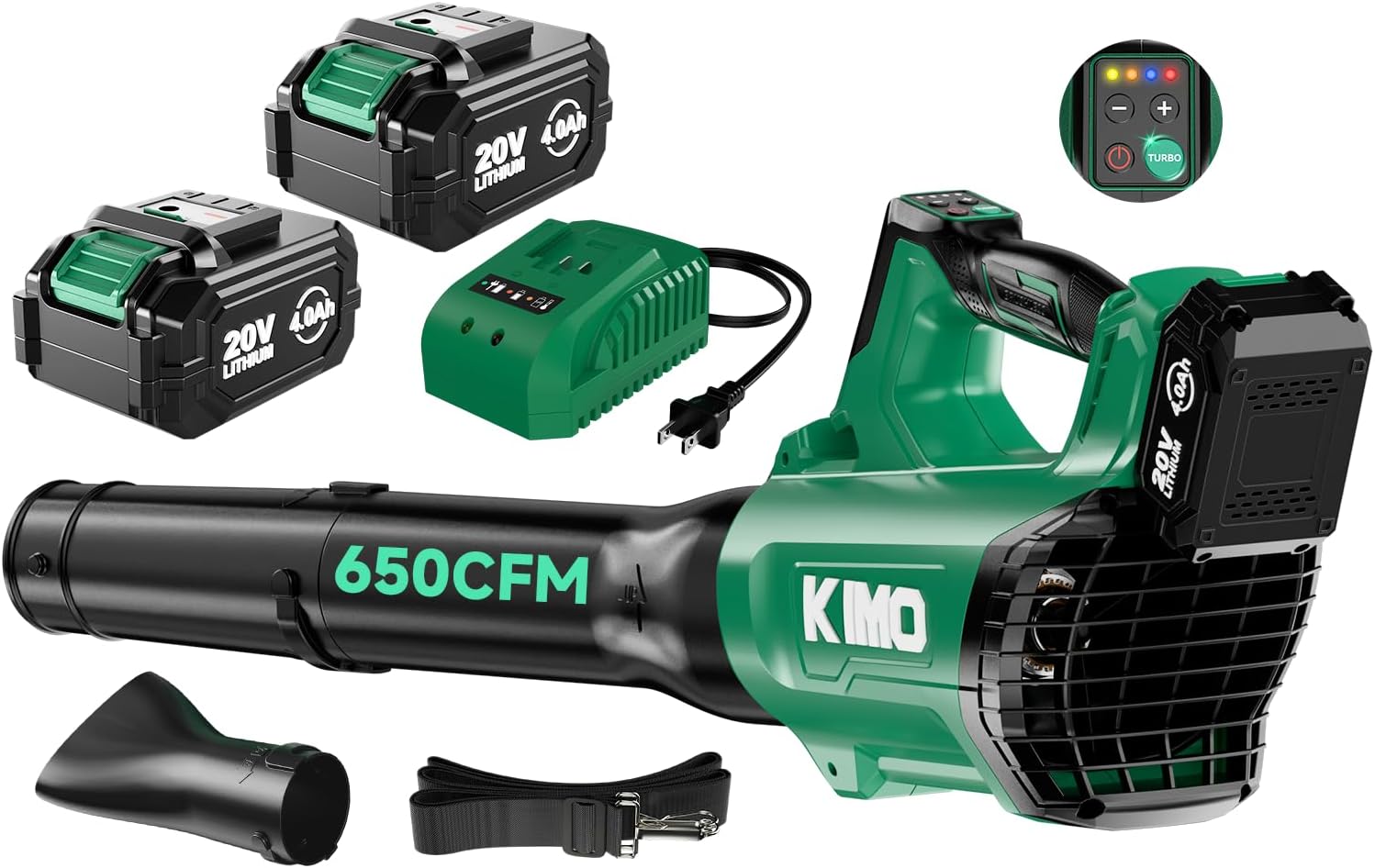
The KIMO cordless leaf blower is sold as a complete kit: a brushless blower, two 4.0Ah batteries, a charger, and extension tubes. The Amazon title promises 750 CFM and 220 MPH, four speeds with a turbo mode, and a smart control panel. Lowe’s listed the same kit as a “20V Max” blower for about $80, which tells you the price class we’re talking about.
Here’s why I’m being careful. Those numbers would beat blowers that cost three or four times as much and run on 56V or 60V batteries, and nobody independent has measured them. So this KIMO 750 CFM review does more than list specs. It checks the claims against simple arithmetic, shows where the sources contradict each other, and compares the KIMO with blowers that testers have actually measured. It’s a research-based review, and I haven’t used the blower myself.
Only as a cheap, light-duty kit, and only if you ignore the headline numbers. Two batteries, a charger, and extension tubes for under $100 is attractive for a small patio or driveway. But the 750 CFM and 220 MPH claims are unverified, a 20V battery can’t sustain that kind of output for long, the voltage is described three different ways, and the warranty is 12 months. Choose the EGO LB6500, the Toro Flex-Force, or the Milwaukee M18 FUEL if you want force that a tester has actually measured.
Verdict Summary
Best for light cleanup on a tight budget
- Best for: small patios, decks, driveways, and light leaves, where you want a complete kit at a very low price
- Standout strength: two batteries and a charger in the box, a brushless motor, four speeds plus turbo, and extension tubes for reach
- Biggest weakness: unverified 750 CFM and 220 MPH claims, a small 20V battery, conflicting voltage data, and only 12 months of warranty
- Skip it if: you have a large yard, wet leaves, or want measured force and a long warranty
Score basis: raised by the low price, the complete kit, and the feature list; lowered by the lack of any independent test, the battery size behind the airflow claims, the contradictory voltage and tube-count information, and the short warranty. The score rests on the listing’s claims and my arithmetic, not on test results. It’s an editorial judgment, not a lab score, and it isn’t based on hands-on testing.
📊 Full Specifications
Core specs
| Spec | Value | Source |
|---|---|---|
| Type | Cordless handheld leaf blower kit with two batteries and a charger | Amazon listings |
| Voltage | Sold as 20V Max at Lowe’s; KIMO’s shop calls the flagship 28V; one Amazon page lists 12V | Lowe’s; KIMO shop; Amazon |
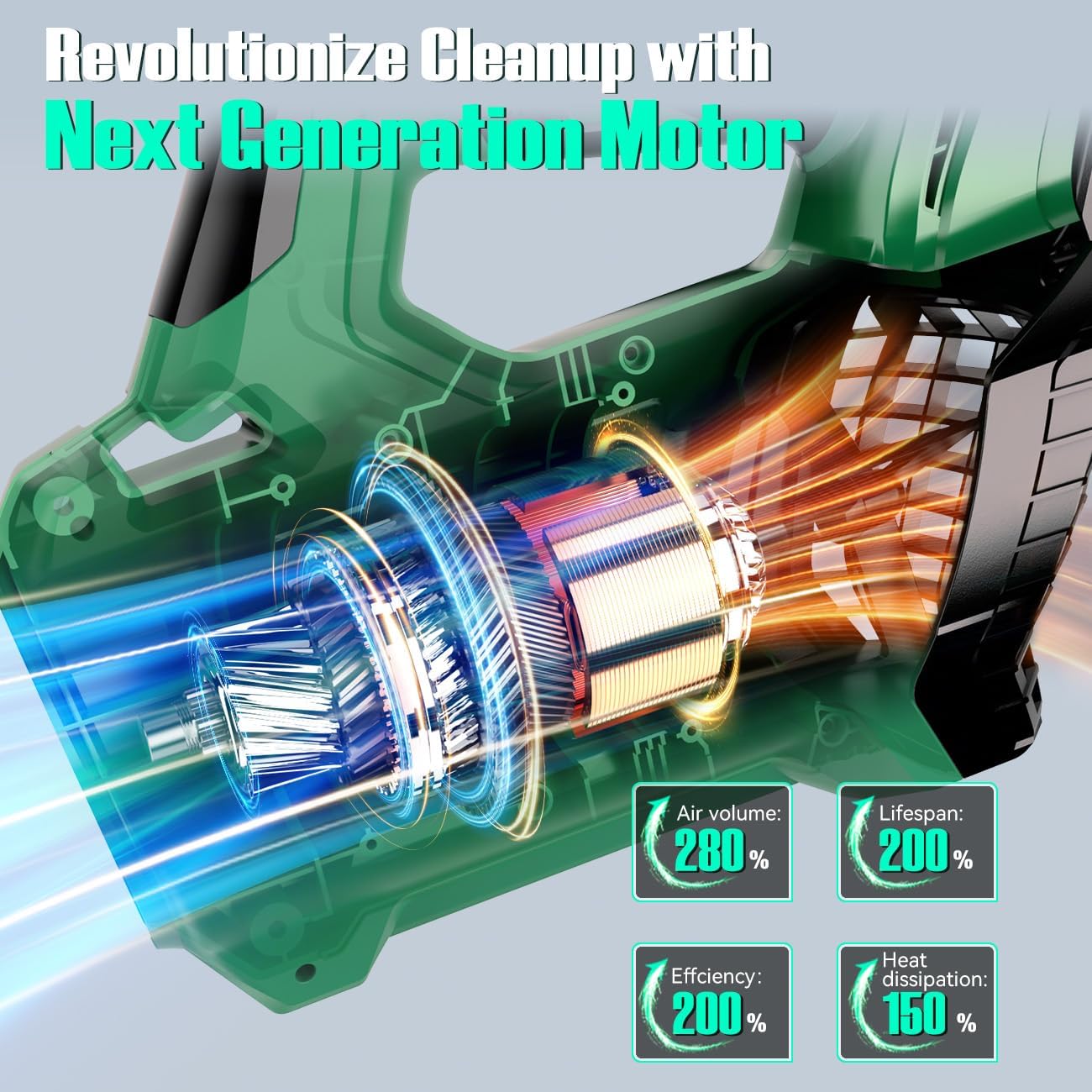
| Motor | Brushless | Amazon listings |
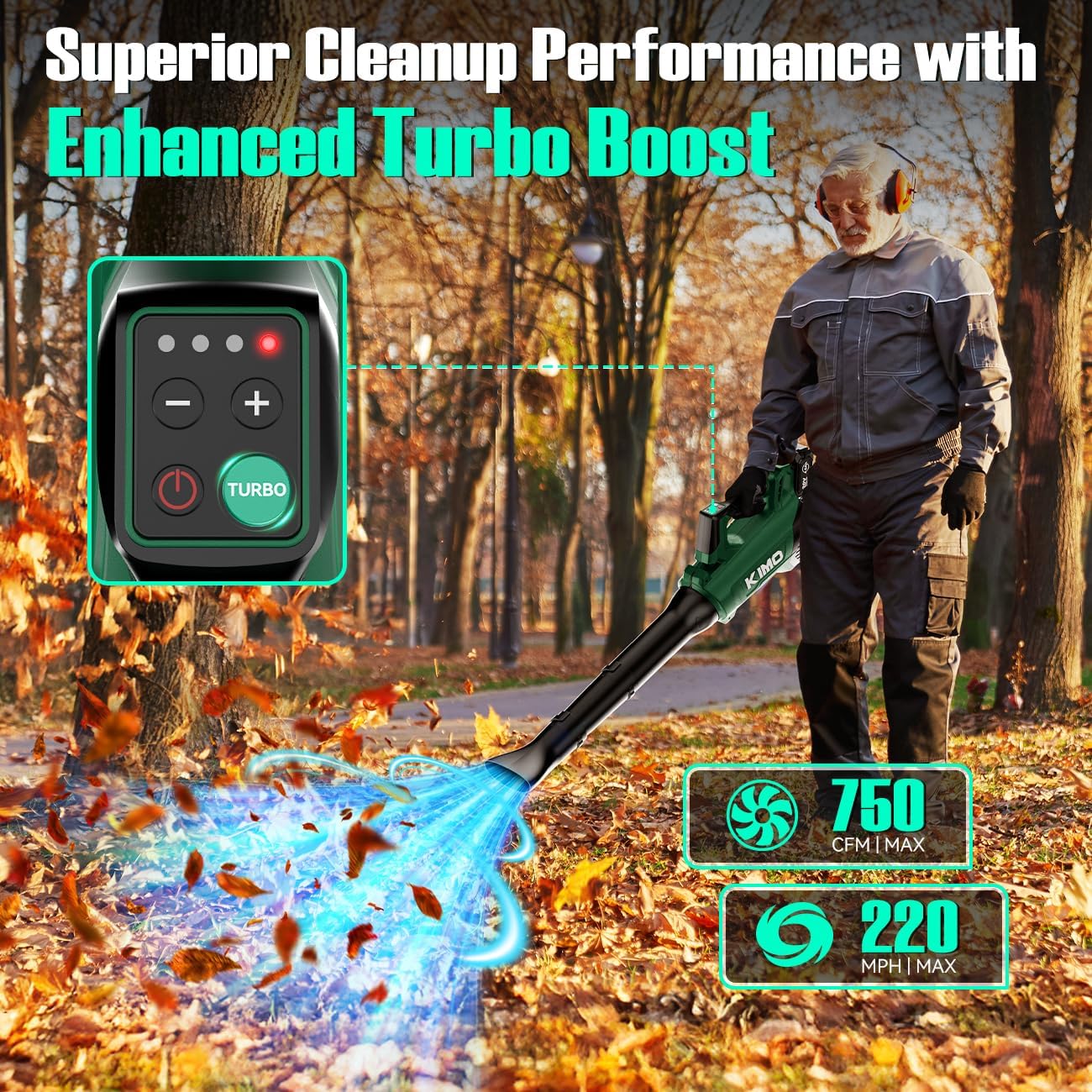
| Air volume | 750 CFM (claimed, turbo mode) | Amazon title |
| Air speed | 220 MPH (claimed, turbo mode) | Amazon title |
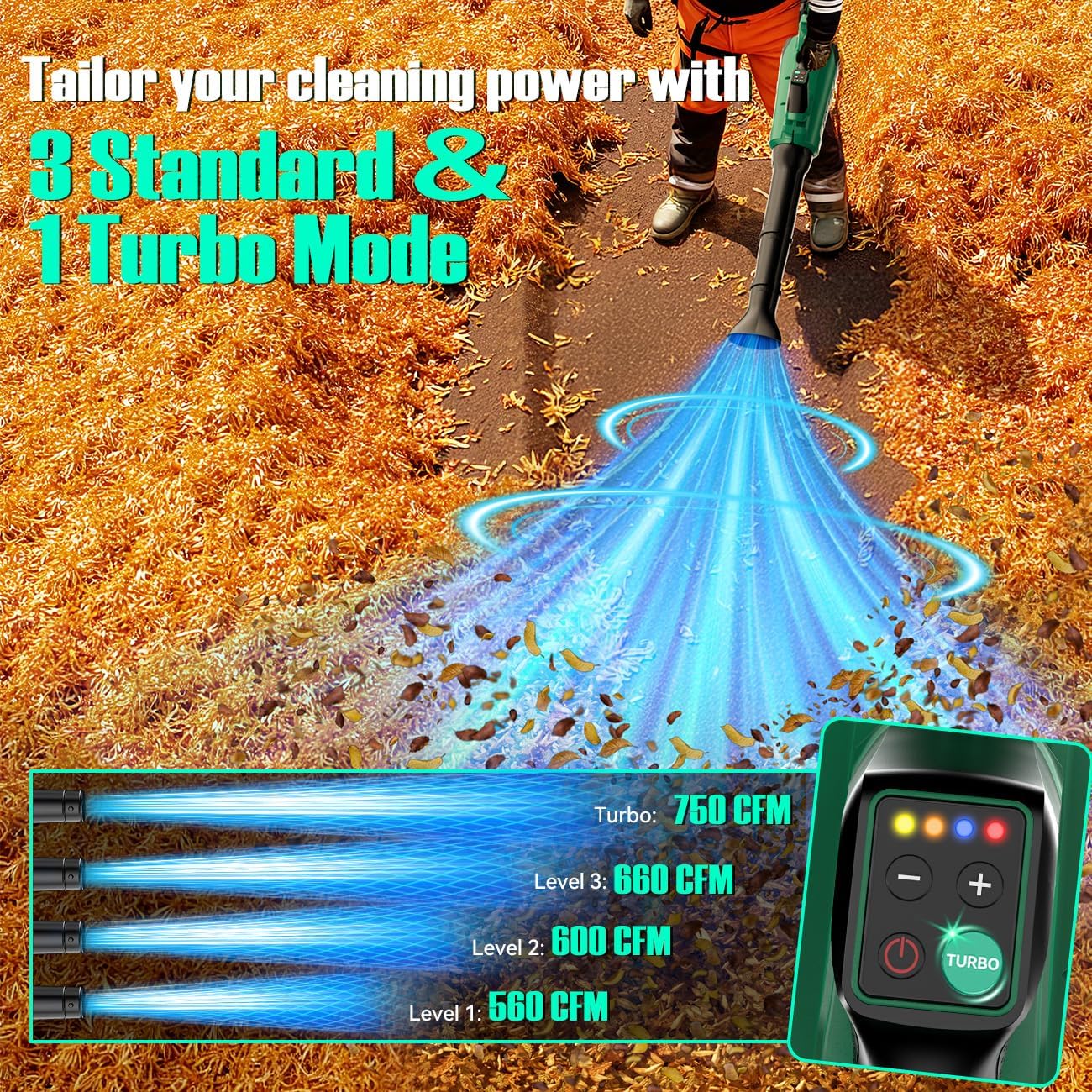
| Speeds and controls | Four speeds plus turbo, with a smart panel and button controls | Amazon listing |
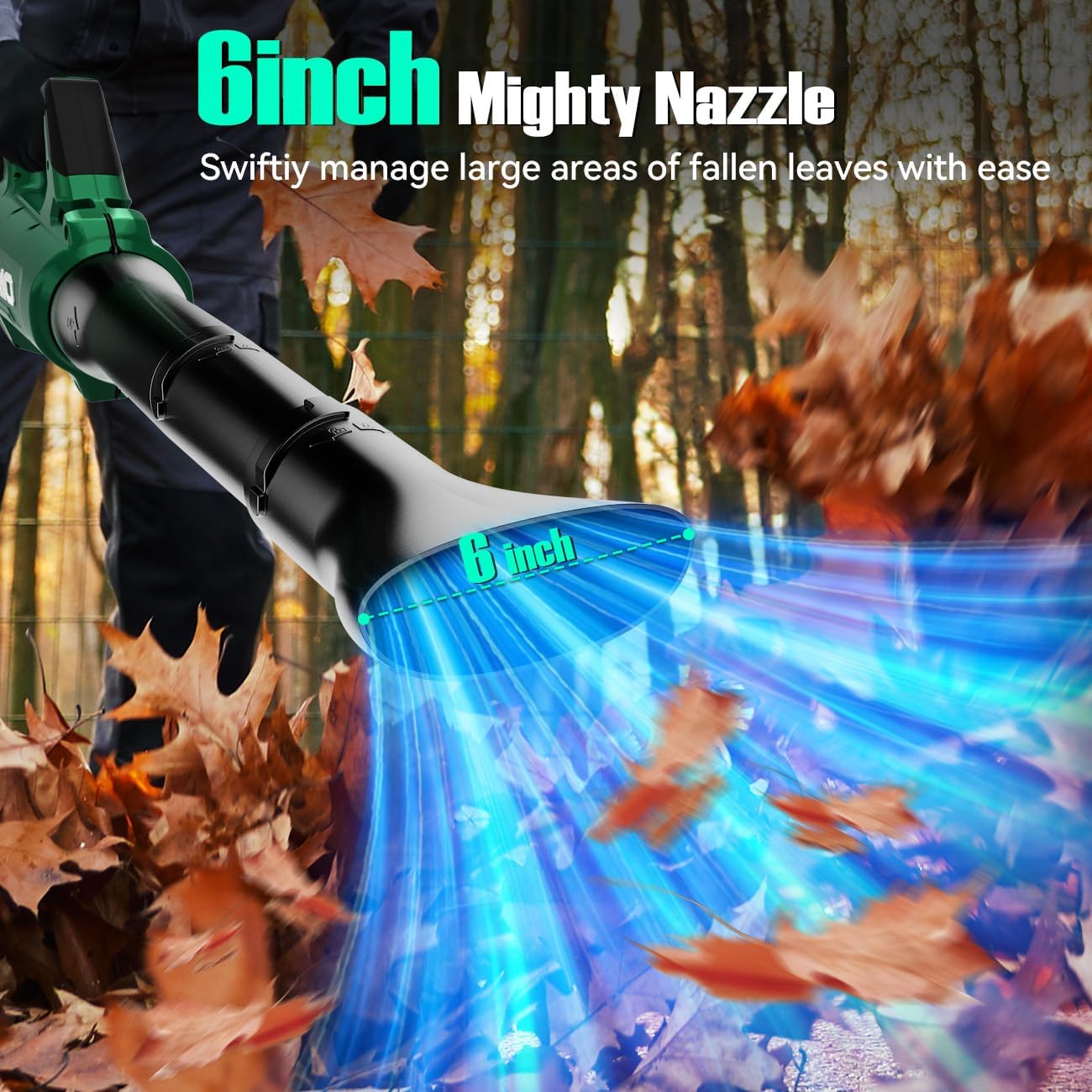
| Nozzle | A reseller lists a 6-inch optimized nozzle; a sibling listing says the nozzle connection is interchangeable | Reseller; sibling listing |
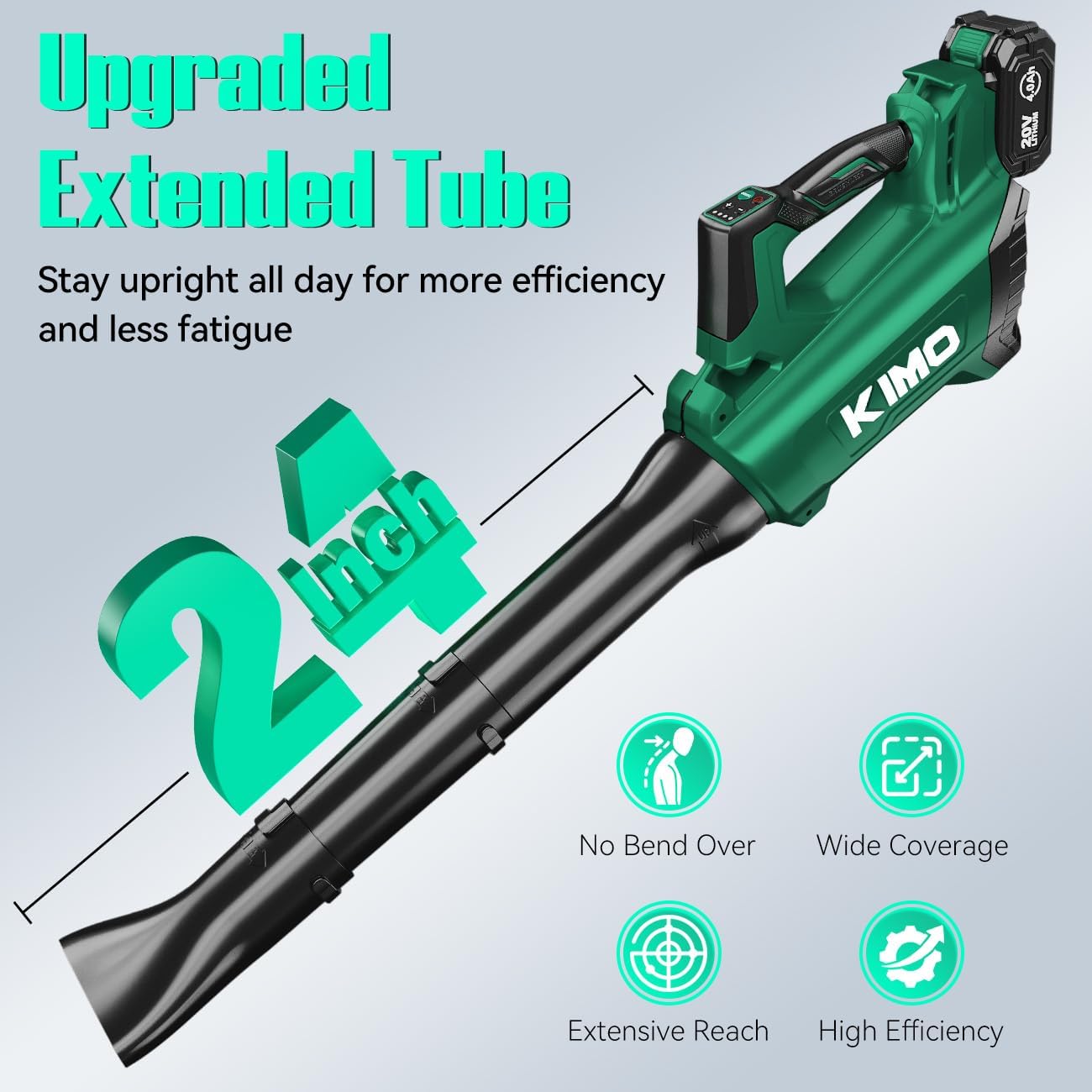
| Tubes | One blowing tube plus two or three extension tubes, depending on the listing | Amazon listings |
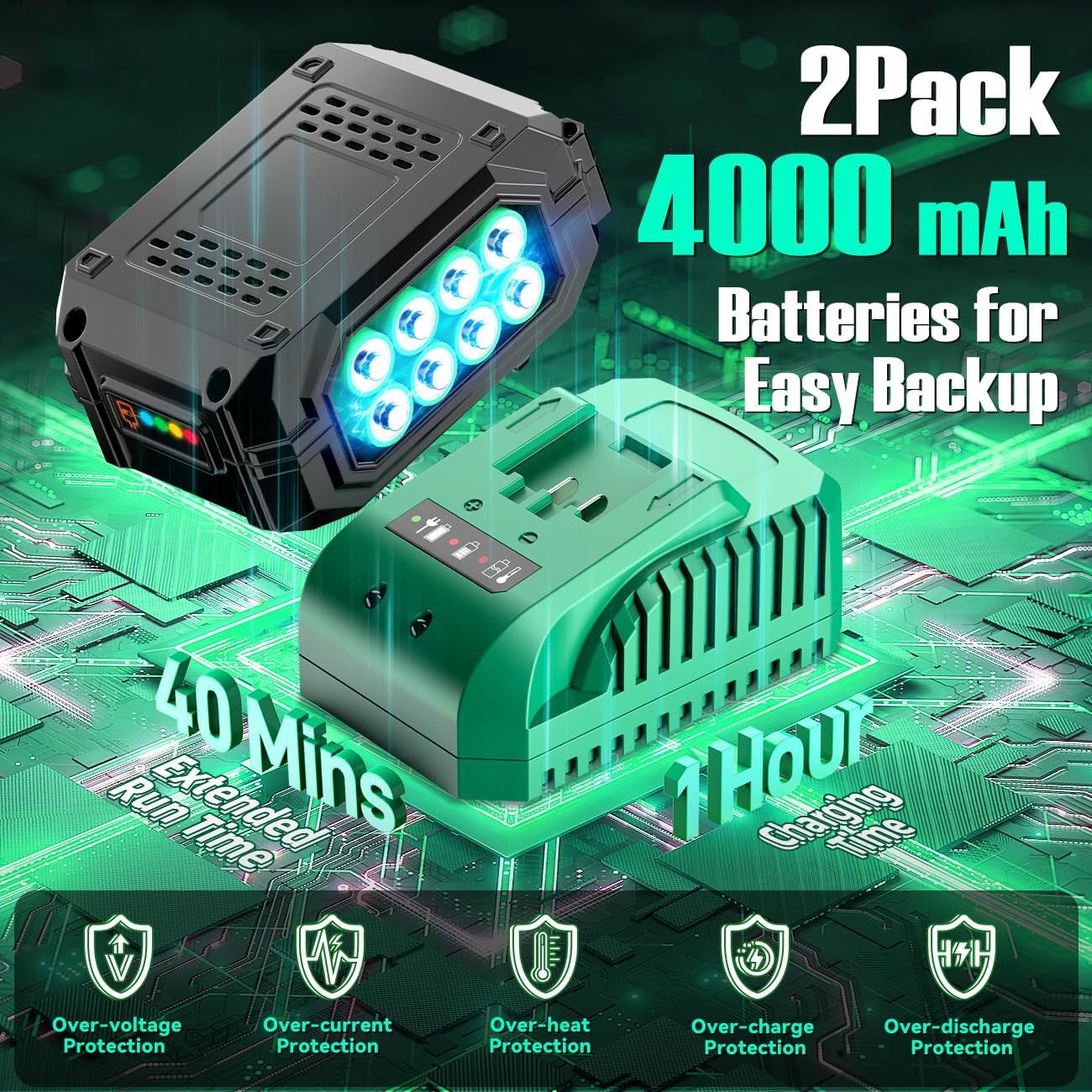
| Batteries | Two 4.0Ah (4000mAh) batteries with a power indicator and five protection functions (voltage, current, heat, charge, discharge) | Amazon; reseller |
| Charger | Included. I found no charge time | Amazon listing |
| Weight | Not found for this model | None found |
| Blowing force | Not published; no independent measurement found | None found |
| Noise | No rating found for this model | None found |
| Weather protection | No rating found | None found |
| Warranty | 12 months of warranty service | Amazon listing |
Figures that vary by source or region
These are the numbers where sources disagree or leave something out. I show each one instead of picking a winner.
| Spec | What sources say | Why it differs |
|---|---|---|
| Voltage | 20V Max (Lowe’s title, an Amazon package list). 28V for the flagship (KIMO’s shop). 12V (an Amazon bare-tool page) | Marketing labels and data errors. Check the label on your battery |
| Tube count | Two extension tubes (one Amazon listing). Three extension tubes (another). One blowing tube plus one extension tube (a reseller package list) | Different bundles under similar titles |
| Nozzle size | 6-inch optimized nozzle (a reseller). A 2.5-inch large nozzle on the cheaper 6202 model at Lowe’s | Different models. The 6-inch claim sits oddly beside a 220 MPH claim, as explained below |
| Airflow history | Earlier KIMO 20V blowers: about 150 to 260 CFM and 150 to 190 MPH. The 6202 at Lowe’s: 240 CFM and 170 MPH. This kit: 750 CFM and 220 MPH | A big jump in one generation. Treat it as a claim until a tester measures it |
| Marketing claims | “Lifespan extended by 85%, air volume increased by 150%” and “lifespan extended by 150%” appear in listings | Vague comparisons with no stated baseline |
| Price | $79.99, marked down from $89.99, in a months-old Lowe’s snippet | Dealer pricing and date. Check the current Amazon price |
💨 Power and Airflow: Can a 20V Blower Really Do 750 CFM at 220 MPH?
CFM and MPH sell blowers, but blowing force in newtons says more about how one handles a heavy pile. KIMO doesn’t publish a force figure, and no tester has measured this blower, so I can’t tell you what it actually does. What I can do is run a few sanity checks on the claims, and they’re worth a few minutes of your time before you spend money.
Check one: how much energy is in the battery?
Each battery is rated 4.0Ah on a 20V Max label, which works out to about 80 Wh, or roughly 72 Wh if the pack’s real nominal voltage is 18V. The two together hold about 160 Wh. For comparison, the EGO LB6500’s 5.0Ah battery stores about 280 Wh. In independent tests the LB6500 measured about 20.3 N and ran about 16 and a half minutes in turbo, which works out to roughly 1,000 W of average power. If KIMO’s turbo needed anything like that, one 80 Wh pack would be flat in under five minutes.
| If the blower draws | One 80 Wh pack lasts about | Both packs last about |
|---|---|---|
| 300 W | 16 minutes | 32 minutes |
| 500 W | 10 minutes | 19 minutes |
| 800 W | 6 minutes | 12 minutes |
| 1,000 W | 5 minutes | 10 minutes |
This is simple arithmetic: stored energy divided by power draw. It ignores losses, and the real draw of this blower is unknown. It shows why turbo mode on a small battery has to be short, not that the claim is false.
Check two: do the airflow and the speed fit together?
Airflow equals the speed of the air multiplied by the area of the opening it leaves through, so a given CFM and MPH imply an opening size. If all 750 CFM left at an average of 220 MPH, the outlet would need to be only about 2.7 inches across. A reseller says this kit has a 6-inch nozzle, and through a 6-inch opening 750 CFM works out to an average speed of only about 43 MPH. The table shows the pairing for a few outlet sizes.
| Outlet diameter | Average speed if all 750 CFM leaves through it |
|---|---|
| 2.5 inches | About 250 MPH |
| 2.7 inches | About 215 MPH |
| 4 inches | About 98 MPH |
| 6 inches | About 43 MPH |
Manufacturers often measure CFM at the fan and top speed at the centerline of the jet, so the two figures don’t have to match exactly. This is a rough consistency check, not a proof. The takeaway is that 750 CFM and 220 MPH are probably peak figures from different measurements, and you won’t get both at once from one nozzle.
Check three: what do measured blowers look like?
Independent tests show that CFM alone doesn’t predict force. In my EGO LB6500 review, a 650 CFM blower on a 56V pack measured about 20.3 N. In my Toro review, a 605 CFM blower measured 18.1 N in turbo but only 8.5 N on high. In my Milwaukee M18 FUEL review, a 450 CFM blower measured 11.2 N. A claim of 750 CFM from an 80 Wh battery is, at the very least, a claim that deserves a test, and I’d wait for one before believing it.
None of this proves the KIMO is a bad blower. A brushless 20V tool can be a perfectly good light-duty tool for a patio or driveway. It just means the headline numbers shouldn’t drive your decision. If you’re comparing options, the current Amazon listing shows what’s bundled.
🎛️ Speeds, Turbo, Tubes, and Setup
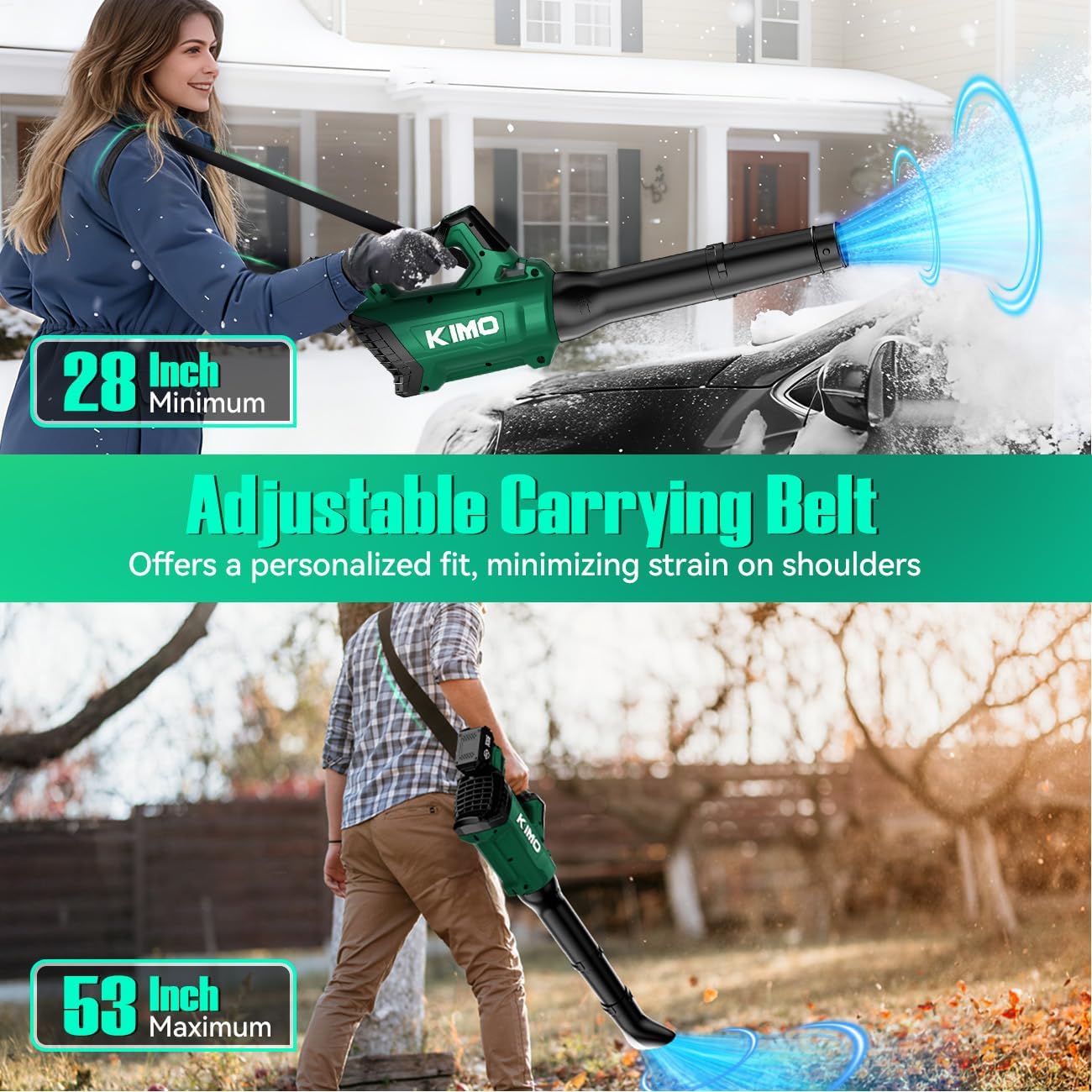
The listing describes four speeds plus a turbo mode, set from a smart panel with simple buttons. It also lists a quick, two-step assembly, which is reassuring for a kit you’ll build yourself: attach the nozzle, slide in a battery, and go. The images supplied for this page also show extension tubes and an adjustable belt, and the listings mention that the nozzle connection can be swapped. Here’s a practical way to think about the controls:
| Setting | What it’s for (my reading of the listing) | What to expect |
|---|---|---|
| Lowest speeds | Dusting patios, clearing grass clippings, moving light debris | The longest runtime, and the quietest operation |
| Higher speeds | Pushing dry leaves across a lawn or driveway | A noticeable drop in runtime |
| Turbo mode | Short bursts on stuck debris or damp patches | The shortest runtime on a small battery |
KIMO doesn’t publish airflow figures for each speed. This table is my reasoning from how battery blowers generally behave, not a KIMO specification.
A first-day test you can run yourself
Because there’s no independent data, the best evidence you’ll get is your own. If you buy one, use the return window to check the claims. This is a simple, honest way to do it:
- Time each battery: run one fresh pack on the lowest speed, then another on turbo, and note when each cuts out. Write the times down.
- Check the label: look at the voltage printed on the battery and the blower, and compare it with the listing.
- Count the parts: confirm the number of extension tubes and the nozzle against the listing.
- Feel the temperature: after a long run, note whether the blower or the battery gets unusually hot.
- Try a real pile: move a pile of dry leaves and a pile of damp leaves, and judge whether turbo is worth the runtime.
🔋 Battery, Runtime, and What You’re Buying Into
Two 4.0Ah batteries and a charger make this a complete kit, which is the best part of the deal. The listing says the batteries have a power indicator and five protection functions against overvoltage, overcurrent, overheating, and overcharge or over-discharge. Those are sensible features, though they’re standard for lithium packs. Here is the stored energy in the kit, at the 20V Max label:
Battery energy in the kit (Wh)
The EGO and Toro figures come from their makers’ battery ratings. The KIMO figures are my arithmetic from the 4.0Ah and 20V labels, so the real value may be about ten percent lower.
That chart is the heart of the story. Having two packs doubles the total, but you’re still carrying less stored energy than a single EGO pack, so long runs depend on swapping. I found no KIMO runtime or charge-time figure, so I can’t say how long a charge lasts or how long recharging takes.
The compatibility question
It isn’t clear whether KIMO’s 20V batteries fit other brands’ tools, or whether a spare is sold separately. Don’t assume either. If you already own DEWALT 20V MAX or Black+Decker batteries, buy a tool for that brand rather than hoping a KIMO pack swaps over. Check the Amazon listing for today’s price and the exact kit.
⚖️ Weight, Noise, Build, and Use by Job
Weight and handling
I couldn’t find a weight for the 750 CFM model. A cheaper KIMO sold at Lowe’s, with smaller 2.0Ah batteries, is listed at 2.7 lb, and this one is likely heavier because of the larger packs and the brushless motor, but I don’t have a number. The extension tubes add reach for low-bending work, and the adjustable belt in the images, if it’s included, would help with balance on longer jobs.
Noise
There’s no decibel rating for this model that I could find. A cheaper KIMO listing claims 70 dB, and I wouldn’t apply that figure here, since this is a different, more powerful tool. A blower in turbo is usually loud at the ear, so wear hearing protection and check your local noise rules.
Build, warranty, and the seller
An Amazon listing says KIMO’s cordless tools carry 12 months of warranty service. That is short compared with the 3 to 5 years on EGO, Toro, and Milwaukee blowers, so the return window matters more here. I found no weather rating and no long-term durability data, and Lowe’s showed no reviews for the nearby 6202 model. KIMO also sells impact wrenches, ratchets, and polishers, so it isn’t a one-product brand, but that doesn’t tell you how its blowers age.
What the numbers suggest, by job
These are reasoned from the specs and my arithmetic, not from my own testing.
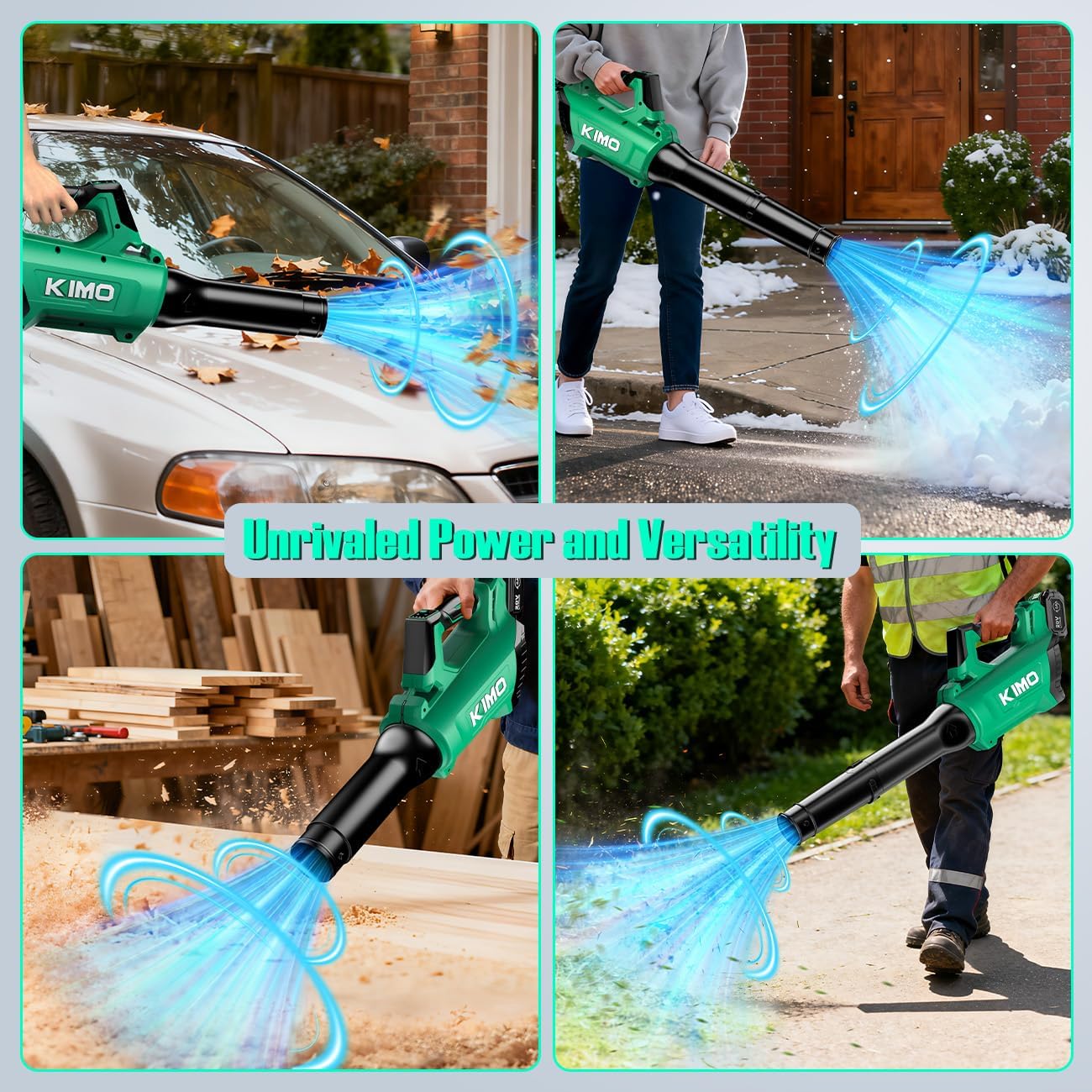
- Patio, deck, and walkways: a sensible fit for dust, clippings, and light debris.
- Small lawn with dry leaves: workable, but expect to swap batteries, especially if you use turbo.
- Wet leaves: the title mentions them, but a small battery makes sustained force unlikely. Treat that as unproven.
- Snow and gravel: a marketing talking point, not a verified use.
- Half acre and up: a poor fit, given the battery size and the unknown runtime.
- Heavy-duty or frequent use: choose a blower with measured force and a longer warranty.
⚔️ How the KIMO 750 CFM Blower Compares
The table puts the KIMO’s claims next to blowers that independent testers have measured. The newton figures come from Pro Tool Reviews bench tests that I cite in my other reviews. KIMO publishes none.
| Blower | Force and airflow | Battery | Price and warranty |
|---|---|---|---|
| KIMO 750 CFM kit (this review) | Not tested; claims 750 CFM, 220 MPH | 2 × 4.0Ah at 20V, about 160 Wh total | About $80 to $90; 12-month warranty |
| EGO LB6500 | 20.3 N (5.0Ah); 650 CFM, 180 MPH | One 5.0Ah at 56V, 280 Wh (see our review) | Bare tool about $230; 5-year tool warranty |
| Toro Flex-Force 51820 | 18.1 N turbo, 8.5 N high; 605 CFM | One 2.5Ah at 60V, 135 Wh (see our review) | Kit about $240; 3-year warranty |
| EGO LB5302 kit | 16.5 N turbo; 530 CFM | One 2.5Ah at 56V, 140 Wh (see our review) | A boxed kit; check the current price |
| Milwaukee M18 FUEL 450 CFM | 11.2 N; 450 CFM, 120 MPH | Any M18 battery (see our review) | Bare tool; about $150 to $180 |
| DEWALT DCBL722B | Not published; 450 CFM, 125 MPH | 20V MAX batteries (see our review) | Tool only; 3-year warranty |
Claimed airflow (CFM), manufacturer ratings, not measured
Measured blowing force (newtons), Pro Tool Reviews bench tests
The grey bar for the KIMO is a claim, not a measurement. CFM figures come from different makers and methods, so treat the charts as a rough guide.
If you want proven force, the EGO LB6500 is the stronger handheld, and the Toro and Milwaukee are good value on their own platforms. If you want the cheapest complete kit for light work and can live with the unknowns, the KIMO is a low-risk gamble as long as you use the return window to test it.
⭐ Owner Feedback, Pros and Cons
I couldn’t verify owner reviews for this model. Lowe’s showed no reviews for KIMO’s nearby 6202 blower, and I couldn’t open the Amazon review pages. So there’s no honest owner pattern to report. When you read the Amazon reviews, sort by newest and look for three things in particular: whether anyone has timed the battery in turbo, whether the voltage and tube count match the listing, and how the seller handled returns and warranty claims. Five-star reviews from the first weeks of a new listing tell you very little.
The points below are my analysis of the specs and sources above:
- Complete kit: two 4.0Ah batteries, a charger, and tubes
- Brushless motor, four speeds, and a turbo mode
- Extension tubes for added reach
- Battery power indicator and protection functions
- A very low price, around $80 to $90 at Lowe’s in one snippet
- A claimed 750 CFM and 220 MPH, if the claim holds up
- No independent test or measured force
- The 750 CFM and 220 MPH claims are hard to square with an 80 Wh battery and a 6-inch nozzle
- Voltage is described as 20V, 28V, and 12V
- Tube count and package contents vary by listing
- Only 12 months of warranty
- No weight, runtime, or noise rating for this model
- Battery compatibility with other brands is unconfirmed
🎯 Who Should Buy It
Buy it if:
- You want the cheapest complete cordless kit for a patio, deck, or small driveway
- You’ll test the runtime and the voltage label inside the return window
- You don’t mind a short warranty and an unproven brand
Skip it if:
- You want measured force. Look at the EGO LB6500 or the Toro Flex-Force
- You already own Milwaukee or DEWALT batteries. Compare the Milwaukee M18 FUEL blower or the DEWALT DCBL722B
- You have wet leaves or a large yard
❓ KIMO 750 CFM Cordless Leaf Blower FAQ
Is the KIMO 750 CFM blower a 20V or a 28V tool?
Sources disagree. Lowe’s sells the 750 CFM kit as a “20V Max” blower, and an Amazon listing for the same family says it takes a 20V blower and two batteries. KIMO’s own web shop calls its flagship a 28V model, and one Amazon bare-tool page lists 12 volts, which looks like a data error. Check the voltage printed on the battery you receive.
What comes in the KIMO kit?
Listings describe the blower, a blowing tube, one or more extension tubes, two 4.0Ah (4000mAh) batteries, a charger, and a user manual. One Amazon listing says two extension tubes, another says three, so the tube count depends on the listing.
Are 750 CFM and 220 MPH realistic for a 20V blower?
I can’t confirm them, and no independent test exists. A single 4.0Ah 20V battery stores about 80 Wh, far less than the 280 Wh pack that EGO’s 650 CFM LB6500 runs on. Treat the headline numbers as best-case seller claims, probably measured in turbo with a small outlet, and expect real-world force to be lower.
How long does the KIMO battery last?
I found no runtime figure for this model. By simple arithmetic, a 4.0Ah 20V pack holds about 80 Wh, so a blower drawing 1,000 W would drain it in under five minutes, and one drawing 300 W would last about 16. Turbo will be the shortest. This is an illustration, not a KIMO number.
Is the KIMO 750 CFM leaf blower brushless?
Yes, the listings say it has a brushless motor. One older KIMO listing for a cheaper model talks about a copper motor instead, so don’t assume every KIMO blower is brushless.
How many speeds does it have?
The listing says four speeds plus a turbo mode, controlled from a smart panel with buttons. I found no speed-by-speed airflow figures.
How heavy is the KIMO 750 CFM blower?
I couldn’t find a weight for this model. A different KIMO blower sold at Lowe’s, the 6202 with smaller 2.0Ah batteries, is listed at 2.7 lb, but that is not this tool. Check the weight on your listing, and remember that two 4.0Ah batteries add noticeable weight.
How loud is it?
There’s no decibel rating for this model that I could find. A different, cheaper KIMO listing claims 70 dB, but I wouldn’t apply that here, and a turbo-mode blower is usually much louder than a distance rating suggests.
Can it handle wet leaves?
The Amazon title mentions wet leaves, but that is marketing copy, and I found no independent test. A tool with a small battery is more likely to struggle with heavy, soaked leaves than a 56V or 60V blower with measured force.
What warranty does the KIMO blower have?
An Amazon listing says 12 months of warranty service. That is shorter than the 3 to 5 years from EGO, Toro, and Milwaukee, so keep your order record and note the return window.
Can I use other brands’ batteries with it?
I found nothing confirming that. Don’t assume the battery fits DEWALT, Black+Decker, or any other 20V platform, and don’t assume KIMO’s battery fits other tools.
How does the KIMO compare with the EGO LB6500?
The KIMO claims more airflow, at 750 CFM against 650 CFM, but the EGO runs on a 56V, 280 Wh battery, measured about 20.3 N in independent testing, and carries a 5-year tool warranty. The KIMO has no measured force and a 12-month warranty. See our EGO LB6500 review for the measured numbers.
What is the difference between this KIMO and the cheaper 6202 model?
The 6202 sold at Lowe’s is listed at 170 MPH and 240 CFM with two 2.0Ah batteries and a weight of 2.7 lb. The 750 CFM kit adds a brushless motor, 4.0Ah batteries, a turbo mode, and extension tubes, and it makes much bigger claims. Earlier KIMO 20V blowers were listed at 150 to 260 CFM, so the jump to 750 CFM is a big one.
🏆 Final Verdict: Is the KIMO 750 CFM Blower Worth It?
The KIMO 750 CFM cordless blower is a lot of kit for the money: two batteries, a charger, extension tubes, and a turbo mode. What it can’t show you is proof. The headline airflow and speed are unverified, they sit awkwardly beside an 80 Wh battery and a 6-inch nozzle, the voltage is described three ways, and the warranty is 12 months.
If your needs are modest and you can test it inside the return window, it’s a reasonable low-risk buy for a patio, deck, or small driveway. If you want measured force, a longer warranty, or real leaf-clearing power, spend more on a tested blower. If it fits how you work, you can check the latest price, the tube count, and what other buyers say on Amazon.
📸 KIMO 750 CFM Leaf Blower Photos
Click to see full view
📚 More Blower Reviews
EGO LB6500 Leaf Blower: Specs, Pros & Cons
EGO’s strongest handheld, with about 20 N of measured force.
Toro Flex-Force 60-Volt Max Brushless Handheld Leaf Blower Review
A 605 CFM 60V blower with strong turbo force.
Milwaukee M18 FUEL 450 CFM Blower: Specs, Pros & Cons
A light cordless handheld for Milwaukee M18 owners.
DEWALT DCBL722B 20V MAX XR Blower: Specs, Pros & Cons
A light cordless handheld for DEWALT 20V MAX owners.
✅ Before You Buy: Quick Checklist
A few details vary by seller, so it’s worth a minute on the listing to confirm:
- The voltage label: 20V Max, 28V, and 12V all appear in sources
- The tube count: two or three extension tubes, depending on the listing
- Warranty and returns: 12 months is the stated warranty; check the return window
- Your own runtime test: time a battery on low and on turbo within the return window
- Current price and what ships in the box
Affiliate Disclosure: BestLeafBlowerCordless.com is a participant in the Amazon Services LLC Associates Program, an affiliate advertising program designed to provide a means for sites to earn advertising fees by advertising and linking to Amazon.com. As an Amazon Associate, we earn from qualifying purchases.