
Gas Backpack Blower Review
Husqvarna 350BT Backpack Leaf Blower Review: Specs, Pros & Cons
As an Amazon Associate, I earn from qualifying purchases at no extra cost to you.
⚡ Overview: Husqvarna’s Mid-Size Backpack Blower
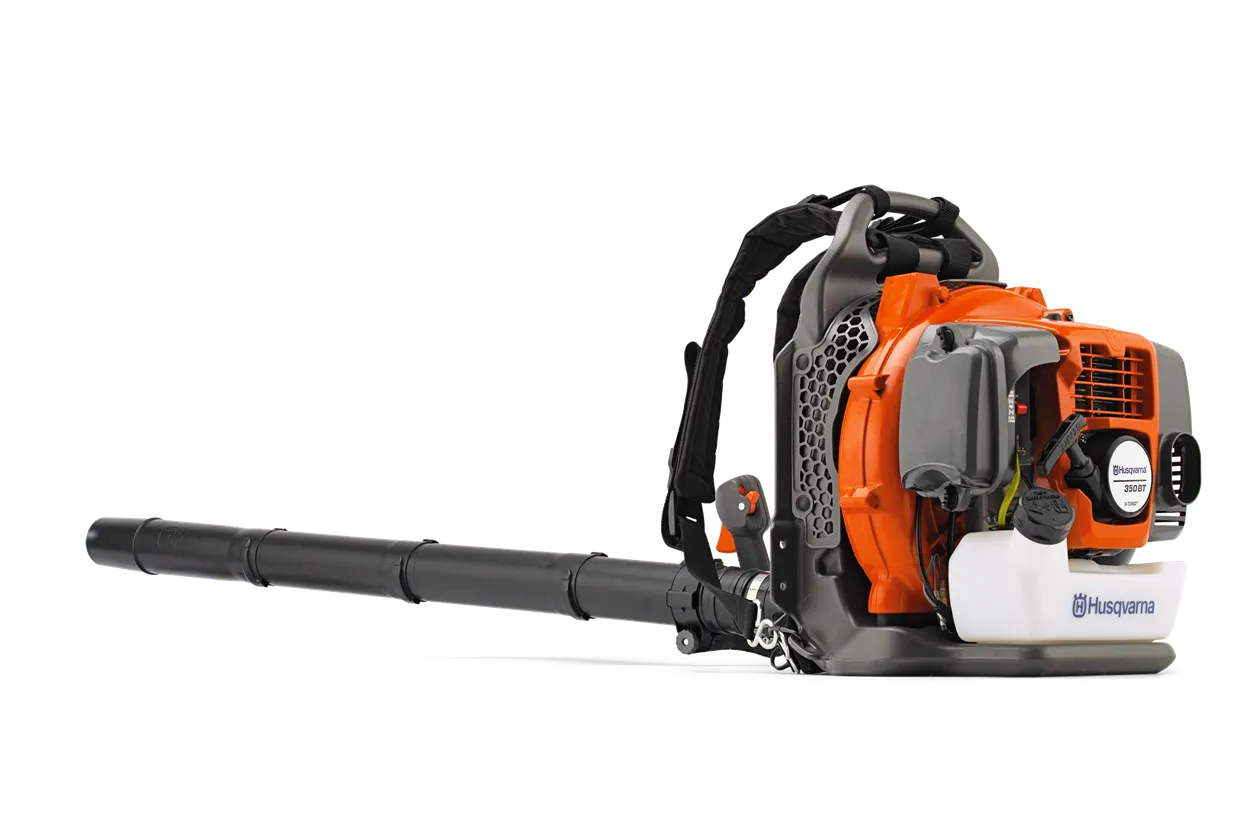
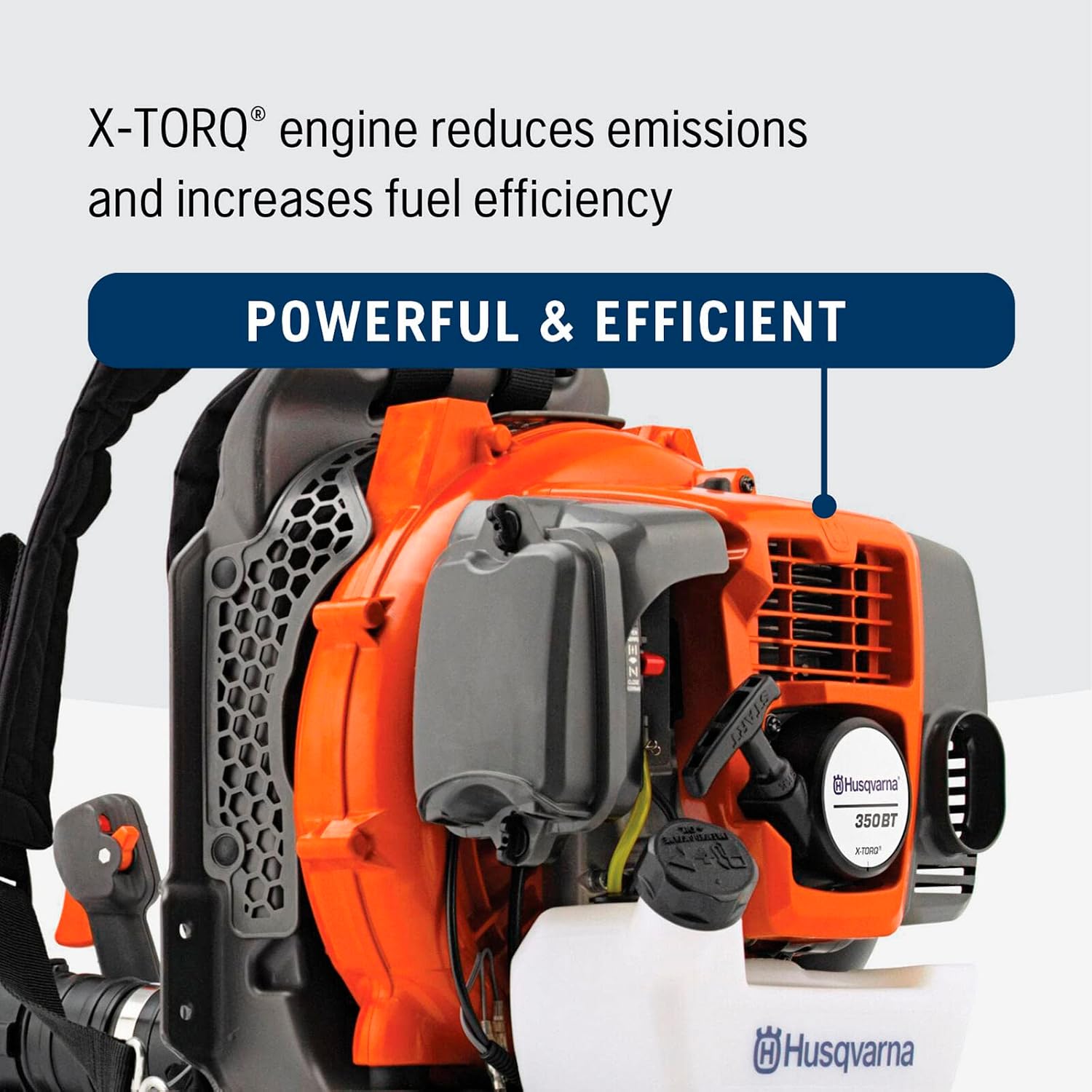
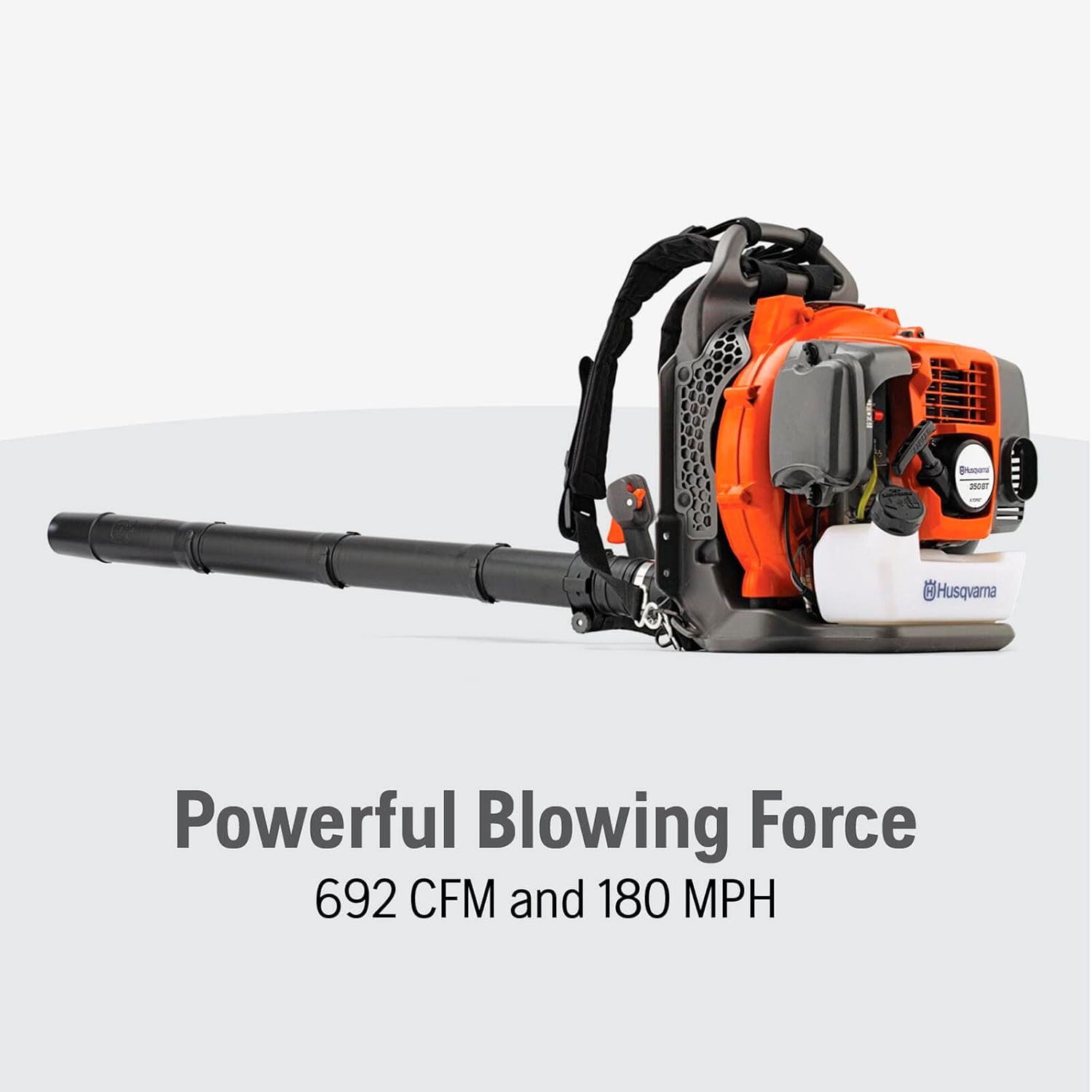
The 350BT is Husqvarna’s 50.2 cc backpack blower, built around the company’s X-TORQ two-stroke engine. Husqvarna rates it at 2.1 hp, 180 MPH, and 21 N of blowing force, with airflow of 494 CFM in the pipe and 692 CFM measured in the housing. It weighs 22.5 lb, has a 1.25 liter fuel tank, an offset adjustable handle, a padded harness with a hip belt, and a throttle with cruise control. Husqvarna’s US list price is $429.99.
Its appeal is simple: it’s a proven gas layout, with a big tank and no battery limits. Reviewers praise the harness, the power, and the easy starting thanks to an air purge system. The downsides are noise (94 dB(A) at your ear), engine upkeep, exhaust, and a smaller group of owners who report power loss or heavy fuel use.
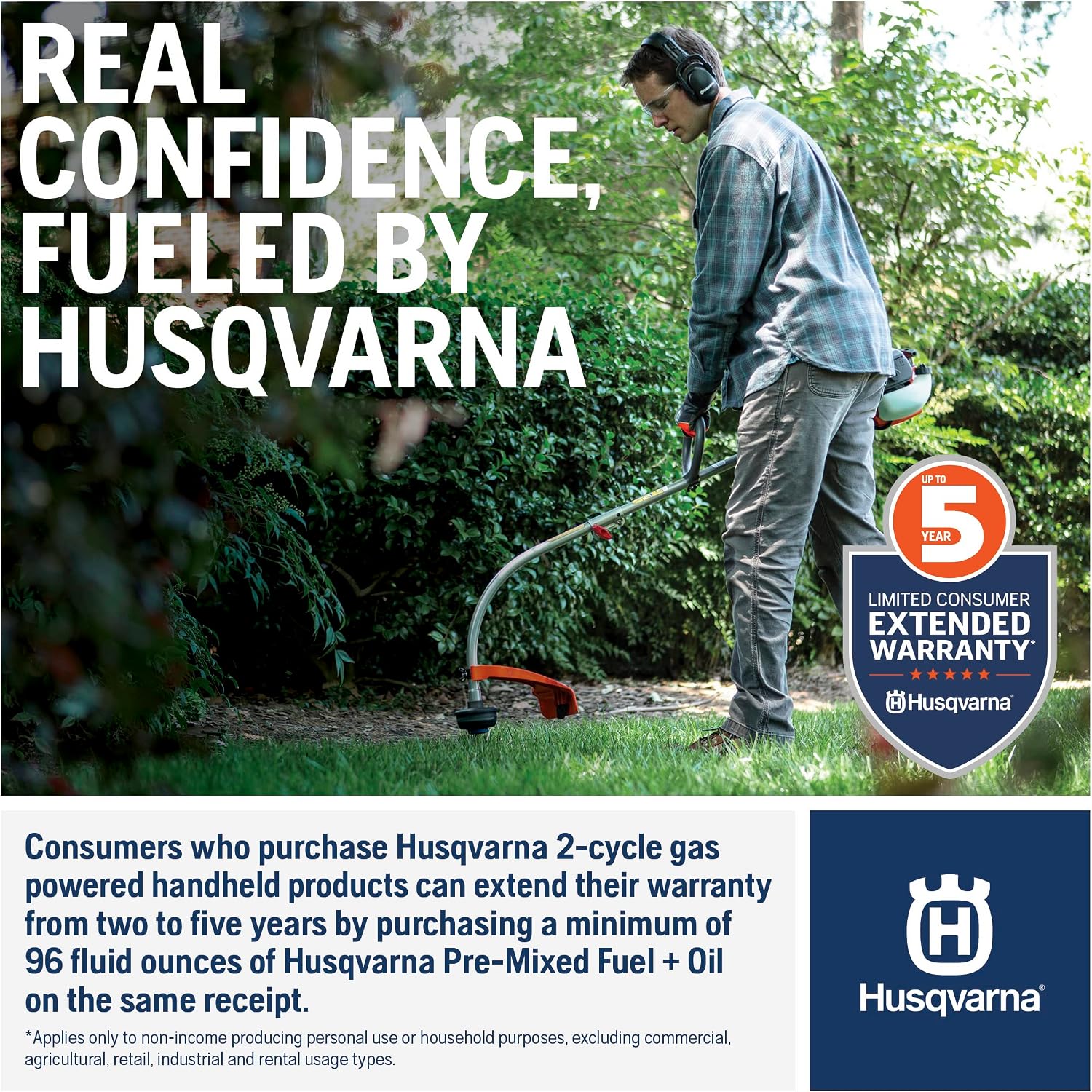
One important detail: there’s a 2-year base warranty, and it can reach 5 years only under a specific fuel-purchase program for residential owners. This page explains how that works, what the numbers mean, how the 350BT compares with cordless blowers, and who should buy it.
Check the listing for the seller, the exact model number, and what’s included
Yes, if you want a dependable gas backpack for a large yard and don’t mind engine upkeep and noise. It has a large tank, a comfortable harness and easy starting, and it keeps working as long as you have fuel. Look at a cordless option such as the EGO Commercial LBX6000, which runs from a backpack battery, if you want quieter operation with no fuel, or a handheld like the EGO LB7654 if your yard is small enough that a backpack is overkill.
Verdict Summary
Best for large yards where you want uninterrupted runtime and don’t mind a gas engine
- Best for: homeowners with large yards and heavy leaf fall who want a proven gas backpack with a big tank
- Standout strength: up to 180 MPH and 21 N, a comfortable weight-leveling harness, and no battery to run down
- Biggest weakness: 94 dB(A) at your ear, exhaust fumes, fuel mixing and engine upkeep, and a short list of reports of power loss
- Skip it if: you want a quiet, no-fuel tool, have a small yard, or need a vacuum or mulching function
Score basis: raised by the strong rated output, ergonomic harness, cruise control, large tank and easy-start features; lowered by noise, upkeep, owner reports of power loss and heavy fuel use, the confusing warranty program, and the fact that I found no independent bench test. It’s an editorial judgment, not a lab score, and it isn’t based on hands-on testing.
📊 Specifications
Core specs
| Spec | Value | Source |
|---|---|---|
| Model | 350BT, US part number 965 87 75-02 | Husqvarna US |
| Engine | X-TORQ 2-cycle, 50.2 cc (44 mm bore, 33 mm stroke), rotary valve carburetor | Husqvarna product sheet |
| Power | 2.1 hp (1.6 kW) output shaft power; max torque 2.48 Nm at 6,000 rpm | Husqvarna |
| Engine speeds | Idle 2,200 rpm, max power speed 7,500 rpm | Husqvarna |
| Air volume | 494.41 CFM at the round nozzle and in the pipe; 692.17 CFM in the housing | Husqvarna |
| Air speed | 180 MPH (80.47 m/s) at the round nozzle | Husqvarna |
| Blowing force | 21 N maximum | Husqvarna |
| Fuel tank | 1.25 liters (42.27 fl oz) | Husqvarna |
| Fuel consumption | 455 g/kWh | Husqvarna product sheet |
| Weight | 22.5 lb (10.2 kg) net | Husqvarna |
| Dimensions | About 11 × 13.8 × 17.6 in | Husqvarna US; listings |
| Noise | 94 dB(A) at the operator’s ear; 104 dB(A) sound power; 71 dB(A) at 15 m | Husqvarna product sheet |
| Vibration | 2.2 m/s² at the handle, with LowVib damping | Husqvarna |
| Spark plug | NGK CMR7H, 0.7 mm electrode gap | Husqvarna product sheet |
| Starting aid | Air purge system for easier cold starts | Husqvarna |
| Handle and tube | Offset, adjustable handle; tube diameter 2.6 in | Husqvarna |
| Vacuum kit | Not included; not a vacuum model | Husqvarna |
| Warranty | 2 years; extendable to 3 or 5 years under Husqvarna’s residential program | Husqvarna |
Figures that vary by source or region
These are the numbers where sources disagree. I show each one instead of picking a winner.
| Spec | What sources say | Why it differs |
|---|---|---|
| Airflow | 494 CFM (Husqvarna’s pipe figure and some retailers) versus 692 CFM (Husqvarna’s housing figure and Lowe’s title) | Different measuring points on the same blower |
| Weight | 22.5 lb on Husqvarna; one reviewer cites 26 lb | The listed weight doesn’t say whether it includes fuel, and the heavier number may include fuel or accessories |
| Noise | 94 dB(A) at the ear and 104 dB(A) sound power (Husqvarna). A comparison site shows 104 dB(A) as the “sound level” | Sound power and sound at your ear are different measurements |
| Warranty | 2 years on every Husqvarna document I read. One review says it can reach 4 years with oil; Husqvarna’s program says 3 years with oil and 5 with fuel | A third-party review conflicts with Husqvarna’s own program page |
| Emissions claims | Husqvarna’s product sheet claims up to 75% less harmful exhaust and up to 20% better fuel efficiency. One review says 60% fewer emissions and 20% less fuel | Different comparison baselines, and neither says exactly what it’s compared to |
| Price | $429.99 MSRP on Husqvarna’s US page; some listings show no price | Dealer prices change; I don’t quote them |
💨 Power and Airflow: 494 CFM, 692 CFM, and 21 N
Husqvarna lists 494 CFM at the nozzle and 692 CFM in the housing for the 350BT. Both numbers are real, and they describe different places on the same machine: the larger figure is how much air the fan moves inside the housing, and the smaller one is what leaves the pipe. For comparing to other blowers, use the pipe figure of 494 CFM. Where a retailer title says 692 CFM, it’s quoting the housing number.
Blowing force is a better guide for moving a pile, and Husqvarna rates it at 21 N. That’s a manufacturer figure, and I didn’t find an independent bench test for this model. For context, EGO rates its cordless LBPX8000 backpack at 26 N, and Pro Tool Reviews measured 27.9 N in turbo on that blower, so a top cordless backpack now matches or beats this class of gas blower on paper. Manufacturers measure force differently, so treat that as a rough comparison.
Rated blowing force (newtons), manufacturer figures
In practice, the 350BT does what a good gas backpack does: it clears large lawns of dry leaves quickly and handles several inches of leaf cover. One reviewer reports clearing yards covered several inches deep and even moving hard-packed snow. A smaller group of reviewers say it struggles with heavy, wet piles, and a few want more wind speed, so don’t expect it to match a larger commercial blower on matted, soaked leaves.
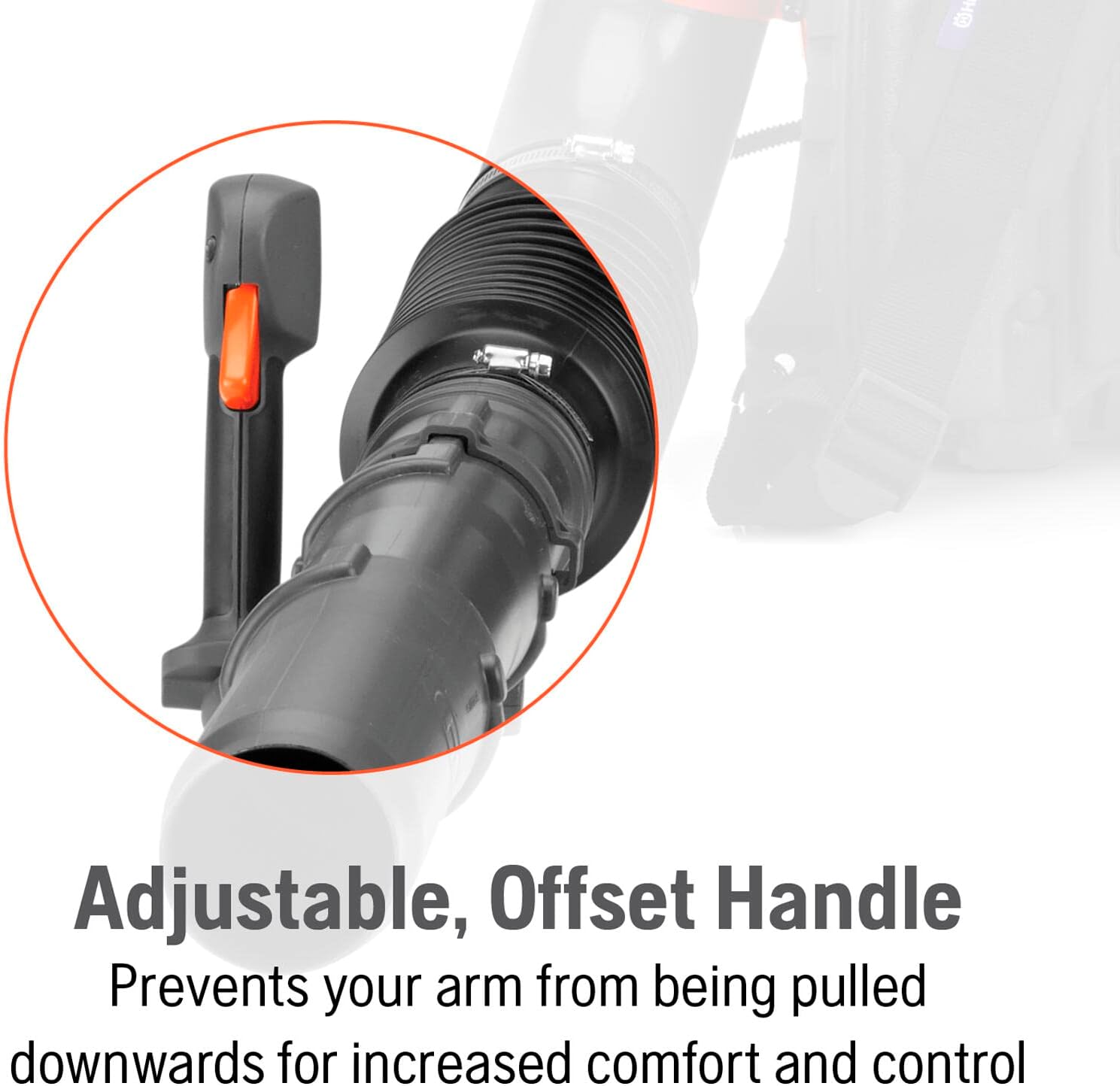
The round nozzle and the 2.6 inch tube are designed for volume and reach. The offset, adjustable handle sets the angle so you can sweep without bending your wrist. I haven’t used this blower myself, so these are findings from the sources I read. If you’re comparing options, the current Amazon listing shows what’s bundled.
⛽ Fuel, Runtime, and the Warranty Program
A gas blower’s “runtime” comes from its tank, and the 350BT’s 1.25 liter tank is its main practical advantage over a cordless backpack. Husqvarna lists fuel consumption at 455 g/kWh. At the engine’s 1.6 kW rating, that works out to about 0.73 kg of fuel per hour at full power. A full tank holds roughly 0.9 kg of petrol, so the theoretical figure is a bit over an hour at full throttle, and longer at lower speeds or with cruise control. That’s my arithmetic from Husqvarna’s numbers, not a test result.
Owners tell a mixed story. One review says a full tank lasts for hours, while a comparison site summarizes reviews with complaints about heavy fuel use at full throttle. That fits the math: fuel use rises quickly at full power, so settle on the lowest speed that does the job.
Fuel mix
This is a 2-cycle engine, so it needs petrol mixed with 2-cycle oil. I didn’t find the mixing ratio on Husqvarna’s US product page, so check the owner’s manual or the label on the machine, and use a good quality 2-cycle oil made for air-cooled engines. Stale fuel is the most common cause of hard starting, so mix small batches and don’t leave fuel in the tank over the winter.
How the warranty program works
The base warranty is 2 years. Husqvarna’s US extended program can lift that for homeowners, but only if you follow its steps:
| Option | Coverage | What you must do |
|---|---|---|
| Standard | 2 years | Nothing extra; keep the receipt |
| Oil route | 3 years | Buy at least 6 bottles of Husqvarna 2-stroke oil on the same receipt, then register online |
| Fuel route | 5 years | Buy at least 96 fl oz of Husqvarna pre-mixed fuel on the same receipt, then register online |
Registration must be completed within 30 days of purchase with a copy of the receipt. The program is for personal, household use only. Commercial, rental, industrial and agricultural use is excluded. Details come from Husqvarna’s US program page and can change.
Plan for this before you buy, since the extra fuel or oil has to be on the same receipt as the blower. If you’re a professional, expect the 2-year coverage. If you’re shopping on Amazon, ask whether the seller can meet the receipt rule before relying on the 5-year figure. On cost, check the Amazon listing for what the seller includes.
⚖️ Weight, Noise, Harness, and Real-World Use
Weight, harness, and controls
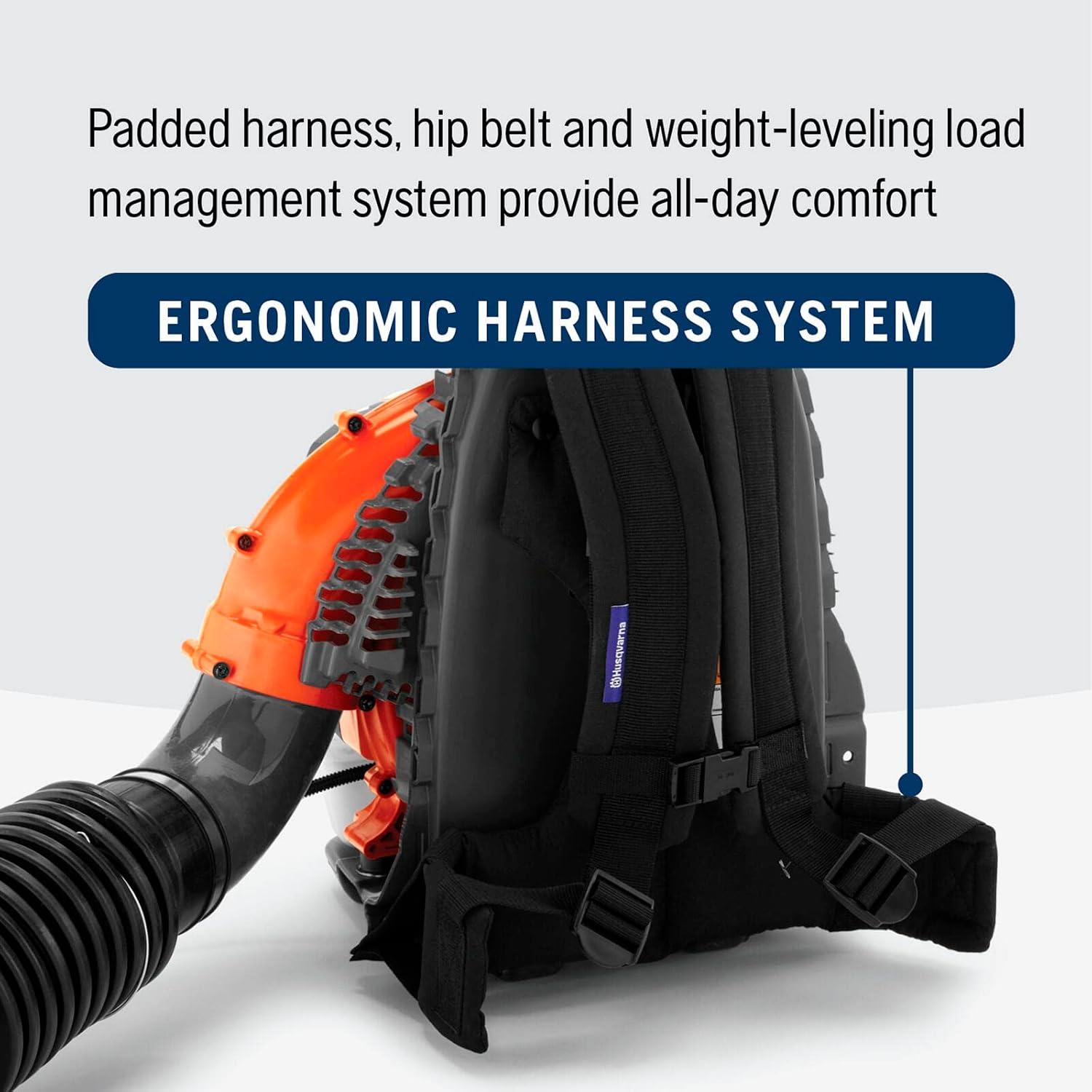
The listed weight is 22.5 lb, and the 1.25 liter tank adds about 2 lb when full (my estimate). Husqvarna’s harness is integrated, with padding, a hip belt and a weight-leveling system, and the reviewers I read praise it for spreading the load across the shoulders and hips. The handle is offset and adjustable, and the tube length adjusts so you don’t have to stoop. The throttle is mounted on the tube and has variable speed with an optional cruise control, which reduces trigger fatigue on long runs.
Two small points. One review notes the blower can’t be switched between right-handed and left-handed use. A comparison site’s summary also lists complaints about tube fit and the position of the fuel filler.
Noise and vibration
Husqvarna measures 94 dB(A) at the operator’s ear and 71 dB(A) at 15 meters. That’s loud, and hearing protection is the sensible choice. A reviewer calls it quieter than the loudest gas blowers, which can reach 112 dB, but it’s well above the 81 to 83 dB at the ear that Pro Tool Reviews measured on the cordless EGO LBPX8000. Check your local noise rules too. Handle vibration is rated at 2.2 m/s², and the LowVib system is designed to reduce hand and arm strain.
Emissions and starting
The X-TORQ engine is designed to cut exhaust and fuel use compared with older two-stroke designs, with air purge to help cold starts. Husqvarna’s sheet lists CO of 283 g/kWh under the EU method and 536 g/kWh under the EPA method. It’s still a petrol engine, so you get exhaust at the tool, which matters if you work around people or in tight spaces. Reviewers say it starts easily, even cold.
What the numbers suggest, by job
These are reasoned from the specifications and sources above, not from my own testing.
- Large lawns with heavy leaf fall: the tank and cruise control suit long sweeps, and you’re not watching a battery gauge.
- Dry leaves and debris on hard surfaces: 180 MPH and 21 N are enough to move them quickly.
- Wet, matted leaves: some reviewers find it limited. A stronger blower or a cordless backpack with turbo may do better.
- Mulching or vacuuming: not possible, since there’s no vacuum kit.
- Noise-sensitive neighborhoods: 94 dB(A) at the ear means a cordless blower is the easier choice.
🛠️ Maintenance and Troubleshooting Basics
Gas power means upkeep, which is the biggest practical difference from a cordless tool. This table summarizes what the sources suggest, and the owner’s manual has the exact intervals, so check it before you rely on my summary.
| Item | What to do | When |
|---|---|---|
| Air filter | Check before each use, and clean or replace when dirty. One reviewer recommends checking it regularly, and it’s a sensible first check if power drops | Before each use |
| Spark plug | NGK CMR7H, gap 0.7 mm. A power drop or hard starting is a reason to inspect it | Regularly; replace as needed |
| Fuel | Use fresh mixed fuel, and don’t leave it in the tank over long storage | Every season |
| Blower tube and fan housing | Clean out debris so airflow stays strong | As needed |
| Professional service | A dealer service helps with carburetor and engine checks; Husqvarna says warranty claims must be examined by a dealer | Yearly, or when problems appear |
A frequent theme in owner reports of power loss is fuel or air supply: stale fuel, a dirty filter or a carburetor that needs attention. A comparison site collects reports of knocking and power loss after about 10 minutes at full throttle, and Husqvarna’s manual and dealer network are the right place to take that kind of problem. I can’t say how common it is from the sources I read.
⚔️ Gas or Cordless: How the 350BT Compares
Because this site focuses on cordless blowers, the useful question is how the 350BT compares with the best cordless backpack I’ve covered. The table below uses the EGO LBPX8000 as the example, and mixes manufacturer figures with tested ones, so read it as a guide.
| Factor | Husqvarna 350BT (gas) | Cordless backpack example |
|---|---|---|
| Force (rated) | 21 N | 26 N for the EGO LBPX8000; Pro Tool Reviews measured 27.9 N in turbo |
| Noise at the ear | 94 dB(A) | 81 dB on high and 83 dB in turbo (Pro Tool Reviews, EGO LBPX8000) |
| Weight | 22.5 lb listed, plus fuel | 16.3 lb for the LBPX8000 tool with its tube, plus batteries (about 23 to 28 lb by my estimate) |
| Runtime | A full tank, with refueling in a minute | About 25 to 37 minutes on 7.5Ah pairs (EGO LBPX8000, tested) |
| Fuel and upkeep | Mixed fuel, spark plug, air filter, carburetor | Charging, and batteries to replace eventually |
| Starting | Prime and pull, with air purge to help | Squeeze the trigger |
| Exhaust | Yes | None at the tool |
| Price | $429.99 MSRP | $399 and up for the bare LBPX8000, plus batteries |
Noise at the operator’s ear (dB(A)); lower is quieter
The cordless backpack matches or beats the 350BT on rated force, noise and weight, and costs more once you buy batteries. The gas blower’s real advantages are runtime and a lower starting price. If you blow for hours without a break, the 350BT is simpler. If your sessions are shorter, or you want less noise and no fuel, a cordless model fits better. See my EGO LB7654 review for a single-battery handheld and my EGO Commercial LBX6000 review for a cordless commercial option.
🥊 Husqvarna 350BT vs ECHO PB-580T
The closest rival most buyers cross-shop is the ECHO PB-580T. The figures below come from a comparison site that says compensation can affect its placement and scores, so I use only its spec table, and I’d verify them with the manufacturers.
| Spec | Husqvarna 350BT | ECHO PB-580T |
|---|---|---|
| Air speed | 180 MPH | 215 MPH |
| Airflow | 494 CFM (pipe) / 692 CFM (housing) | 510 CFM |
| Weight | 22.5 lb | 20.5 lb |
| Fuel tank | 42.27 fl oz | 62 fl oz |
| Adjustable handles | Yes | No |
| Warranty | 2 years (up to 5 with the program) | 5 years |
The same site names the ECHO its “Best Pick,” though it gives no written reasoning. It reports owners praising the ECHO’s quiet running and wet-leaf power, and it reports that both models draw complaints about stalling after about 10 minutes at full throttle. The 350BT’s advantages in that comparison are higher airflow, adjustable handles and a larger share of positive reviews on coverage. I couldn’t independently confirm these figures, so check the specs before you buy.
🧰 Getting the Most From the 350BT
These tips come from Husqvarna’s documents and the reviews behind this page. They aren’t my own hands-on advice.
- Wear hearing protection. At 94 dB(A) at your ear, a long session without it is a bad idea.
- Use cruise control for long passes. It holds your speed and saves your trigger hand.
- Use the lowest speed that works. Fuel use climbs quickly at full throttle, and reviewers who complain about thirst are running it hard.
- Mix fresh fuel in small batches. Stale fuel is a common cause of hard starting and power loss.
- Check the air filter before each session. A dirty filter is one of the first things to check when power drops.
- Adjust the harness and tube before you start. Set the handle angle and tube length at home so the load sits on your hips.
- Plan the warranty on the day you buy. The 5-year option needs 96 fl oz of Husqvarna pre-mixed fuel on the same receipt and online registration within 30 days.
⭐ Owner Feedback, Pros and Cons
Owner feedback for this model is scattered, and I couldn’t find a large review pool I could verify. The Lowe’s page I read showed no ratings, one review site shows a single 5-star review, and a reader-supported review site rates the blower 4.6 out of 5 after some hours of use, with feedback drawn from other online reviews. Across those sources, owners praise the power, easy starting, the comfortable harness and the large tank. The recurring complaints are noise, fuel use, price, trouble with wet leaves, and a smaller number of reports of power loss at full throttle. Because the review pool is thin, I give these themes less weight than a bench test.
The points below are my analysis of the specs and sources above:
- 180 MPH and 21 N of rated force, with 494 CFM at the pipe
- Large 1.25 liter tank, so no battery limits
- Padded harness with hip belt and weight-leveling system
- Variable throttle with cruise control, and an offset adjustable handle
- Air purge starting aid and a reputation for easy starts
- LowVib vibration damping at 2.2 m/s²
- X-TORQ engine designed to use less fuel and cut exhaust
- 94 dB(A) at the operator’s ear, with exhaust fumes
- Fuel mixing and regular engine upkeep
- Some reports of power loss or knocking at full throttle, and heavy fuel use
- Struggles with heavy, wet leaf piles according to some reviewers
- No vacuum kit, and the handle can’t be switched for left-handed use
- 2-year base warranty, with a conditional program for 3 or 5 years
- No independent bench test found
🧪 What Reviewers Found
This is a gap worth knowing about. Unlike the cordless models on this site, the 350BT hasn’t been bench-tested by the labs I rely on, so the figures here are manufacturer ratings and informal reviews.
| Source | Score | Notes |
|---|---|---|
| Home Grail | 4.6 out of 5 | Reader-supported review after some hours of use. Praises power, harness and starting, and lists price and no vacuum function as the cons |
| Toolstash | 5.0 from one review | A single first-person review. It notes difficulty with heavy wet leaves and the 94 dB(A) noise, and it advises ear protection |
| Lowe’s | No reviews shown | The product page I read had zero ratings |
| Independent bench test | None found | I found no published force, runtime or noise measurement by a third-party lab for this model |
I’ll update this page if a bench test appears.
🎯 Who Should Buy It
Buy it if:
- You have a large yard and want a gas backpack with a big tank
- You want runtime that’s limited by fuel, not batteries
- You’re comfortable mixing fuel and doing basic engine upkeep
- You can use the residential warranty program
Skip it if:
- You want a quiet, no-fuel tool. Look at the EGO Commercial LBX6000
- You have a small to mid-size yard. Look at the EGO LB7654
- You need a vacuum or mulching function
- Your leaves are mostly heavy and wet
❓ Husqvarna 350BT FAQ
Is the Husqvarna 350BT a cordless blower?
No. It’s a gas backpack blower with a 50.2 cc X-TORQ two-stroke engine. I cover it here as the gas benchmark that cordless backpack blowers are measured against.
How powerful is the Husqvarna 350BT?
Husqvarna rates it at 2.1 hp, 180 MPH and 21 N of blowing force, with 494 CFM at the pipe and 692 CFM in the housing. I found no independent bench test of its force.
Why do some listings say 494 CFM and others 692 CFM?
Husqvarna publishes both numbers for the same blower. 692 CFM is the airflow in the housing, and 494 CFM is the airflow at the nozzle and in the pipe. Use 494 CFM when comparing with other blowers.
How loud is the 350BT?
Husqvarna lists 94 dB(A) at the operator’s ear, 104 dB(A) sound power and 71 dB(A) at 15 meters. Wear hearing protection and check your local noise rules.
How heavy is the 350BT?
Husqvarna lists 22.5 lb. A full 1.25 liter tank adds roughly 2 lb by my estimate, and one reviewer cites 26 lb.
How long does a tank of fuel last?
Husqvarna doesn’t publish a runtime. From its fuel consumption figure, a full tank gives a bit over an hour at full power in theory, and longer at lower speeds. Reviewers report anything from long runtimes to heavy fuel use at full throttle.
What warranty does the 350BT have?
The base warranty is 2 years. Husqvarna’s US program for residential buyers can extend it to 3 years with six bottles of Husqvarna 2-stroke oil, or to 5 years with at least 96 fl oz of Husqvarna pre-mixed fuel, bought on the same receipt and registered online within 30 days. Commercial use is excluded.
Does the 350BT work as a vacuum?
No. It doesn’t come with a vacuum kit and isn’t designed for vacuuming or mulching.
Is it good for wet leaves?
It handles dry leaves and several inches of leaf cover well, according to reviewers. Some say it struggles with heavy, wet piles, so a stronger or turbo-equipped blower may suit that job better.
Should I buy a gas or a cordless backpack blower?
Choose gas if you blow for hours without a break and want the lowest starting price. Choose cordless if you want less noise, no fuel and no exhaust. A top cordless backpack such as the EGO LBPX8000 now matches the 350BT’s rated force, but it costs more once you buy batteries.
🏆 Final Verdict
The Husqvarna 350BT is a solid gas backpack for people who want a big tank, a comfortable harness, and a blower that doesn’t care how long the job takes. Its rated 21 N and 180 MPH are plenty for dry leaves on a large lawn, and it’s easy to start. What holds it back is noise, upkeep and the usual limits of a petrol engine, plus a thin pool of independent testing.
If you have a big yard and prefer gas, it’s a sensible buy. If you want quiet, no-fuel operation, a cordless backpack is now a real alternative. If it fits how you work, you can check the latest price, the exact model number, and what other buyers say on Amazon.
Specs and availability change. Check the Amazon listing for current details.
📸 Husqvarna 350BT Photos
Click to see full view

📚 More Blower Reviews
EGO Commercial LBX6000 56V Backpack Blower: Specs & Pros
A cordless commercial option that runs from a backpack battery.
EGO LB7654 56V Cordless Leaf Blower: Specs, Pros & Cons
A 765 CFM cordless handheld for big yards and wet leaves.
EGO LB5302 56V 530 CFM Leaf Blower: Specs, Pros & Cons
A lighter 530 CFM EGO kit for small to mid-size yards.
DEWALT DCBL722B 20V MAX XR Blower: Specs, Pros & Cons
A cordless handheld for DEWALT 20V MAX owners.
✅ Before You Buy: Quick Checklist
A few details vary by seller, so it’s worth a minute on the listing to confirm:
- The model number: 965877502 is the US model, and an “R” means reconditioned
- New or used: confirm the unit is new and sold by an authorized seller
- Fuel and oil: the blower ships dry, so buy 2-cycle oil and fresh fuel
- The warranty plan: the 5-year option needs Husqvarna fuel on the same receipt and registration within 30 days
- Hearing protection, current price and availability
Affiliate Disclosure: BestLeafBlowerCordless.com is a participant in the Amazon Services LLC Associates Program, an affiliate advertising program designed to provide a means for sites to earn advertising fees by advertising and linking to Amazon.com. As an Amazon Associate, we earn from qualifying purchases.