HTK Gas Backpack Leaf Blower Review: 63CC, 665 CFM, 205 MPH Specs, Pros & Cons
As an Amazon Associate, I earn from qualifying purchases at no extra cost to you.
⚡ Overview: A Budget 63cc Gas Backpack Blower
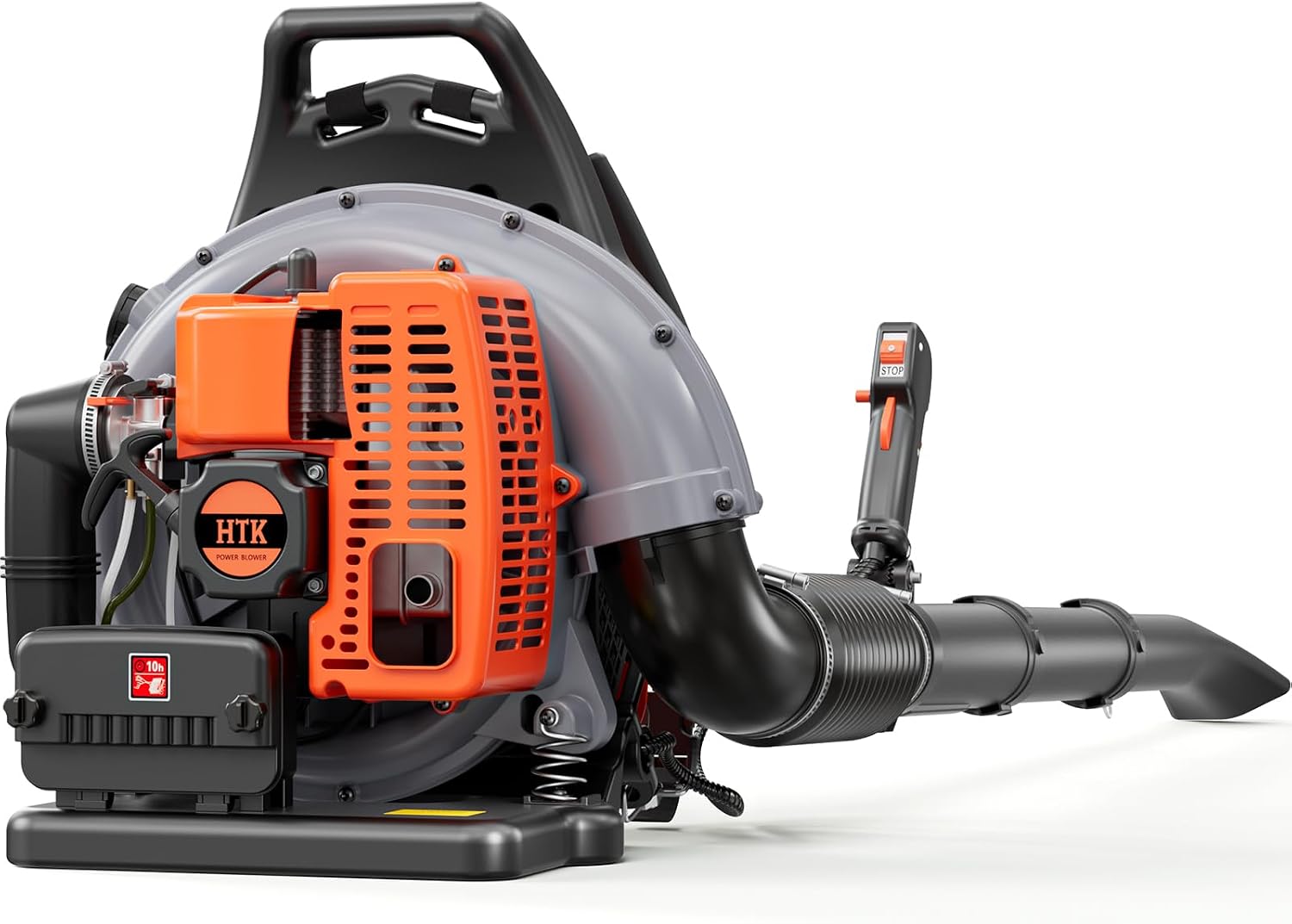
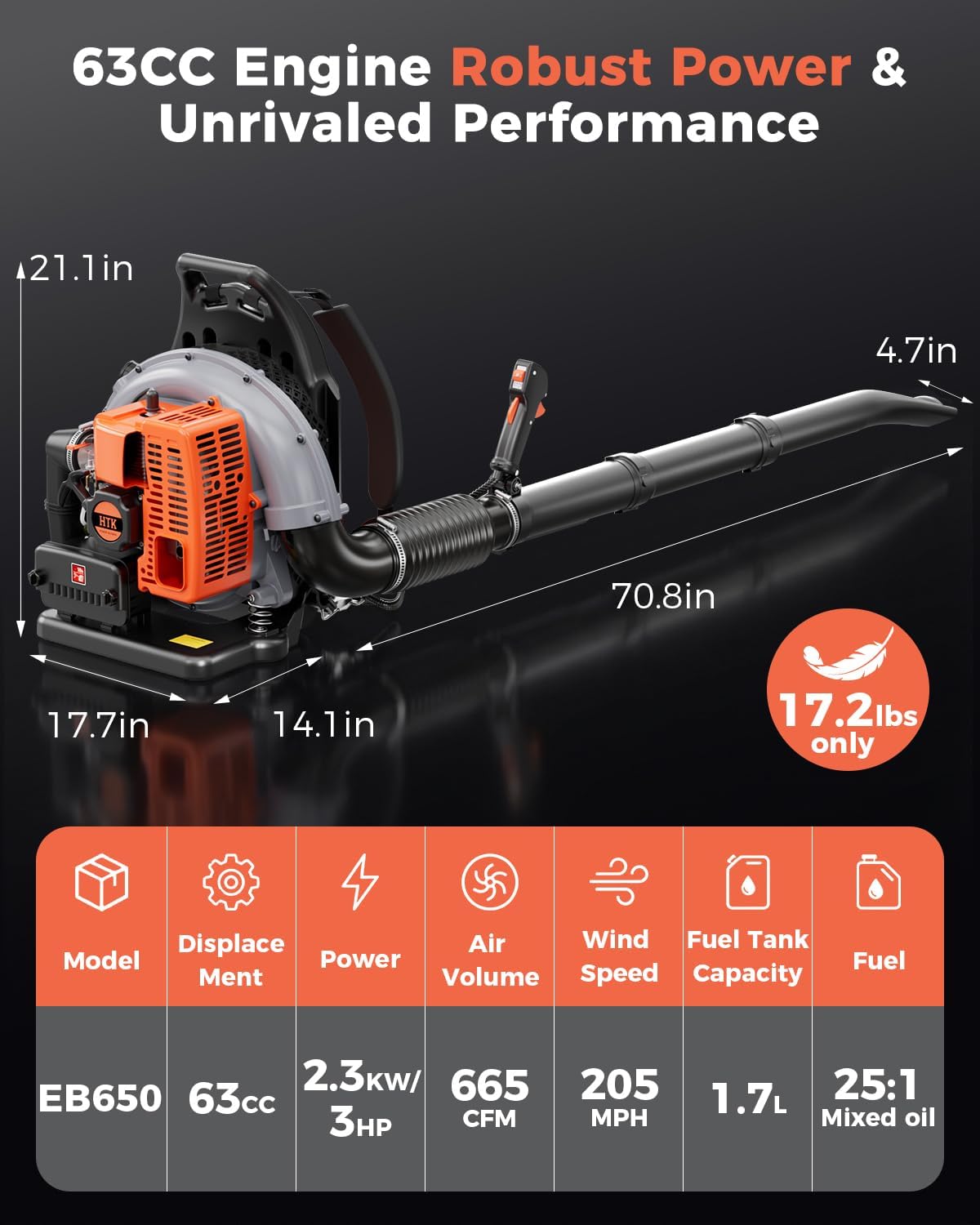
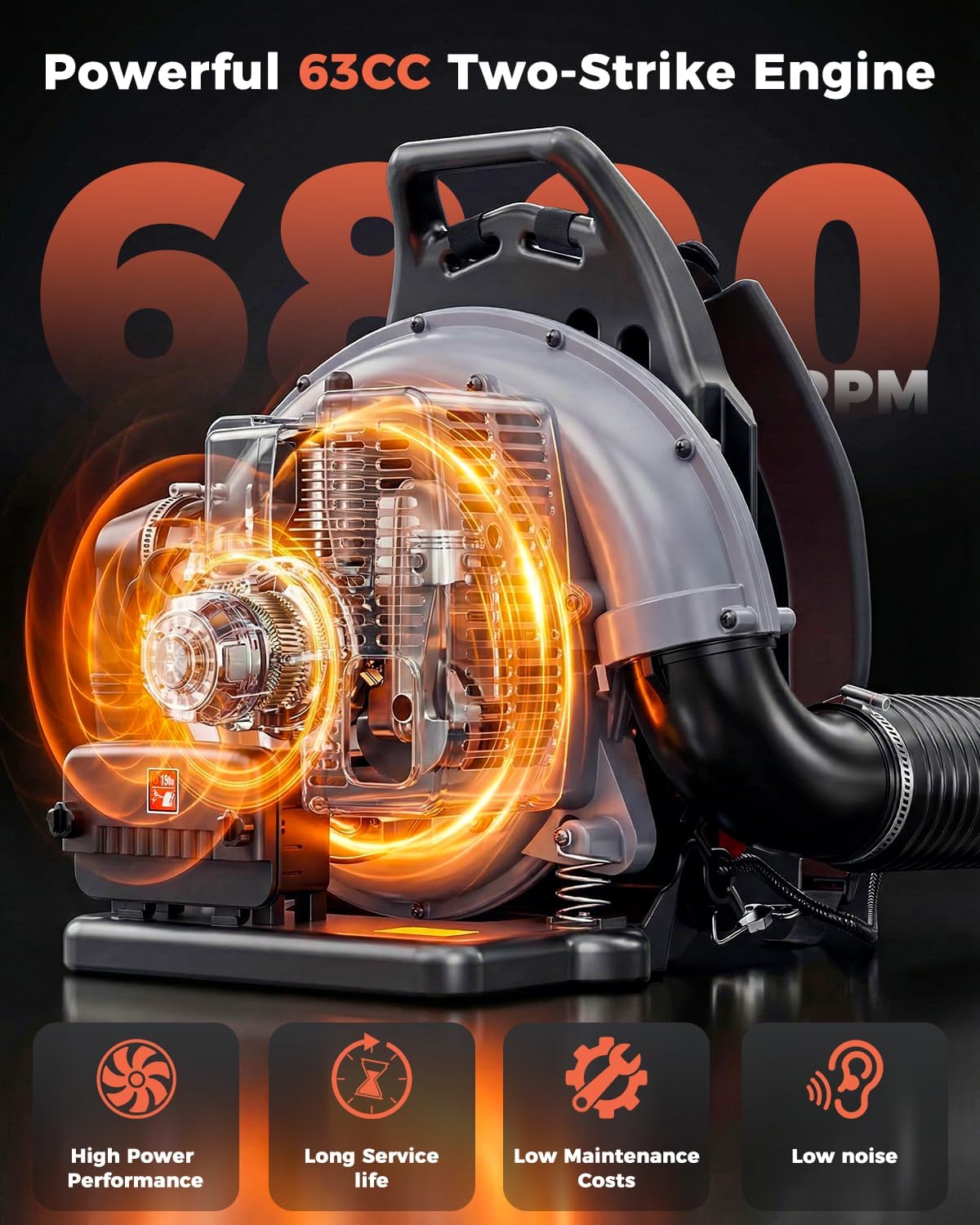
The HTK gas backpack leaf blower is a 63cc two-stroke, air-cooled backpack blower sold on Amazon. HTK rates it at 665 CFM and up to 205 MPH. It has a 1.7 L fuel tank, an air-purge primer to make pull-starting easier, a variable-speed throttle with cruise control, and a fully padded harness. The newest listing, labeled the HTK 650, also states a 71 dB sound level, and the manual and a blower tube are included.
Because this site is about cordless blowers, here’s the key point up front: this is a gas machine. It runs on mixed fuel, makes engine noise and exhaust, and needs two-stroke upkeep, but it has no battery to charge and no runtime limit beyond the tank. It also belongs to a crowded family. Several other Amazon brands sell a 63cc backpack blower with nearly identical specs, and their claims differ, so I treat every number on this page as a seller claim until someone measures it.
I found no independent test of the HTK, no published blowing force, and no manufacturer website with a manual, so this review is built from HTK’s Amazon listings, spec sheets for the same-platform blowers sold by other brands, roundups, owner comments and test data for established brands. I haven’t tested it myself.
Check the listing for the exact version, the seller, and what’s included
It can be, if you want a low-cost gas backpack blower for a large yard and you accept the unknowns. The specs are big for the price class: 63cc, 665 CFM claimed, cruise control, air-purge starting and a padded harness. But nobody has published a force measurement, the noise claim (71 dB) conflicts with 101 dB(A) on a same-platform spec sheet, and the fuel-mix advice varies, so you have to follow the manual. Choose a cordless backpack like the EGO LBPX8000 if you want tested power without fuel, or an established gas brand if you want proven support.
Verdict Summary
Best for big yards on a budget where gas is still allowed
- Best for: homeowners with a large, leafy lot who want a gas backpack blower at a budget price and don’t mind mixing fuel
- Standout strength: a large 63cc engine, a padded harness, cruise control and air-purge starting, with no battery or runtime limit
- Biggest weakness: no independent test, conflicting noise and fuel-mix figures, and a weight of 17 lb or more before fuel
- Skip it if: you want a cordless, quiet tool, live where gas blowers are restricted, or need proven commercial durability and service
Score basis: raised by the engine size for the price, the comfort and control features, and the lack of a runtime limit; lowered by the missing independent data, unclear warranty and support, noise and weight, and spec claims that differ between near-identical blowers. It’s an editorial judgment, not a lab score, and it isn’t based on hands-on testing.
📊 Full Specifications
Core specs (as claimed)
| Spec | Value | Source |
|---|---|---|
| Brand and model | HTK. The newest listing is labeled the HTK 650 | HTK Amazon listings |
| Engine | 63cc, single-cylinder, two-stroke, air-cooled | HTK listings |
| Power and engine speed | 3.0 HP (2.3 kW) rated, idle 2,800 rpm and maximum 6,800 rpm on a same-platform spec sheet from another seller | Powuse spec sheet; not confirmed by HTK |
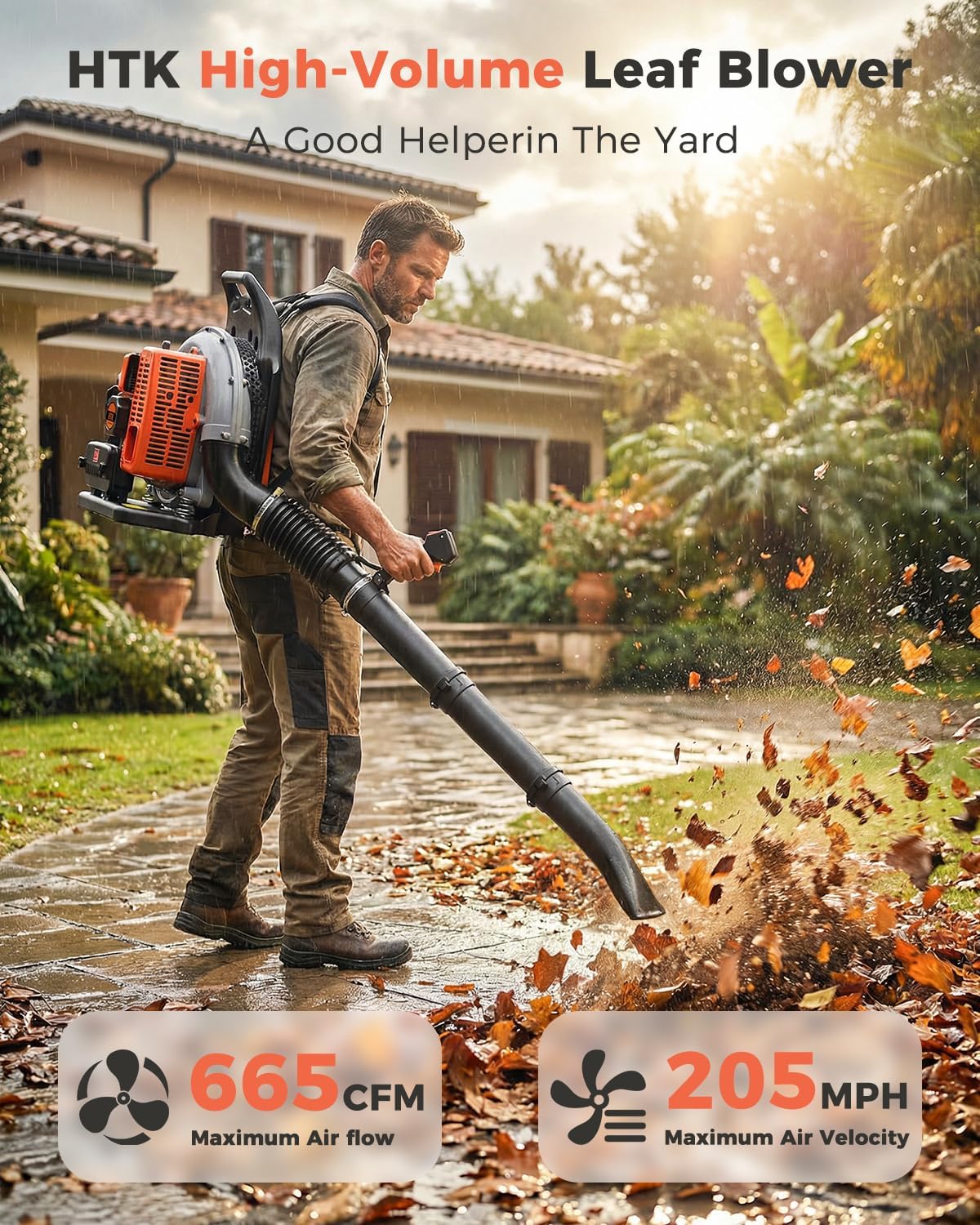
| Air volume | 665 CFM | HTK listings (unverified) |
| Air speed | Up to 205 MPH | HTK listings (unverified) |
| Blowing force | Not published. I found no independent measurement | None found |
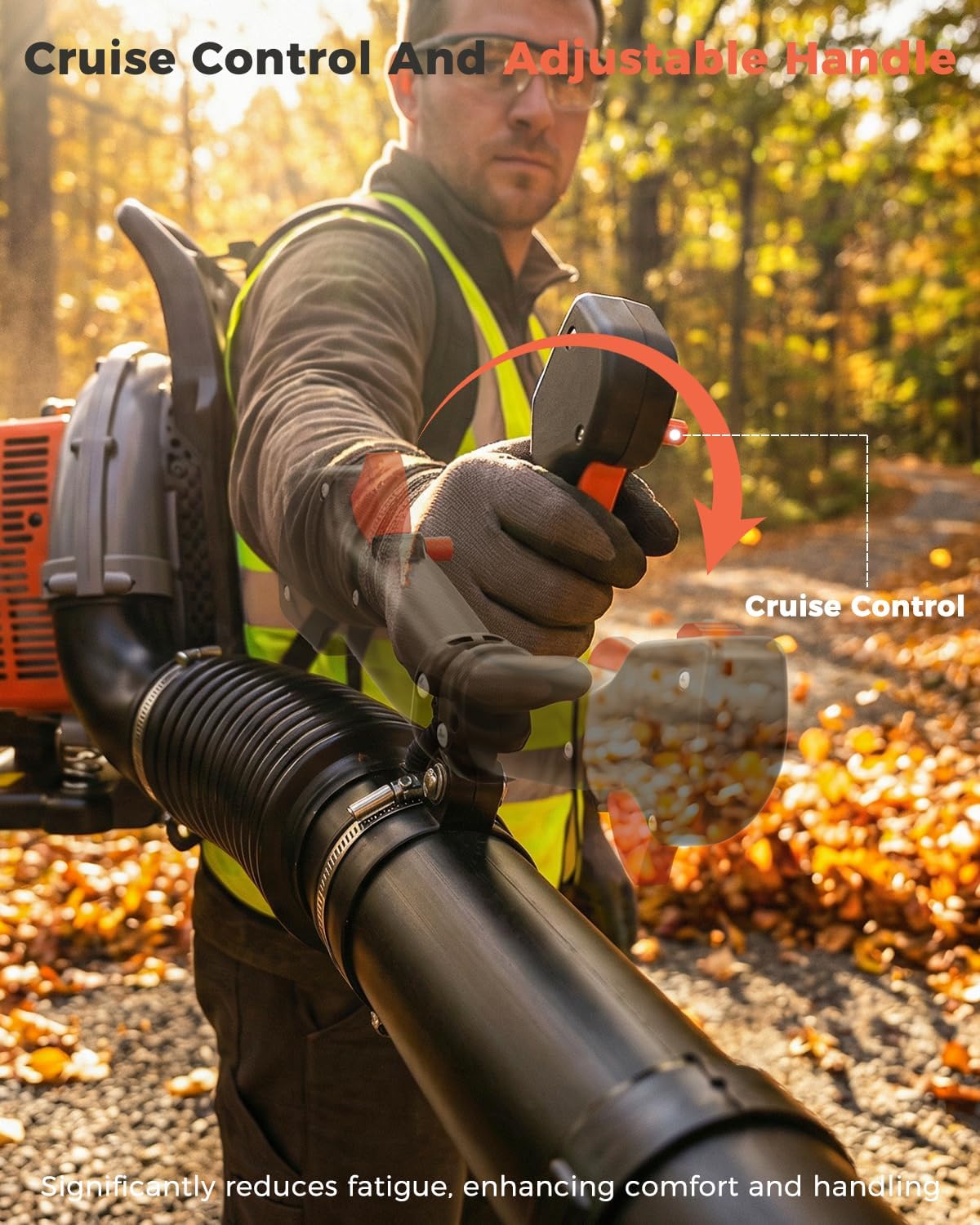
| Controls | Variable-speed throttle with cruise control | HTK listings |
| Starting | Air-purge primer plus recoil pull start | HTK listings |
| Fuel tank | 1.7 L (about 57 fl oz, or 0.45 US gallon) | HTK listings |
| Fuel mix | Listings say 25:1 during break-in, with 40:1 and 50:1 supported afterward. A video tester says the manual calls for 25:1 | HTK listings; video; see below |
| Weight | 17 lb listed, or 18.25 lb with fuel in the tank per one listing. A roundup lists 21 lb | HTK listings; roundup |
| Size | About 17.7 × 14.1 × 21.2 in | HTK listing |
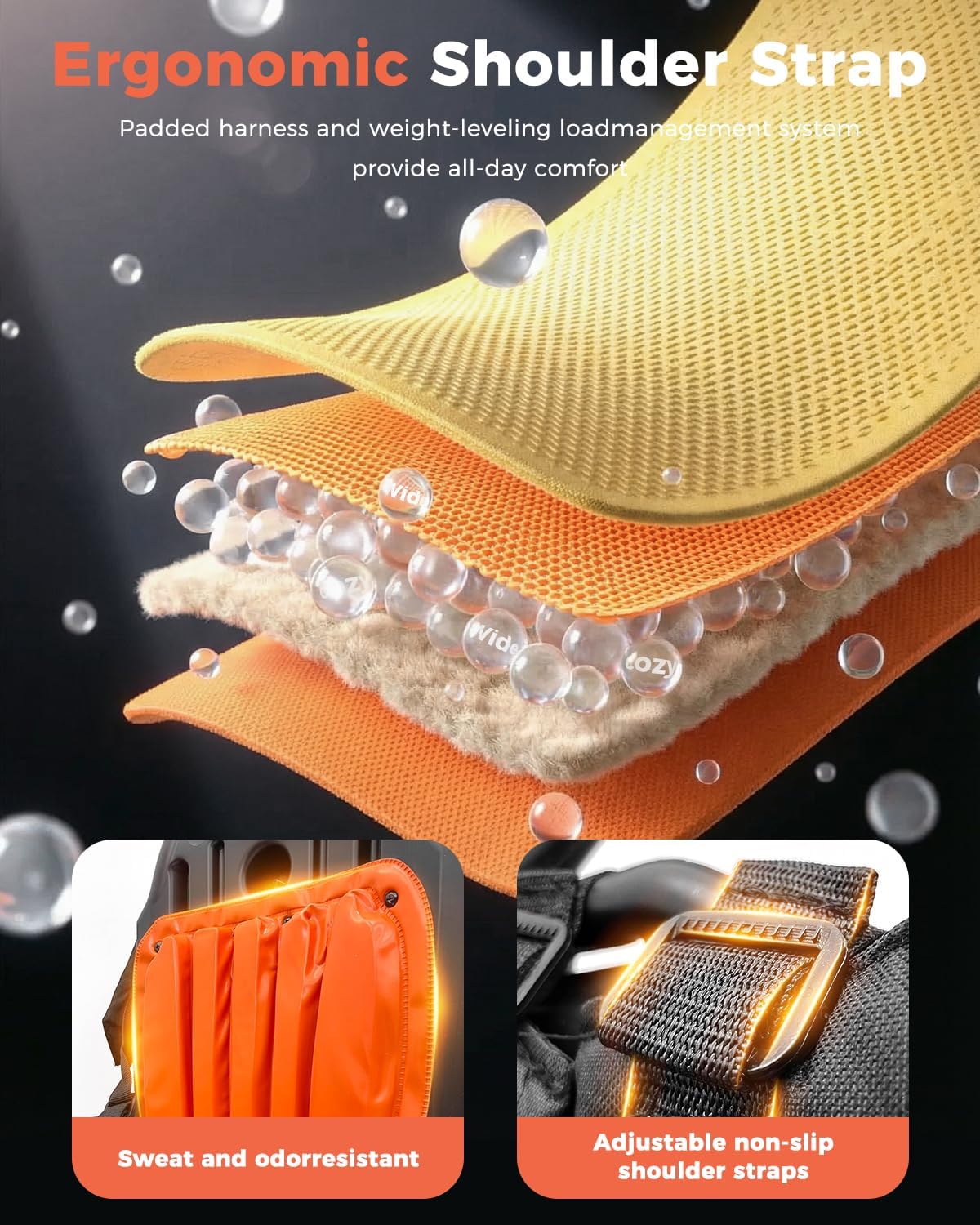
| Harness and fit | Fully padded backpack harness, adjustable tube length on older listings, anti-vibration mounts claimed | HTK listings |
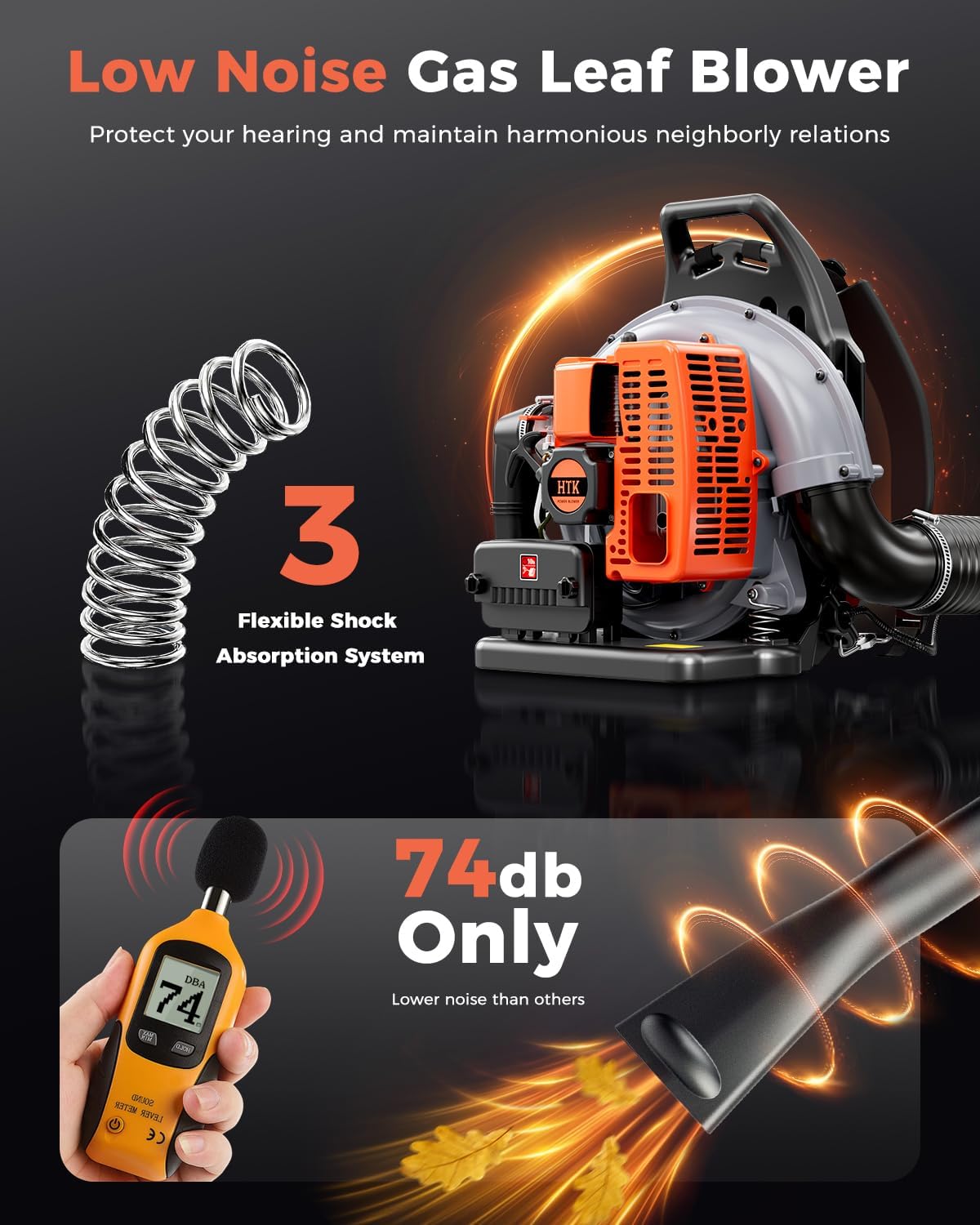
| Noise | 71 dB stated on the newest listing. A same-platform spec sheet lists 101 dB(A) | HTK listing; Powuse spec sheet |
| Weather protection | No rating. Treat it as a dry-conditions tool | None found |
| Warranty | Not stated on the HTK listings I read. A same-platform seller lists a 1-year service warranty | Powuse (other seller) |
Figures that vary by source or region
These are the numbers where sources disagree or leave something out. I show each one instead of picking a winner.
| Spec | What sources say | Why it differs |
|---|---|---|
| Noise | 71 dB on HTK’s newest listing. 101 dB(A) on a spec sheet for a blower with the same 63cc, 665 CFM and 205 MPH specs | A 71 dB reading at the operator’s ear would be unusually low for a 63cc two-stroke, so it may be a distance figure. No method is stated |
| Weight | 17 lb (HTK listings), 18.25 lb with fuel (one listing), 21 lb (a roundup), 19.8 lb with a full tank (a different brand’s 63cc) | Different configurations and measuring conditions |
| Fuel mix | 25:1 recommended for break-in, 40:1 or 50:1 afterward (listings). A video says the manual calls for 25:1. A different brand’s Q&A says always 50:1 | Brands differ. Use your own manual’s ratio |
| Included parts | Blower tube and manual (newest listing), extension nozzle and manual (older listings) | Different listings and revisions |
| Same specs, other brands | Other sellers list 63cc blowers at 665 CFM and 205 MPH, 636 CFM, and 850 CFM at 200 MPH | Engine size alone doesn’t fix the airflow, so these claims aren’t comparable |
| Price | Varied widely between listings and sellers | Seller pricing and date; I can’t confirm when each was posted |
💨 Power and Airflow: Reading 665 CFM and 205 MPH
CFM and MPH sell blowers, but blowing force in newtons says more about how one handles a heavy pile, and no force figure exists for the HTK. HTK rates it at 665 CFM and 205 MPH, which are maximums from the seller. Here is how I’d read them.
Engine size isn’t airflow
A 63cc engine sounds big next to a 51cc Husqvarna, but displacement doesn’t set the airflow. Fan design, housing and nozzle matter just as much. A Husqvarna 150BT has a smaller 51cc engine and is rated at 765 CFM and 270 MPH in the roundups I read, and Echo’s 79.9cc PB-9010T is rated at 1,110 CFM and 220 MPH. Meanwhile, other white-label 63cc blowers claim anything from 636 to 850 CFM. That spread is why I wouldn’t treat 665 CFM as a measurement.
What tested blowers show
Pro Tool Reviews found that even strong battery blowers in the 765 to 800 CFM range measured roughly 20 to 28 N in turbo, such as the EGO LB7654 at 25.3 N and the EGO Commercial LBPX8000 backpack at 27.9 N in turbo. STIHL rates its BR 430 gas backpack at 26 N and its BG 86 gas handheld at 15 N. A listing for the Husqvarna 150BT gives 22 N. The HTK has no figure at all, so I can’t place it on that scale.
What the listings promise
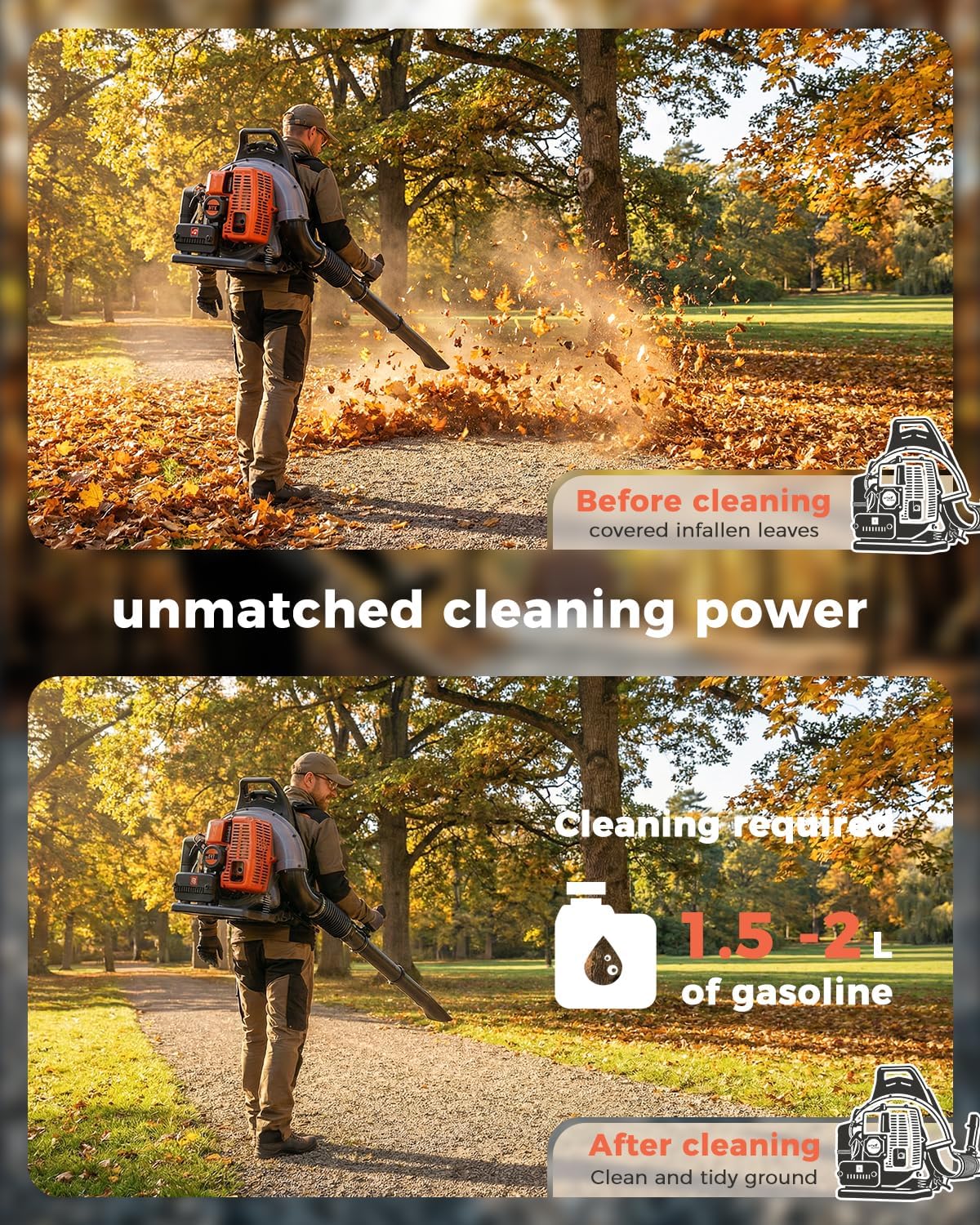
HTK’s copy talks about wet leaves, snow and heavy debris. A backpack blower with a big engine and a wide tube can do that, but I couldn’t verify it for this model. Roundups that praise its power repeat the listing’s wording and don’t give measurements, so I treat them as marketing. If you’re comparing options, the current Amazon listing shows what’s bundled.
🔑 Starting, Controls, and Break-In
I couldn’t find HTK’s manual online, so this section is general guidance for a two-stroke backpack blower with an air-purge primer, not a quote from HTK. Follow the manual that ships with yours where it differs.
- Fuel and start the engine outdoors, on level ground, away from sparks and open flames. Mix the fuel in a clean container at the ratio your manual gives.
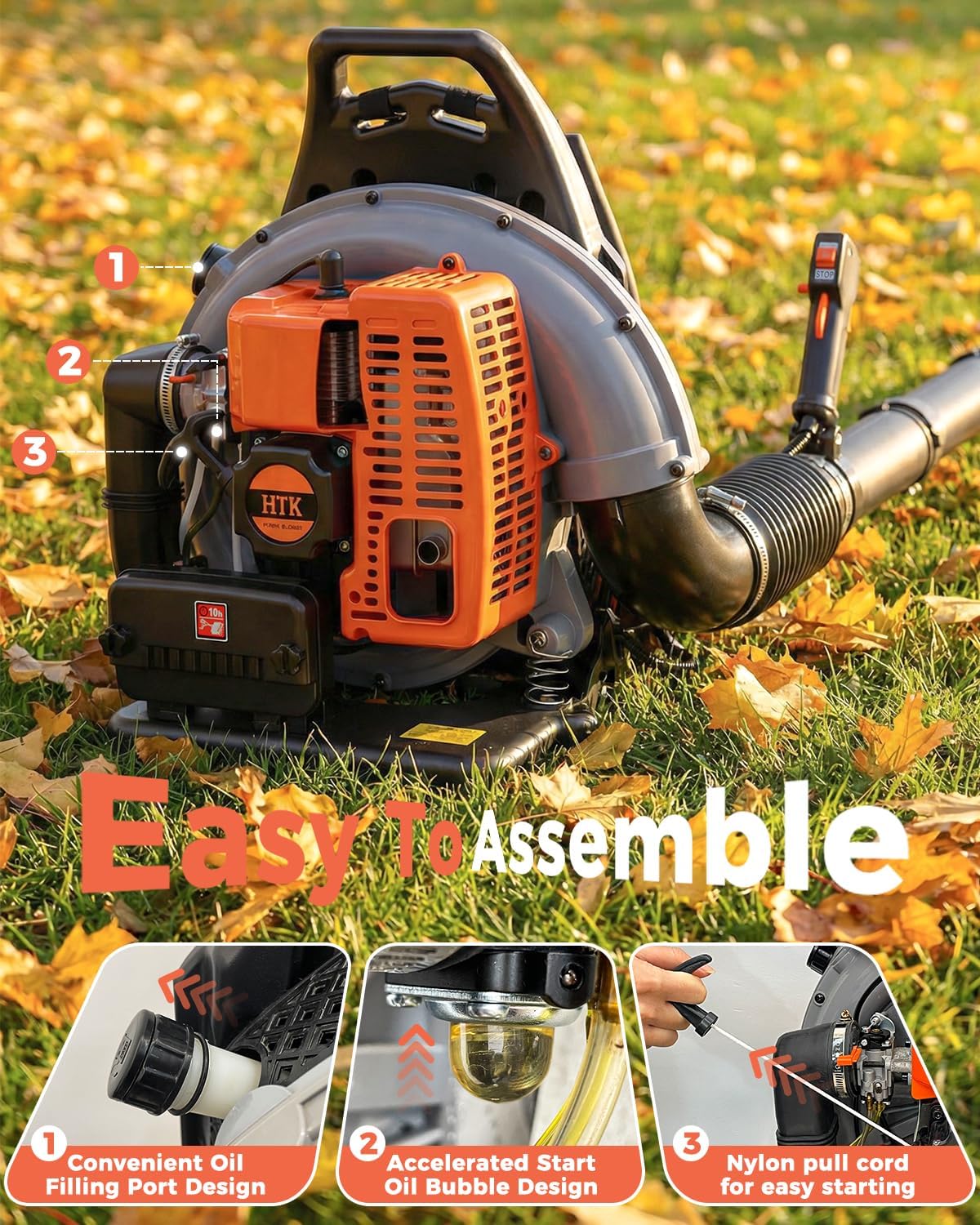
- Press the air-purge bulb several times until fuel is visible moving in the lines. This is what the listings call the air-purge system, and it’s meant to cut the number of hard pulls.
- Set the choke for a cold engine as your manual describes, and set the throttle for starting.
- Pull the starter cord firmly, and don’t let the handle snap back. Once the engine fires, move the choke to run and let it settle at idle.
- Use the variable-speed throttle for control. Cruise control holds a speed so you don’t have to keep the trigger squeezed.
- To stop, return the throttle to idle and switch the engine off. Let it cool before refueling.
Break-in, from the sellers’ notes
Listings for this platform say a new engine needs a break-in period. They recommend a 25:1 fuel mix of gasoline (90 octane or higher) to two-stroke oil, and running at medium speed while avoiding the lowest and maximum settings. After break-in, they say 40:1 or 50:1 mixes are also suitable. These notes come from HTK’s and other sellers’ listings, not a manual I could read, so confirm them against yours.
⛽ Fuel, Mixing, and What You’re Buying Into
With no battery to size, the 1.7 L tank sets your working time between refills. HTK doesn’t publish a runtime per tank. One roundup says “several hours” depending on use, which I can’t verify, and a same-platform spec sheet lists fuel consumption under about 545 g/kWh, which isn’t enough to calculate minutes. Plan on refilling as often as your throttle use demands.
| Topic | What to know |
|---|---|
| Mix ratio | Listings: 25:1 during break-in, then 40:1 or 50:1. A video tester ran 50:1 although he says the manual calls for 25:1. Another brand’s Q&A says always 50:1. The safe move is to follow the ratio printed in your own manual |
| Gasoline | Fresh gasoline of 90 octane or higher, per the listings |
| Oil | Use a good two-stroke oil, and measure it accurately. Small mistakes in small batches change the ratio a lot |
| Mixing | Mix in a clean approved container, not in the tank, and shake it before fueling (general practice) |
| Storage | Don’t leave mixed fuel in the tank for months. Use it up or drain it, and run the carburetor dry before long storage (general practice) |
| Smoke | Heavy smoke usually points to too much oil or the wrong oil, based on a similar-class 63cc manual |
Gas saves you the cost of batteries, but fuel, oil and upkeep are ongoing costs, and some areas restrict gas blowers. If you want a cordless backpack with tested force, look at the EGO LBPX8000, or compare the gas STIHL BG 86 if you only need a handheld. To see what you’d pay for the HTK, check the Amazon listing.
🛠️ Maintenance, Storage, and Troubleshooting
I couldn’t find an HTK manual, so the tables below are general two-stroke care, with troubleshooting causes taken from a manual for a similar 63cc blower from another brand. Follow your own manual where it differs.
| Item | What to do | When |
|---|---|---|
| Fuel system | Check for leaks at the cap, lines and primer bulb before each start, and don’t start the engine if you find one | Before each start |
| Air filter | Knock out or clean the filter. A dirty filter cuts power and makes starting harder | Regularly; sooner in dust |
| Spark plug | Inspect it, and replace it when worn or fouled. Check the type and gap in your manual | Seasonally |
| Cooling fins and inlet | Keep them clear of leaves and dust, since the engine is air-cooled | Before and after use |
| Fasteners, tubes and harness | Check screws, tube connections and strap buckles. One owner called the plastic tubes thin, so look for cracks | Before each use |
| Muffler | Don’t run with a damaged muffler, and let it cool before you touch it | Before each use |
| Storage | Store it dry and out of children’s reach, with the tank drained or the fuel fresh for long storage | Between uses |
Troubleshooting
| Symptom | What to check |
|---|---|
| Won’t start or hard to start | Similar 63cc manuals list: no fuel or the wrong mix, choke not set right, a fouled or loose spark plug, a dirty air filter, or the ignition switch off |
| Loss of power while running | Similar manuals list: a dirty filter, the wrong fuel mix, a spark plug issue or overheating. Let it cool and clean the filter and fins |
| Heavy smoke | Similar manuals list too much oil or the wrong type of oil. Drain and refill with the correct mix |
| Weak airflow (my inference) | Check the tube is fully seated, the inlet isn’t blocked, and the throttle isn’t set low by the cruise control |
| Cracked or loose tube (owner report, my inference) | One owner thought the plastic tubes looked thin. Replace a cracked tube before use, and ask the seller about spares |
⚖️ Weight, Noise, Safety, and Use by Job
Weight and handling
HTK’s listings give 17 lb, with one listing giving 18.25 lb with fuel in the tank, and a roundup lists 21 lb. Add fuel and the load rises. For comparison, EGO lists its cordless LBPX8000 backpack at 16.3 lb without batteries. Owners say the straps are comfortable, and a backpack harness moves the weight onto your shoulders and back, but a gas backpack is still a lot to carry for an hour. Adjust the straps before you start and take breaks.
Noise
HTK’s newest listing says 71 dB, but a spec sheet for a blower with the same engine and airflow claims says 101 dB(A). A 63cc two-stroke at full throttle is loud, and the 71 dB figure would most plausibly be a distance rating, though the listing doesn’t say so. Owners say it’s much louder than an electric blower. Wear hearing protection, and check your local noise rules and hours.
General safety practice
- Never run the engine indoors or in a closed space, because the exhaust is toxic
- Fuel outdoors with the engine off and cool, wipe up spills, and keep fuel away from sparks and flames
- Wear eye protection, hearing protection, sturdy shoes and long pants, and a dust mask in dusty work
- Keep bystanders, children and pets well away, and never point the tube at people
- The muffler stays hot after use, so don’t set the blower down on dry grass, wood chips or leaves
- Clear rocks, glass and wire from the area first, since the airstream can throw them
- Don’t use it on a ladder or an unstable surface
- Follow the safety instructions that came with it over anything here
What the numbers suggest, by job
These are reasoned from the claims, the weight and what tested blowers do, not from my own testing.
- Large lawns and leaf-heavy lots: the use case a backpack is built for, and the one HTK aims at.
- Long driveways and parking areas: a good fit on paper, since you can keep going as long as you have fuel.
- Wet leaves: the listing claims it can, but no test shows it. Expect to work close and use more throttle.
- Light snow: listings mention snow. A blower can move dry powder, but it isn’t a snow blower.
- Small yards: more machine than you need. A handheld like the STIHL BG 56 D or a cordless model is lighter and quieter.
- Commercial all-day use: I wouldn’t assume it. I found no durability data or service network, and one seller’s own listing is for household use.
⚔️ How the HTK 63cc Backpack Blower Compares
Force is the number that matters most, but none is published for the HTK. These are manufacturer, seller or roundup figures from different sources, so treat the table as a rough guide, not a like-for-like contest.
| Blower | Key specs | Best for | Trade-off vs. the HTK |
|---|---|---|---|
| HTK 63cc backpack (this blower) | 665 CFM and 205 MPH claimed, 17 lb listed, gas | Budget gas backpack for big yards | Unverified claims; support unknown |
| Husqvarna 150BT (gas) | 51cc, 765 CFM, 270 MPH, 22 N claimed in a roundup listing | A known brand with dealer support | Costs more, and a smaller engine |
| Echo PB-9010T (gas) | 79.9cc, 1,110 CFM, 220 MPH | Commercial-class power | Bigger, heavier and pricier |
| Houltune 63cc (gas) | 63cc, 850 CFM, 200 MPH claimed, 19.8 lb with a full tank | Another white-label 63cc | Same unknowns, with a different claim |
| EGO LBPX8000 (cordless) | 800 CFM, 26 N rated, 27.9 N turbo measured, 16.3 lb without batteries | Tested cordless backpack power | Batteries and charger cost a lot |
| EGO LB7654 | 765 CFM, 25.3 N turbo measured, cordless handheld | Big yards with no fuel | Handheld, and shorter runtime |
| STIHL BG 86 | 15 N rated, gas handheld | A proven gas handheld | Much less force than a backpack |
Airflow ratings (CFM), manufacturer or seller claims
If you want a cheap gas backpack and accept the unknowns, the HTK is a reasonable gamble from a seller with a good return policy. If you want proven performance, step up to a known brand. If you’d rather skip fuel, look at a cordless blower: the EGO LB7654 for a handheld, or the EGO LBPX8000 backpack. For a lighter gas option, read our STIHL BG 56 D review.
⭐ Owner Feedback, Pros and Cons
I couldn’t open Amazon’s review pages, so I read review excerpts mirrored on other sites, roundups and one video test. An older mirror of one HTK listing showed 3.8 out of 5 from 28 ratings, though I can’t confirm today’s figure. It’s an informal sample, so treat what follows as patterns I saw, not a survey. Owners praise the power compared with a rake or a handheld electric blower, easy starting, comfortable straps and the cruise control, and one says it’s much louder than any electric blower. One owner says the plastic tubes seem thin. A video tester ran it on a 50:1 mix and reported that it worked well, even though he says the manual calls for 25:1. Several roundup sites rank it as a top pick, but their text mirrors the listing and gives no measurements, so I’m not counting that as evidence. I found no durability data and no manufacturer website, so check the return window and the seller’s support.
The points below are my analysis of the claims and sources above:
- 63cc two-stroke engine at a budget price
- Air-purge primer to make starting easier
- Variable-speed throttle with cruise control
- Fully padded backpack harness
- 1.7 L tank, and no runtime limit beyond the fuel
- Owners praise power, starting and comfort
- No battery to buy, charge or replace
- No independent test or force measurement
- 665 CFM and 205 MPH are unverified claims
- 71 dB noise claim conflicts with 101 dB(A) on a same-platform sheet
- Fuel-mix advice varies, and I couldn’t read the manual
- 17 to 21 lb before fuel
- Plastic tubes called thin by one owner
- Warranty and support unclear, and gas blowers are restricted in some areas
🎯 Who Should Buy It
Buy it if:
- You have a large, leafy lot and want a gas backpack on a budget
- You’re comfortable mixing two-stroke fuel and doing basic upkeep
- You buy from a seller with a clear return policy
- Gas blowers are allowed where you live
Skip it if:
- You want cordless and quiet. Look at the EGO LB7654 or the EGO LBPX8000
- You need proven commercial durability, parts and service
- You want a published force figure or a documented warranty
- You have a small yard, where a lighter blower is easier
❓ HTK 63cc Gas Backpack Blower FAQ
Is the HTK 63cc gas backpack leaf blower worth buying?
It can be for a large yard on a budget if you accept the unknowns. It has a 63cc engine, cruise control, air-purge starting and a padded harness, but I found no independent test, and a known brand is the safer choice if you want proven support.
Is the HTK blower cordless?
No. It’s a gas-powered two-stroke backpack blower that runs on mixed fuel. It has no battery and no cord.
How powerful is it?
HTK claims 665 CFM and up to 205 MPH. HTK doesn’t publish blowing force, and I found no independent measurement, so I can’t say how it compares with tested blowers in newtons.
What fuel mix does it use?
Listings recommend 25:1 gasoline to two-stroke oil during break-in, with 40:1 or 50:1 supported afterward, using gasoline of 90 octane or higher. A video tester says the manual calls for 25:1. Follow the ratio in your own manual.
How long does a tank last?
HTK doesn’t publish a runtime. The tank holds 1.7 L, and one roundup says several hours depending on use, which I couldn’t verify. Throttle use sets the real figure.
How loud is it?
HTK’s newest listing says 71 dB, but a spec sheet for a same-platform blower says 101 dB(A). Treat the blower as loud, wear hearing protection and check your local rules.
How much does it weigh?
HTK’s listings say 17 lb, with one listing giving 18.25 lb with fuel in the tank. A roundup lists 21 lb. The load rises as you fuel it.
Does it have cruise control?
Yes, per HTK’s listings. A variable-speed throttle with cruise control lets you hold a speed without squeezing the trigger.
What does the air-purge system do?
It’s a primer bulb that clears air from the carburetor and fuel lines, which the listings say cuts the number of hard pulls when starting.
What’s in the box?
The newest listing says the blower, a blower tube and the manual. Older listings say an extension nozzle and the manual. I couldn’t confirm a mixing bottle.
Can it handle wet leaves or snow?
The listing claims it can, but I couldn’t verify that. Tested blowers show how much force wet leaves need, and the HTK has no force figure. It isn’t a snow blower.
Is it good for commercial use?
I wouldn’t assume so. The listing says “commercial-grade,” but I found no durability data, no manufacturer site and no clear warranty. A same-platform seller lists a 1-year warranty.
What warranty does it have?
I couldn’t confirm one on HTK’s listings. A seller of a same-platform blower lists a 1-year service warranty. Check the Amazon page and the return window before you buy.
Is the HTK the same as other 63cc backpack blowers?
Several brands sell 63cc backpack blowers with similar specs and designs, with claims from 636 to 850 CFM. They look like the same platform under different names, so compare the seller’s support and return policy, not just the numbers.
Is there a cordless alternative on this site?
Yes. See our EGO LB7654 review for a cordless handheld that measured 25.3 N in turbo, and the STIHL BG 86 review if you want a proven gas handheld.
🏆 Final Verdict: Is the HTK 63cc Backpack Blower Worth It?
The HTK 63cc gas backpack blower offers a lot on paper for a low price: a big engine, a padded harness, cruise control, air-purge starting and a tank that lets you keep working. What holds it back is that none of its performance has been measured, its noise figure conflicts with a same-platform spec sheet, the fuel-mix advice varies, and I couldn’t find a manual, a manufacturer site or a clear warranty.
If you have a large yard, you’re comfortable with a two-stroke, and gas is allowed where you live, it’s a reasonable gamble from a seller with a good return policy. If you want proven power, support or a quieter cordless tool, look at a known brand instead. Before you order, confirm which listing you’re buying, what’s included, the fuel ratio in the manual and the return policy. If it fits how you work, you can check the latest price, what’s included, and what other buyers say on Amazon.
Specs and availability change. Check the Amazon listing for current details.
📸 HTK 63cc Gas Backpack Blower Photos and Charts
Click to see full view

📚 More Blower Reviews
STIHL BG 86 Handheld Blower: Specs, Pros & Cons
STIHL’s strongest gas handheld, for big properties and frequent use.
STIHL BG 56 D Handheld Blower: Specs, Pros & Cons
A light, simple gas handheld for small to mid-size yards.
EGO LB7654 56V Cordless Leaf Blower: Specs, Pros & Cons
A 765 CFM cordless handheld that measured 25.3 N in turbo.
EGO Commercial LBX6000 56V Backpack Blower: Specs & Pros
A commercial handheld that runs from a backpack battery.
✅ Before You Buy: Quick Checklist
A few details vary by listing and seller, so it’s worth a minute on the page to confirm:
- Which listing: the HTK 650 or an older HTK listing, and the color
- What’s included: a blower tube or an extension nozzle, and the manual
- The fuel ratio: read your manual before the first fill, since sources differ
- The seller: a clear return policy and a way to get spare parts
- Local rules: some towns and states restrict gas blowers and noise
- Protective gear: eye and ear protection, and a fuel container
Affiliate Disclosure: BestLeafBlowerCordless.com is a participant in the Amazon Services LLC Associates Program, an affiliate advertising program designed to provide a means for sites to earn advertising fees by advertising and linking to Amazon.com. As an Amazon Associate, we earn from qualifying purchases.