Cordless Blower Review
RYOBI 18V 100 MPH Jet Fan Leaf Blower Review & Buying Guide
As an Amazon Associate, I earn from qualifying purchases at no extra cost to you.
⚡ Overview: A Budget 18V Blower for the RYOBI ONE+ System
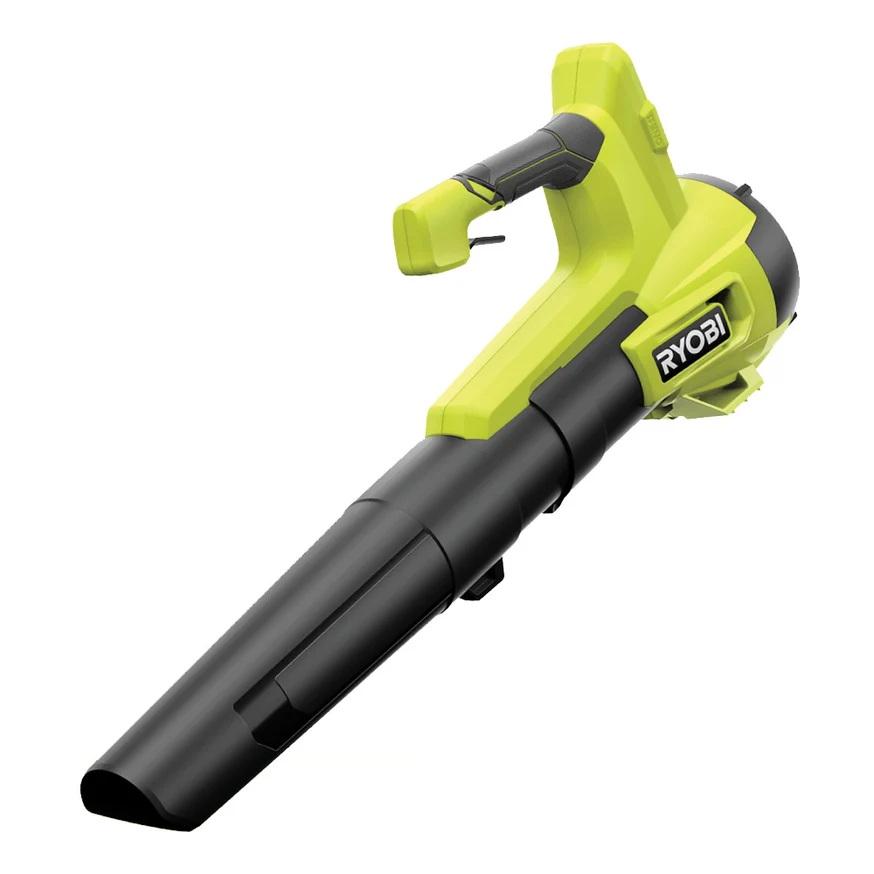
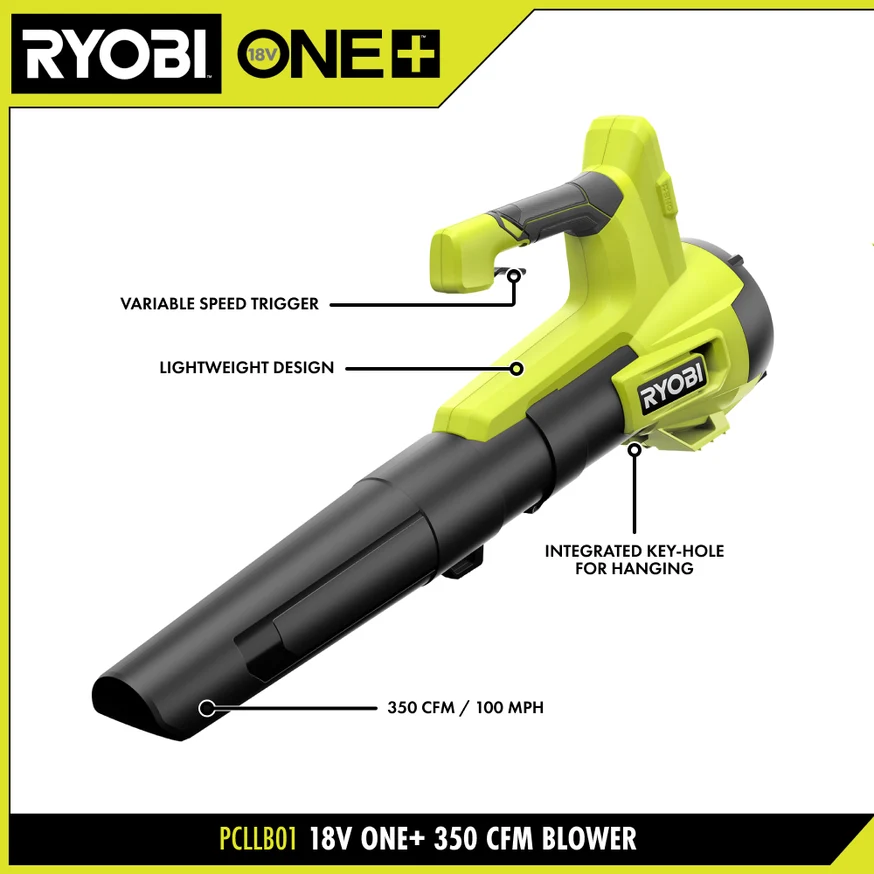
The RYOBI 18V Leaf Blower ONE+ Jet Fan is an entry-level cordless blower rated at 350 CFM and 100 MPH. It has a variable-speed trigger, a compact jet-fan design, and a key-hole slot for hanging it on a wall. It’s sold as a tool-only model (PCLLB01B) and as a kit with a 4Ah battery and charger (PCLLB01K), and any RYOBI 18V ONE+ battery fits it.
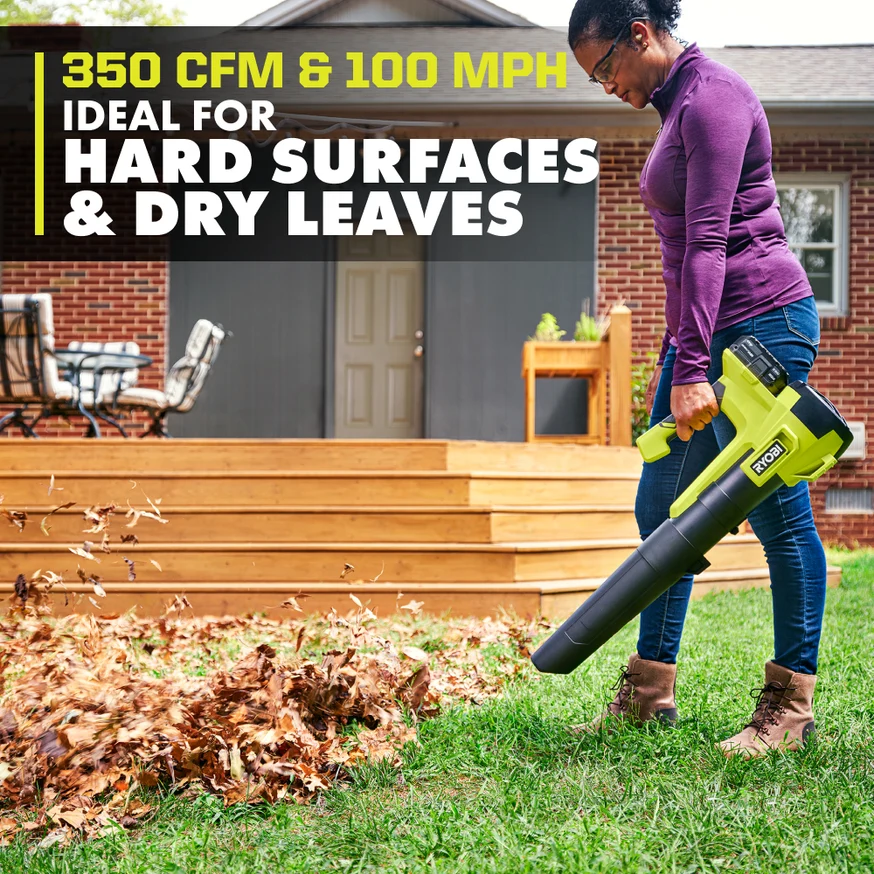
This RYOBI 18V 100 MPH jet fan leaf blower review doubles as a buying guide. I cover what the numbers mean, how the blower connects and starts, runtime, upkeep, what to check before you order, and how it compares with the RYOBI HP brushless version and with rivals from WORX, DEWALT, and EGO. RYOBI itself calls it ideal for hard surfaces and dry leaves, so it’s built for light work, not for heavy wet piles.
Yes, for small yards, patios, decks, and driveways, especially if you already own RYOBI 18V ONE+ batteries. It’s light, has a variable-speed trigger, and costs about $99 for the tool or $129 for the kit on RYOBI’s site. RYOBI says up to 70 minutes of runtime on low with a 4Ah battery. Look elsewhere if you have a big yard, wet leaves, or want the best airflow for the money: the 350 CFM rating is modest, I found no independent force test, and RYOBI doesn’t publish a high-speed runtime.
Verdict Summary
Best for small yards and RYOBI ONE+ battery owners
- Best for: homeowners with a small to mid-size yard, patio, or deck who want a low-cost blower, or anyone already using RYOBI 18V ONE+ batteries
- Standout strength: a low price, a variable-speed trigger, and a battery that fits over 300 RYOBI ONE+ tools
- Biggest weakness: modest airflow, no published high-speed runtime, and no independent force or noise test
- Skip it if: you have a large yard, wet leaves to clear, or want the strongest blower in this price range
Score basis: raised by the low price, the light design, the variable-speed trigger, ONE+ battery compatibility, and the 3-year warranty; lowered by the modest 350 CFM rating, the lack of independent test data, inconsistent weight figures, and a high-speed runtime RYOBI doesn’t publish. It’s an editorial judgment, not a lab score, and it isn’t based on hands-on testing.
📊 Full Specifications
Core specs
| Spec | Value | Source |
|---|---|---|
| Model and versions | PCLLB01B (tool only), PCLLB01K (kit with a 4Ah battery and charger). The blower itself is the PCLLB01 | RYOBI |
| Battery platform | RYOBI 18V ONE+. Any 18V ONE+ battery works with it, and RYOBI says there are over 300 ONE+ products | RYOBI |
| Fan design | Jet fan, with a variable-speed trigger | RYOBI |
| Motor | RYOBI doesn’t state the motor type. Only the HP model is marketed as brushless | RYOBI |
| Air volume | 350 CFM | RYOBI; Home Depot |
| Air speed | 100 MPH (160 km/h) | RYOBI; Home Depot Canada |
| Blowing force | Not published. I found no independent measurement | None found |
| Controls | Variable-speed trigger. No separate speed dial or turbo button is listed | RYOBI |
| Weight | 6.9 lb per RYOBI. Home Depot Canada lists 8.0 lb assembled for the tool and 10 lb for the kit | RYOBI; Home Depot Canada |
| Size | About 23 × 8 × 13 in assembled | Home Depot Canada |
| Kit battery | PBP005, 18V, 4Ah, integrated LED fuel gauge. About 72 Wh theoretical (4Ah × 18V) | RYOBI; my arithmetic |
| Kit charger | PCG002, 120V, 60Hz, 60W | RYOBI |
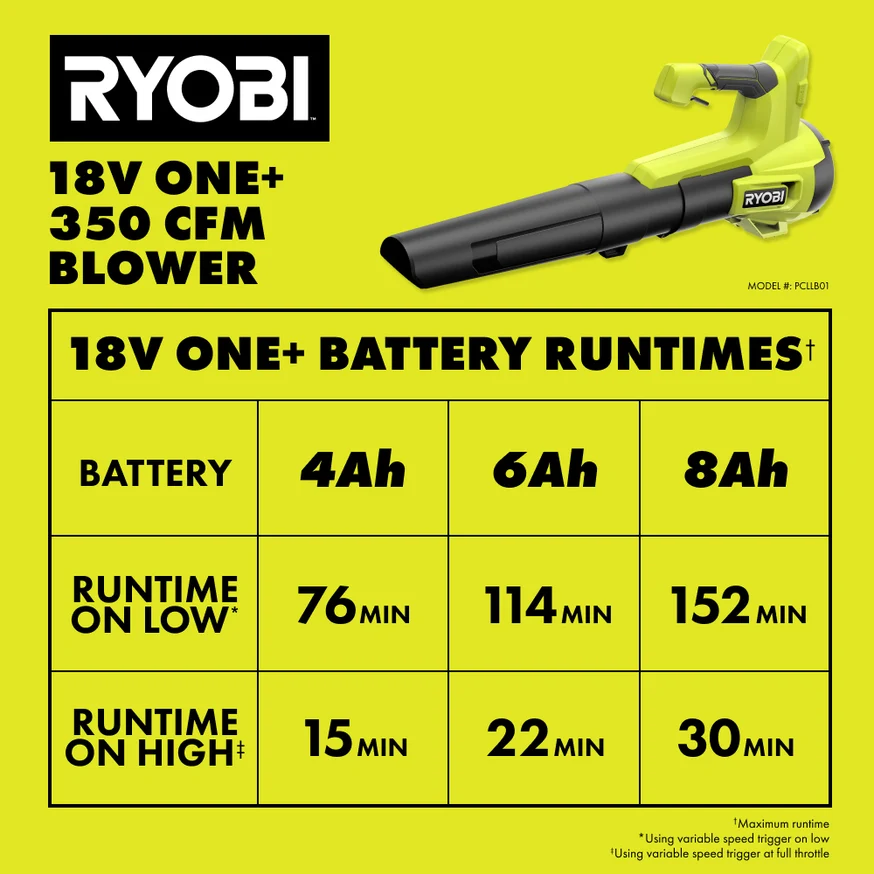
| Runtime claim | 70 minutes on low with the 4Ah battery, using the variable-speed trigger | RYOBI |
| Noise | Rated “Medium” on Home Depot Canada. No decibel figure for this model | Home Depot Canada |
| Storage | Key-hole slot for hanging | RYOBI |
| Use | Blowing only. The manual says it isn’t for vacuum use | RYOBI manual |
| Warranty | 3-year limited, on the blower, battery, and charger | RYOBI |
| Customer rating | 4.3 out of 5 from about 9,157 ratings on Home Depot for the kit. I can’t verify how it was calculated | Home Depot |
Figures that vary by source or region
These are the numbers where sources disagree or only apply to one market. I show each one instead of picking a winner.
| Spec | What sources say | Why it differs |
|---|---|---|
| Weight | 6.9 lb (RYOBI), 8.0 lb assembled tool (Home Depot Canada), 10 lb for the kit (Home Depot Canada) | The sources don’t say what each includes. The kit figure likely includes the battery and charger packaging |
| Runtime | RYOBI: 70 minutes on low with a 4Ah battery. No high-speed figure. The HP model lists up to 15 minutes on high with a 4Ah battery | Different speeds, and the HP model is a different tool |
| Noise | “Medium” (Home Depot Canada) for this model. RYOBI lists 62 dB for the HP model | Different models and no stated method |
| Price | $99 tool and $129 kit on RYOBI’s site. $99 for the kit at Home Depot, marked down from $129. About $75 for the tool at an eBay seller | Promotions, sellers, and date |
| Model confusion | PCLLB01 is rated at 100 MPH. The HP brushless P21012 and P21120 are rated at 110 MPH | They are separate products with similar names |
💨 Power and Airflow: What 350 CFM and 100 MPH Really Mean
CFM and MPH sell blowers, but blowing force in newtons says more about how a blower handles a heavy pile. RYOBI doesn’t publish a force figure for this blower, and I found no independent bench test, so I can’t tell you where it sits in newtons next to tested blowers. What RYOBI does publish is 350 CFM of air volume and 100 MPH of air speed.
Those are entry-level numbers. In my other reviews, the WORX WG547 is rated at up to 360 CFM and 75 MPH, the DEWALT DCBL722B at up to 450 CFM and 125 MPH with a concentrator, and the EGO LB5302 at 530 CFM and 110 MPH in turbo. RYOBI’s own description says this blower is ideal for hard surfaces and dry leaves, which fits the numbers. If you’re comparing options, the current Amazon listing shows what’s bundled.
How CFM and MPH work together
CFM describes how much air the blower moves, which helps push a wide band of leaves across a patio or lawn. MPH describes how fast that air travels, which helps lift leaves that stick to a surface. A blower with high MPH but low CFM can loosen debris yet struggle to move a large pile. The jet-fan design is meant to raise airflow in a compact, in-line body, according to RYOBI, but a 350 CFM rating still puts this blower at the light-duty end.
Variable-speed trigger
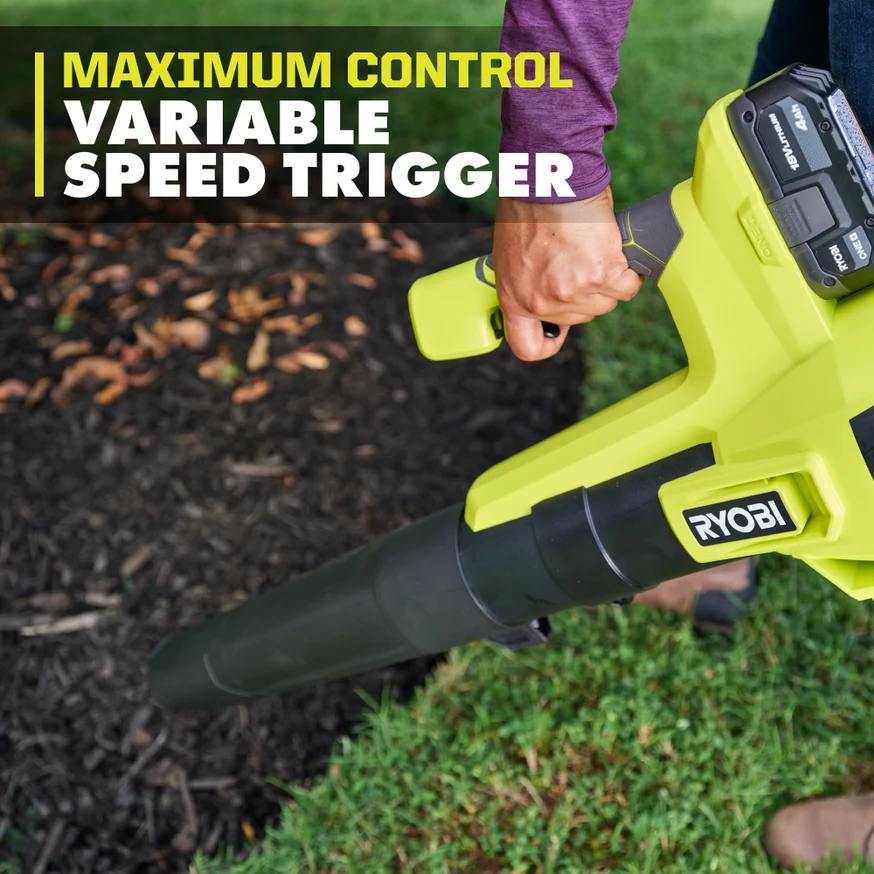
The trigger is variable, so you control the speed by how far you squeeze. RYOBI says this gives “maximum control” for delicate jobs like blowing leaves out of mulch beds. It’s also how you stretch the battery: the 70-minute runtime claim is for low speed using the trigger, so lighter squeezes mean longer runs, which is my reading of RYOBI’s wording.
How it differs from the HP brushless version
RYOBI’s HP brushless jet-fan blower (P21012 and P21120) has the same 350 CFM rating but a higher 110 MPH speed, and RYOBI markets it with a brushless motor and up to 15 minutes of runtime on high with a 4Ah battery. Pro Tool Reviews noted that the HP model works with HP battery packs to boost performance. If you want a bit more speed and a motor built for longer life, look at the HP model. If you want the lowest price, the PCLLB01 does the basics.
🔑 How to Assemble, Start, and Use It
This summarizes the steps in RYOBI’s operator’s manual for the PCLLB01. Read the full manual for your unit before first use.
- Charge the battery first if you bought the kit. The PBP005 battery has an integrated LED fuel gauge that shows its charge.
- Make sure the battery is removed, then fit the blower tube. With the tube foot facing down, align the tab on the blower housing with the slot in the tube and slide it until it locks.
- Insert the battery. The manual says the raised rib on the battery must align with the bottom of the tool and latch into place.
- Verify that all guards and tubes are in place before every use. If you drop the blower, stop it and inspect it before using it again.
- Squeeze the variable-speed trigger to start. A light squeeze gives lower speed and a harder squeeze gives more.
- Use light passes and sweep debris in front of you. Work along edges first, so you don’t scatter the pile, which is my practical tip, not RYOBI’s instruction.
- To stop, release the trigger. To remove the battery, press the battery latches and pull it out.
- To store it, hang it by the key-hole slot, with the battery removed and the trigger not depressed.
Safe handling. The manual says to keep bystanders, children, and pets at least 50 ft away, wear safety glasses with side shields, and never point the nozzle at people or pets. It’s a blower only, not a vacuum.
🔋 Battery, Runtime, and What You’re Buying Into
The kit battery is an 18V, 4Ah pack, which stores about 72 watt-hours (4Ah × 18V). That’s a theoretical figure for context, not a measured one. RYOBI’s only runtime claim for this blower is for low speed, so here is what the sources say, side by side:
| Source | What it says | How much to trust it |
|---|---|---|
| RYOBI product page | Up to 70 minutes on low with a 4Ah battery, using the variable-speed trigger | RYOBI’s own claim. Speed and conditions aren’t detailed |
| RYOBI HP brushless model | Up to 15 minutes on high with a 4Ah battery | A different, brushless model. Not a figure for the PCLLB01 |
| High-speed runtime for the PCLLB01 | Not published on the pages I checked | Plan on much less than 70 minutes at full speed |
Runtime depends on battery size, speed setting, temperature, and battery age. Treat the 70-minute figure as a best case on low.
The ONE+ advantage. RYOBI says any 18V ONE+ battery works with any 18V ONE+ product. If you already own ONE+ tools, the tool-only PCLLB01B lets you reuse batteries you have. A larger or second battery is the simplest way to extend working time on a bigger yard.
Charging. The kit’s PCG002 charger is rated 120V, 60Hz, 60W. RYOBI doesn’t list a charge time on the pages I checked, so check the battery and charger manuals. The manual also says to charge only with the charger specified for the battery and never to charge the unit outdoors.
Cost. RYOBI lists $99 for the tool and $129 for the kit, and Home Depot showed the kit at $99 when I checked. If you already own ONE+ batteries, the tool-only model is the cheapest way in. Prices change, so check the Amazon listing for today’s price and what’s included.
🛠️ Maintenance and Storage
A small battery blower needs very little upkeep. RYOBI’s manual lists the items below. The intervals are mine where the manual gives none.
| Item | What to do | When |
|---|---|---|
| Battery | Remove it before cleaning, adjusting, or any maintenance, and whenever the blower isn’t in use | Every time |
| Whole tool | Inspect for damaged, missing, or loose parts such as screws, nuts, bolts, and caps. Tighten what’s loose and replace damaged parts before use | Periodically, and before each use |
| Air openings | Keep them free of dust, lint, hair, and debris. A blocked opening reduces airflow | Before each use |
| Cleaning | Use a clean cloth. Never use brake fluid, gasoline, petroleum products, or strong solvents on the plastic housing | When cleaning |
| Handle and tool | Keep the blower and handle dry, clean, and free of oil and grease | Regularly |
| Charger | Don’t use a damaged cord or plug. Have a damaged charger replaced by an authorized service center, and don’t handle it with wet hands | Every charge |
| Battery storage | Keep a spare battery away from paper clips, coins, keys, nails, screws, and other small metal objects that could short the terminals | Always |
| Storage | Hang it by the key-hole slot with the battery removed, away from children | Between uses |
🔧 Common Problems and What to Check
RYOBI’s manual has no troubleshooting table, so this mixes the manual’s guidance with the most common complaints for small battery blowers.
| Symptom | What to check |
|---|---|
| Short runtime | RYOBI’s 70 minutes is for low speed. Use lighter trigger squeezes, charge fully, and add a spare or larger battery |
| Won’t start | Make sure the battery is charged, the raised rib is aligned with the bottom of the tool, and the battery is latched. The manual says a blower that can’t be controlled by its switch should go for repair |
| Weak airflow | Check that the air openings aren’t blocked and the tube is locked on. The manual says not to use the blower with an opening blocked |
| Tube won’t stay on | Remove the battery and refit the tube, aligning the tab on the housing with the slot in the tube until it locks |
| Dropped or damaged | Stop the blower and inspect it. If it isn’t working properly, or was dropped, left outdoors, or dropped in water, return it to a service center, per the manual |
| Battery won’t charge | Use only the charger specified for the battery, indoors. If the charger’s cord or plug is damaged, have it replaced by an authorized service center |
⚖️ Weight, Noise, Safety, and Use by Job
Weight and handling
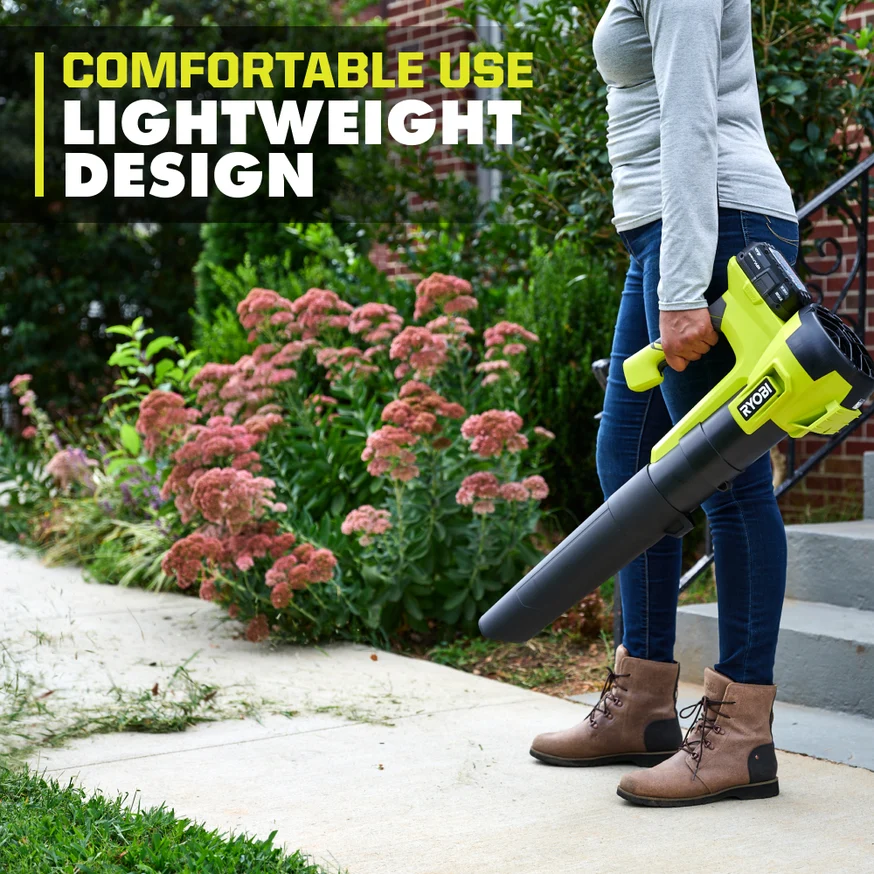
RYOBI lists the blower at 6.9 lb, while Home Depot Canada lists 8.0 lb assembled for the tool and 10 lb for the kit. The sources don’t say exactly what each figure includes, so use 6.9 lb as the lower bound and expect the weight in hand to rise with a 4Ah battery attached. RYOBI describes the design as light enough to reduce fatigue, and the compact in-line layout keeps the weight close to the hand, but I have no comfort data from a long session.
Noise
Home Depot Canada rates the noise as “Medium” and lists no decibel figure, and RYOBI’s 62 dB figure belongs to the HP model. The manual calls for hearing protection under appropriate conditions. Noise rules vary by town, and this page can’t tell you whether the blower meets yours, so check your local ordinance.
Safety rules in the manual
- Keep bystanders, children, and pets at least 50 ft away, and don’t point the nozzle at people or pets
- Wear safety glasses with side shields, and use a dust mask, non-slip closed footwear, and hearing protection in suitable conditions
- Don’t use the blower on a ladder, roof, tree, or any unstable support, and take extra care on stairs
- Don’t use it in explosive atmospheres, such as around flammable liquids, gases, or dust
- Tie back long hair above shoulder level, and avoid loose clothing and jewelry that could be drawn into the openings
- Don’t put objects in the openings, and don’t use the blower with an opening blocked
- Use only the battery and charger RYOBI specifies, and don’t charge the unit outdoors
- Don’t let children use it, since it isn’t a toy
What the numbers suggest, by job
These are reasoned from the specs and RYOBI’s own descriptions, not from my own testing.
- Patio, deck, and walkways: a good fit. RYOBI lists hard surfaces as an ideal use.
- Dry leaves and light yard debris: the intended use, and a lower trigger squeeze stretches the battery.
- Mulch beds: RYOBI points to the variable-speed trigger for delicate jobs like blowing leaves out of mulch.
- Small to mid-size yard: workable with a spare battery.
- Wet or matted leaves: expect slow going. RYOBI recommends it for dry leaves, and 350 CFM is modest.
- Large yard: plan on several batteries or a stronger blower.
🛒 Buying Guide: How to Choose an 18V Leaf Blower
Picking a blower comes down to a handful of factors. Here is how I’d weigh them when you’re shopping in this price range:
| Factor | What to look for |
|---|---|
| Airflow (CFM) | Higher CFM moves more leaves at once. Around 350 CFM suits light work, and 450 to 550 CFM or more suits bigger jobs |
| Air speed (MPH) | Higher MPH lifts stuck debris. It matters most on hard surfaces and damp leaves |
| Blowing force (N) | The most useful number when you can find it. Many budget blowers, including this one, don’t publish it |
| Battery platform | Choose the platform you already own. ONE+ batteries work in 300+ RYOBI tools, so the blower costs less if you have them |
| Battery size | A 4Ah battery is a good starting point. A second battery or a 6Ah or larger pack extends time between charges |
| Motor type | Brushless motors are marketed for efficiency and life. RYOBI’s HP model is brushless, while this one doesn’t say |
| Weight | Check the weight with a battery fitted, not just the bare tool |
| Total cost | Add the battery and charger if you buy a tool-only model |
Which RYOBI should you pick?
- PCLLB01B (tool only): best if you already own ONE+ batteries and a charger
- PCLLB01K (kit): best if you’re new to RYOBI and need a battery and charger
- HP brushless P21012 or P21120: best if you want 110 MPH and a brushless motor, and can pay more
- A different brand: best if you need more airflow or a bigger yard’s worth of power
My rule of thumb: match the blower to your yard, then match the battery to your blower. A light blower on a small battery is fine for a patio, while a large yard calls for more airflow and more battery.
⚔️ How the RYOBI 18V Jet Fan Blower Compares
Airflow claims are manufacturer ratings from different sources, and I could verify measured force only for the EGO LB5302. Treat the table as a rough guide, not a like-for-like contest.
| Blower | Key specs | Best for | Trade-off vs. the RYOBI |
|---|---|---|---|
| RYOBI PCLLB01 (this review) | 350 CFM, 100 MPH | Low price, ONE+ owners | Modest airflow and no published high-speed runtime |
| RYOBI HP brushless (P21012 / P21120) | 350 CFM, 110 MPH, brushless, 62 dB | A bit more speed and a motor built for longer life | Costs more: $139 tool or $169 kit |
| HART HGBL021VNM | 315 CFM, 100 MPH, 20V Max, brushed | A similar budget option on the HART 20V platform | Lower airflow; Pro Tool Reviews lists $128 when reviewed |
| WORX WG547 | 270 / 360 CFM, 55 / 75 MPH | WORX PowerShare owners; see our review | Lower air speed; runtime 7 to 15 min on 2.0Ah per WORX |
| DEWALT DCBL722B | Up to 450 CFM, 125 MPH with concentrator, 62 dB(A) | DEWALT 20V MAX owners; see our review | Tool only; more costly |
| EGO LB5302 kit | 530 CFM and 110 MPH in turbo; 16.5 N measured | A stronger boxed 56V kit; see our review | Different battery platform; costs more |
Airflow claims (CFM), manufacturer ratings
If you want more airflow, see our DEWALT DCBL722B review or our EGO LB5302 review. If you’re comparing budget options on another platform, see our WORX WG547 review.
⭐ Owner Feedback, Pros and Cons
Home Depot shows an average of 4.3 out of 5 from about 9,157 ratings for the kit, with 351 questions answered, though I can’t verify how that figure was calculated. I couldn’t read a sizable sample of review text for this exact model, so I’m not summarizing complaint patterns I haven’t seen. The points below are my analysis of the specs and sources above:
- Low price: $99 for the tool and $129 for the kit on RYOBI’s site
- Variable-speed trigger for control
- 350 CFM and 100 MPH rating
- Battery fits over 300 RYOBI ONE+ tools
- Up to 70 minutes on low with a 4Ah battery, per RYOBI
- Key-hole slot for easy wall storage
- 3-year limited warranty
- Modest airflow compared with stronger 18V and 20V blowers
- No published runtime on high speed
- No independent force or noise test found
- Weights vary from 6.9 lb to 10 lb depending on source
- Motor type isn’t stated
- Not a vacuum or mulcher
- Easy to confuse with the HP brushless model
🎯 Who Should Buy It
Buy it if:
- You already own RYOBI 18V ONE+ batteries
- You have a small to mid-size yard, patio, or deck
- You want a light, low-cost blower for dry leaves
- You’d like a variable-speed trigger instead of a basic high or low switch
Skip it if:
- You have a large yard or heavy, wet leaves
- You want the strongest airflow for the money. Look at the DEWALT DCBL722B or the EGO LB5302
- You need a published high-speed runtime or measured force
- You want a brushless motor. Look at the RYOBI HP model
❓ RYOBI 18V Jet Fan Blower FAQ
Is the RYOBI 18V 100 MPH jet fan leaf blower worth buying?
It’s worth it for small yards, patios, and decks, especially if you already own RYOBI 18V ONE+ batteries. It’s a weaker choice for large yards or wet leaves, because the 350 CFM rating is modest and RYOBI recommends it for dry leaves and hard surfaces.
What’s the difference between the PCLLB01B and the PCLLB01K?
The PCLLB01B is the tool only. The PCLLB01K is the kit, which adds an 18V ONE+ 4Ah battery (PBP005) and a charger (PCG002). Check which one your listing sells.
How powerful is the RYOBI 18V jet fan blower?
RYOBI rates it at 350 CFM and 100 MPH. RYOBI doesn’t publish a blowing-force figure, and I found no independent measurement.
How long does the battery last?
RYOBI says up to 70 minutes on low with a 4Ah battery, using the variable-speed trigger. RYOBI doesn’t publish a high-speed runtime for this model, so expect much less at full speed.
Which batteries work with it?
Any RYOBI 18V ONE+ battery works, per RYOBI. The kit includes a 4Ah battery, and a larger or second battery extends working time.
Does it come with a battery and charger?
The tool-only PCLLB01B doesn’t. The PCLLB01K kit includes a 4Ah battery and a charger. Read your listing to see which you’re buying.
How is it different from the RYOBI HP brushless jet fan blower?
The HP model (P21012 or P21120) has the same 350 CFM rating but 110 MPH, and RYOBI markets it with a brushless motor. It costs more, at $139 for the tool and $169 for the kit on RYOBI’s site.
How much does it weigh?
RYOBI lists 6.9 lb. Home Depot Canada lists 8.0 lb assembled for the tool and 10 lb for the kit. Sources don’t say exactly what they include, so check the listing.
How loud is it?
Home Depot Canada rates it “Medium” with no decibel figure. RYOBI’s 62 dB figure belongs to the HP model. The manual calls for hearing protection under appropriate conditions.
Can it move wet leaves?
RYOBI says it’s ideal for hard surfaces and dry leaves. Wet or matted leaves are harder, and with a modest 350 CFM rating you should expect slow going.
Can it vacuum or mulch?
No. It’s a blower only, and RYOBI’s manual says it isn’t for vacuum use.
Is it good for a large yard?
It’s better for small to mid-size areas. On a big property you’d need several batteries, and a stronger blower is worth considering.
Can I use it in the rain?
RYOBI doesn’t publish a weather rating for it. The manual says to return an appliance that was left outdoors or dropped in water to a service center, so keep the blower and battery dry.
What warranty does it have?
RYOBI lists a 3-year limited warranty on the blower, and on the battery and charger in the kit. Buy from a seller you trust so the warranty stays valid.
🏆 Final Verdict: Is the RYOBI 18V Jet Fan Blower Worth It?
The RYOBI 18V 100 MPH jet fan blower is a sensible, low-cost way to handle light yard work. It’s light, it has a variable-speed trigger, and its battery works across RYOBI’s large ONE+ family. What holds it back is the modest airflow, the lack of a published high-speed runtime, and the absence of independent test data.
If your yard is small and you already use ONE+ batteries, it fits well. If you want more power, compare the RYOBI HP model or a stronger blower from another brand first. If it fits how you work, you can check the latest price, what’s included, and what other buyers say on Amazon.
📸 RYOBI 18V Jet Fan Blower Photos
Click to see full view
📚 More Blower Reviews
WORX WG547 20V Cordless Leaf Blower Review: Specs, Pros & Cons
A light, low-cost blower for the WORX PowerShare platform.
DEWALT DCBL722B 20V MAX XR Blower: Specs, Pros & Cons
A light cordless handheld for DEWALT 20V MAX owners.
EGO LB5302 56V 530 CFM Leaf Blower: Specs, Pros & Cons
A boxed cordless kit with a battery and charger, and measured force.
✅ Before You Buy: Quick Checklist
A few details vary by seller, so it’s worth a minute on the listing to confirm:
- The model: PCLLB01B (tool only) or PCLLB01K (kit), and not the HP brushless P21012 or P21120
- Battery and charger: whether they’re included, and the battery size
- Your batteries: whether you already own RYOBI 18V ONE+ batteries that fit
- The seller: a seller you trust, with the 3-year RYOBI warranty intact
- Current price and what ships in the box
Affiliate Disclosure: BestLeafBlowerCordless.com is a participant in the Amazon Services LLC Associates Program, an affiliate advertising program designed to provide a means for sites to earn advertising fees by advertising and linking to Amazon.com. As an Amazon Associate, we earn from qualifying purchases.